



The Posting of Workers in an Eastern European Labour Market: From Social Dumping to a Multi-Faceted Labour Mobility Instrument
-
Author(s):Kováčová, LuciaMýtna-Kureková, LuciaStudená, IvanaPublished in:Central and Eastern European Migration Review, Vol. 15, No. 1, 2026, pp. 61-82DOI: 10.54667/ceemr.2026.07Received:
16 April 2025
Accepted:28 April 2026
Views: 557
The posting of workers has been fiercely discussed and analysed as a mechanism of social dumping in the Western European labour markets. This paper takes a reverse perspective and analyses the posting of workers in Slovakia as an Eastern European case whereby posting is presented as a multifaceted labour mobility instrument. We combine a review of the national regulatory framework and administrative data with stakeholder interviews to provide a rich account of why and how posting is used by employers and regulated and enforced by public authorities. We show that, while posting is a specific instrument of short-term intra-EU mobility formally enabling the mobility of services, it effectively plays a much wider role, transcending the low-cost competitiveness objective. We argue that the rise and embedding of posting in Slovakia is sustained by a specific regulatory and labour market context which is reliant on a flexible workforce with a weak enforcement of labour rights and characterised by erratic policy changes. Our study illustrates that the divide in the posting literature between sending and receiving countries is becoming outdated because supposed ‘sending’ countries like Slovakia are receiving substantial numbers of posted workers; they are also increasingly posting in a different way to earlier.
Introduction
The posting of workers has increased dramatically over the past decade (Lens, Mussche and Marx 2022a). In 2022, more than 4.6 million posting permits (Portable Document A1 – PDA1) were issued within EU member states and the UK (de Wispeleare, de Smedt and Pacolet 2024). To those sceptics who anticipated a decline in or even the demise of posting in the context of the 2018 Revised Posting Directive, it might come as a surprise that, after a Covid-related temporary halt, posting has continued to rise. This raises the issue of how to explain and understand this phenomenon in the context of broader economic, social and policy developments in the EU and the respective member states. In addition to growing overall figures, the posting landscape has, in recent years, also become much more geographically diverse (Zwysen and Akgüç 2025). In fact, posting happens not only between East and West but also within its subregions – and is also a prominent form of labour mobility in the Eastern European economies (Danaj, vah Jevšnik, Kiełbasa and Szaraniec 2023; Heindlmaier, Assmus and Schmidt 2024). Posting is geographically unbalanced, with recent evidence showing that, actually, most posting – both in relative and absolute terms – happens between Western economies (Zwysen and Akgüç 2025) and does not always follow patterns or trends of intra-EU labour mobility (van Nuffel and Afanasjeva 2019). To date, this EU-wide territorial diversity of posting patterns has not been extensively researched nor fully understood (Lens et al. 2022a).
Furthermore, existing studies present evidence mainly from the Western European perspective (Arnholtz 2021, 2023; Dølvik and Eldring 2006; Kahmann 2006). Recent studies about posting from Eastern European countries focus on the role of the regulatory framework in the use of posting, mainly in the context of the labour-market protection of third-country nationals being posted to Western Europe (e.g. Heindlmaier and Assmus (2026) for Poland and Slovenia; ELA (2025) for Poland, Portugal and Slovenia). Their focus remains on the role of labour market intermediaries – mainly temporary work agencies – supplying labour. However, the significant rise of posting in Eastern Europe calls for further research into the role of migration regulation and other social and economic policies that would allow us to better understand the ways in which posting is organised in Eastern Europe.
Since its inception, posting has inspired a fierce debate across the member states and stakeholders (Kyriazi 2023). It highlights economic inequalities across Europe that are both reflected in, and mitigated by, institutional differences regarding the implementation of social rights, including equal working conditions (Bottero 2020; Heindlmaier and Assmus 2026; Scharpf 2010). The Eastern enlargement of the EU further intensified the debate, presenting posting as an instrument for recruiting cheap labour and a social dumping threat (Arnholtz and Lillie 2020; Cremers, Dølvik and Bosch 2007; Dølvik and Eldring 2006; Houwerzijl and Berntsen 2019). Some researchers have even argued that there is an explicit ideological and functional split between Western and Eastern European member states regarding posting, which is reflected in the salient character of debates and legislative processes related to posting in the European Parliament (Michon and Weill 2023; Scholten and van Ostaijen 2018). Yet, firm-level perspectives focusing on posting companies in Belgium reveal different motivations to post – which include low-cost objectives but which cannot be reduced to competitiveness logic alone (Lens et al. 2022a).
This paper aims to enrich the existing debate by studying the evolving posting landscape in Slovakia where both incoming and outgoing postings have grown significantly. The country, in the past, suffered from structural labour-market difficulties; this is now combined with labour and skill shortages driven by a strong and expanding foreign-owned automotive sector and the related industries. Importantly, Slovakia has been strongly embedded in the European labour mobility dynamic, with a significant share of its active labour force seeking employment in Western Europe following the country’s accession to the EU in 2004. Past research also shows a strong position of mostly foreign employers in negotiating favourable regulatory conditions as well as the pressure on skilled and flexible labour (Šćepanović and Bohle 2018). More generally, Slovakia is a small, open and highly transnationalised economy dependent on knowledge from the West (Pavlínek 2022). This paper thus interrogates posting in a different institutional and regulatory context than most studies to date.
We argue that the Eastern European perspective is relevant in order to have a fuller understanding of posting as an intra-EU temporary mobility mechanism which has been gradually advancing towards a mixed mosaic of posting exchanges across EU countries. We ask the following research questions: What is the position of posting within the overall migration policy framework in Slovakia? How and why is this instrument used in a small and highly transnationalised economy? We illustrate the changing role of posting in the European semi-periphery and problematise the distinction which is often made in the posting literature between sending (Eastern) and receiving (Western) countries. We show that posting in Slovakia has been diversified from mostly low-cost posting to more diverse forms, corroborating findings about Belgium (Lens et al. 2022a). Using qualitative research methods, we first systematise the administrative data about posting and interpret the trends in connection to the main regulatory changes regarding posting and migration policies in the country. We then present the perspectives of various actors gathered through semi-structured interviews on posting to and from Slovakia.
The posting of workers in the European Union: a literature review
Alongside migration to another member state based on free movement rights and cross-border commuting, posting represents a third main form of labour mobility within the EU (Lens et al. 2022a), with recent evidence showing that its overall figures are sizeably larger than other forms of free mobility in the EU (Zwysen and Akgüç 2025: 55). It is specific in being employer-driven and tied to the freedom to provide services in other member states temporarily. Posting is limited to a maximum of 12 (18 after one extension) months and posted workers do not integrate permanently into the host country’s labour market. Contrary to the other two forms of labour migration, it is rather strongly regulated at the EU and national levels, specifying the conditions under which services could and should be provided (Bottero 2020). The legal status of posted workers is characterised by ‘duality’: whilst they continue to be employed in the country where their employer is based when posted to another country and retain their social security attachment there, the working and pay conditions of the receiving country should be observed. The equal principles in pay and working conditions between standard employees and posted workers have been strengthened in the 2018 Revised Posting Directive.
The main research agenda about posting, to date, is linked to the regulatory and enforcement challenges that posting brings and the institutional changes it facilitates from the perspective of Western European economies. This literature highlights the pressures that posting has exerted on labour standards, labour relations and regulatory frameworks, both nationally and at the EU level (Arnholtz 2021, 2023; Arnoltz and Lillie 2020; Dølvik and Eldring 2006; Kahmann 2006). Studies present rich accounts about employer motivations and the working conditions of typically Eastern European workers in the Western European labour markets (Arnholtz 2021, 2023; Dølvik and Eldring 2006; Kahmann 2006; Voivozeanu 2019). Commonly discussed themes include the emergence of dual labour markets, job displacement in some sectors and downward pressure on working conditions and social rights in the West (Bernaciak 2015), with references to posting re-affirming or creating new hierarchies amongst workers – keeping standards for some very low (Arnholtz 2023; Arnholtz and Lille 2023; Cukut Krilić and Zavratnik 2023). Various regulatory and enforcement challenges have resulted in pressures on institutional changes in (Western) countries and at the EU level (Arnholtz and Lillie 2020; Arnholtz and Andersen 2018; Arnholtz and Wright 2023; Dølvik and Visser 2009; Michon and Weill 2023).
Across the EU, employers rely on posting to increase their national and global competitiveness, whilst posting has been shown to respond to skill and labour shortages in the EU (Lens et al. 2022a; Moriarty, Wickham, Krings, Salamonska and Bobek 2012). Posting can also serve as a potential stabilisation instrument for countries facing asymmetric shocks, with significant macro-economic benefits (de Wispelaere and Pacolet 2015). Whilst the profits seem unequally shared between capital and labour, Muñoz (2024) documents substantive economic gains for firms and individuals in sending countries. Taking the workers’ perspective, when posting is implemented according to regulations, working in a country with higher wages and better labour standards can benefit posted employees. Yet, the often-raised issue is the wide-spread breach of the rights of posted workers, which has been attributed to limited enforcement capacities, different rights regimes, the fragmentation of enforcement structures and responsibilities and poor access to information (Kováčová, Moran, Mýtna Kureková and Studená 2024; Rennuy 2020; Wagner 2015; Wagner and Berntsen 2016).
Posting has traditionally been used to supply cheaper labour from Eastern European countries to high-income countries in Western Europe (Heindlmaier and Assmus 2026). It has been concentrated in selected economic sectors, such as construction and transport, giving companies in the West opportunities to reduce labour costs and to avert obligations which they have to observe towards workers in standard employment (Berntsen and Lillie 2015). Importantly, whilst most accounts speak of posting in low-wage sectors (Voivozeanu 2019), posting has been used beyond the cost-effectiveness motives. Lens et al. (2022a), based on data about Belgium, document three types of posting: i) competition; ii) specialisation and iii) expert posting. The last type applies to the mobility of highly skilled professionals and, in such instances, a posted worker might become more expensive than a local worker. Employers’ motives for posting in such cases are driven by skill shortages, specialisation needs or the career development needs of key staff. To date, no study has investigated whether such varied forms of posting are also used more broadly, including in Eastern Europe.
Posting in the Eastern European (EE) member states has a number of specific features. First, poor enforcement and the growing role of temporary working agencies have been at the forefront of research about posting in EE countries (Andrijasevic and Novitz 2020; Danaj and Meszmann 2024; ELA 2025; Mussche, Corluy and Marx 2018; Thörnqvist and Bernhardsson 2015; Voivozeanu 2019). Second, whilst Eastern European countries continue to be net senders, they are increasingly becoming receiving countries for posted workers. A good portion of incoming postings are of third-country nationals (TCNs), who might be posted further within the EU (Danaj and Meszmann 2024). Danaj et al. (2023) document that Slovenia and Poland belong to the main sending countries for TCN workers posted to other EU countries, arguing that the East might serve as a gateway to their posting. However, a good portion of third-country posted workers remain in these countries, implying a changing role of posting within these economies.
Third, the enforcement and qualities of posting in different Eastern European countries are mediated and mitigated by their institutional characteristics and socio-economic regimes (Heindlmaier and Assmus 2026). For example, while national legislative and regulatory frameworks generally serve the capital interests, Slovenia ensures a certain level of third-country workers’ protection due to maintaining neo-corporatist structures favouring tripartite dialogue and pursuing workers’ rights and social protection reforms. In contrast Poland, with its marginalisation of trade unions and lower social-security protection, is characterised by more relaxed employment schemes for TCNs. The variation in the use of posting and the motivation of employers is determined also by other demographic and structural changes, such as a constantly growing number of TCNs in Poland, especially from Ukraine (Kiełbasa, Szaraniec, Mędrala and Benio 2022).
These specific national and EU policies combined have transformed labour migration in Central and Eastern Europe multi-directionally, making temporary mobility a distinctive feature of their labour markets. The above discussion demonstrates that posting is a dynamic instrument that has served different needs and motivations – and its utilisation results from a complex set of needs as well as policy and structural opportunities and constraints. Compared to Western Europe, posting takes place in an environment with weaker labour rights and looser enforcement.
Methodology and approach
Due to significant data limitations about posting that would help us to characterise the different types of posting (for example, a lack of data about the socio-demographic profiles of posted workers, their education, skills, gender or firm-level data), this paper uses qualitative methodology to gather and interpret information about how and why posting is used in Slovakia. More specifically, we utilised semi-structured stakeholder interviews to learn about the viewpoints and experiences of varied groups of stakeholders engaged in posting practice (posting firms, migration NGOs) and regulation, enforcement or oversight (public agencies, a law firm, social partners) (see Table A1). We follow a methodology similar to that used by Danaj, Hollan and Scoppetta (2020) and Riesco-Sanz, López and Maira Vidal (2020), as engaging different actors helps us to obtain a balanced and rich perspective of stakeholders holding potentially different positions.
Research participants were identified following an intensive desk research mapping the legislative and regulatory environment related to posting in Slovakia (Kováčová, Studená and Mýtna Kureková 2021). Participants were contacted based on publicly available information, capitalising also on authors’ expertise from previous research on intra-EU labour migration. Among research participants are key public institutions engaged in designing, implementing and enforcing regulation related to migration generally and posting specifically (Ministry of Labour, Social Affairs and Family; Ministry of the Interior; National Labour Inspectorate; Social Insurance Agency) (Kováčová, Studená and Mýtna Kureková 2021). Moreover, social dialogue partners – three employer associations and two labour unions on the sectoral and peak level – are members of the high-level tripartite body, and thus are directly engaged in and informed about legislative changes and their objectives. Moreover, the interviewed employer associations assemble companies in the key sectors in the Slovak economy (automotive industry) and from a posting perspective (construction sector).
We strategically focused on large employers in (1) the automotive sector (2 multinational companies) as a dominant sector in the Slovak Republic; and (2) the construction sector (1 company) as a sector within which most of the outgoing postings take place. While the overall number of companies might appear low, employer perspectives were richly represented in employer associations’ and unions’ interviews. The law firm active in multiple CEE countries and serving clients in employment and migration agenda was able to share combined perspectives, referring to both employers and employees. While we do not engage with posted workers, as they are generally difficult to reach, we used vignettes that presented model examples of possible day-to-day issues and practices related to the regulatory environment and its implementation with respect to posted workers. The vignettes were designed for both directions of posting – outgoing and incoming – and used to elicit insights into posting practices from different sides of the institutional relationship: posting employers, social partners, public officials and migration-focused NGO workers. They were presented after a series of more-general questions about respondents’ (and their institutions’) involvement in posting and experiences with posting, including the assessment of regulatory changes ranging from the transposition of the 2018 Revised Directive to developments in national regulation.
The questionnaire(s) involved the following areas (vignettes were followed by a set of questions): (1) key information about stakeholders (especially how the company uses posting or how the public authority is involved in implementation or enforcement); (2) how the instrument is being used (meeting legal requirements, access to information, challenges, role of intermediaries/agencies); (3) provisions on the payment and taxation (formal rules, practices, etc.); (4) working hours and collective agreement provisions; (5) companies’ practices concerning dealing with specific problems that may occur during the posting of workers (work-related injuries/OSH); (6) interpretation of specific characteristics of posting in Slovakia (e.g. the posting of the self-employed, activities of temporary work agencies).
Altogether, 13 interviews were conducted during September–December 2020 and an additional 7 (9 participants) were conducted during February–April 2023. Further details regarding the interviewees are summarised in Table A1 (Appendix). Interviews were conducted, recorded and transcribed using content-focused transcription by the authors and analysed thematically, identifying key information related to the research questions. Respective interviewees are anonymised at the personal level but we reveal their identities at the actor level, as this is relevant for presenting the data and for its meaningful interpretation. Participants signed informed consents and were notified about the purpose of our research – including its use for publication purposes – and about the funder. Furthermore, to de-sensitise the research process, neutral vignettes asking respective actors to assess an example situation, rather than to describe a concrete case from their practice, were used.
The posting of workers, labour migration and an evolving regulatory framework
Different forms of labour mobility, including posting, are widely spread in Slovakia and have contributed to the flexibilisation of the Slovak labour market over the past decade. Next, we present data about posting and labour migration before discussing the legislative and regulatory context relevant to the use of posting in Slovakia.
Increasing posting and labour migration to and from Slovakia
As a result of structural labour-market difficulties until the mid-2010s, labour mobility in Slovakia is characterised by high rates of short-term labour migration and comparatively smaller but fast-growing numbers of incoming labour migrants (Kahanec and Kureková 2016). In 2022, according to Labour Force Survey data, approximately 110,000 people from Slovakia worked abroad, with a decreasing trend in short-term labour mobility since 2017, when it constituted more than 150,000 workers.3 Although Slovakia is traditionally a migrant-sending country, immigration has been on the rise. According to data from the Central Labour Office of the Slovak Republic, the number of foreign nationals soared between 2017 and 2022, when the numbers of them employed in Slovakia increased from approximately 63,000 to over 148,000. The rising trends apply to both EU nationals and TCNs, while the latter category of immigrants has been substantially more dominant than the former since 2018. An additional stream of mobility involves cross-border pendulum migration to Hungary, Austria and the Czech Republic.
Over the past decade, both incoming and outgoing postings have also grown significantly, which makes Slovakia an excellent case for a broader analysis of posting. To illustrate this, in spite of Slovakia being the tenth-smallest EU country by population, in 2022 it ranked seventh in the number of outgoing posting placements among EU countries. Between 2012 and 2022, the number of outgoing postings grew 2.5 times (from 48,900 to 122,500 issued PDA1s), while the number of incoming postings rose tenfold (from 6,600 to current 60,100) (see Figure 1). Whilst posting to Slovakia is less significant than posting from Slovakia, there was a clear upward trend in incoming postings in the years preceding the COVID pandemic and, whilst, in 2021, the number plummeted to 14,500, it then soared again to around 60,100 in 2022 (see Figure 1). Although the trends in the incoming postings correspond with the trends in the immigration stock, interestingly, the shifts in incoming postings since 2018 are quite erratic, in contrast to the steady inflow of EU nationals (Figure 2).
Figure 1. Posting of workers to and from Slovakia (2012–2022)
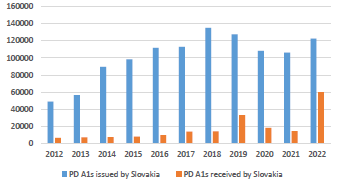
Source: Authors based on de Wispelaere and Pacolet (2015, 2018) and de Wispelaere et al. (2019, 2020, 2021, 2022, 2024).
Figure 2. Incoming migration and postings to Slovakia compared to the trend of the unemployment rate (2012–2022)
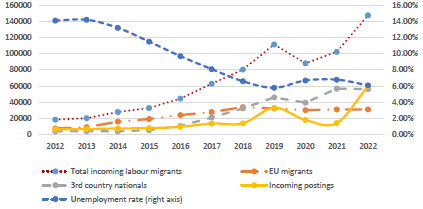
Sources: Central Labour Office of the Slovak Republic (Statistics), de Wispelaere et al. (2024); Statistical Office of the Slovak Republic, DataCube, 2020, Labour Force Survey.
Based on the information known from PDA1 documents (administrative documents certifying posting), we know the main sectors and the main countries of posting. The main sectors of outgoing and incoming posting show different structures (Table 1), which indicates potentially different rationales for why companies post their workers abroad or use posted workers. Workers are posted from Slovakia to another member state mainly in industry (81.6 per cent), out of which the construction sector takes up about 50 per cent. A lesser share is posted in services (17.3 per cent) and a negligible number in agriculture. Workers posted from other member states to Slovakia in 2022 are employed in the services (47.7 per cent) and industries (52 per cent). The construction sector is under-represented relative to outgoing postings (3.9 per cent versus 50 per cent).
Table 1. Sectoral structure of incoming and outgoing postings, 2022

Note: Only postings according to Article 12 for which sectoral data were available. The table shows only the postings for which the sector information was available.
Source: Own elaboration based on de Wispelaere et al. (2024).
Workers from Slovakia are primarily posted to Germany, Austria and the Czech Republic; incoming workers are posted to Slovakia predominantly from Germany, Italy and Poland (de Wispelaere, de Smedt and Pacolet 2024). Interestingly, Slovakia issues a high share of PDA1s to self-employed persons (Moran 2024). In 2022, about half of all posted workers were self-employed, which is the highest share of posted self-employed workers in the EU, despite the overall share of the self-employed in Slovakia being at the EU average level (15 per cent, whereas the EU average is 14.5 per cent) (de Wispelaere et al. 2024).
In the context of the interviews, we were able to gather more insights into the qualification structure of the posted workers in specific sectors and jobs, which are not available in the official data. Similarly to Lens et al. (2022a) for Belgium, we also identify various motives for companies to use posting. In terms of postings from Slovakia to other EU countries, these are reported to represent mainly the postings of workers at lower and medium qualification levels, e.g. operators. However, posting is also used within multinational companies to achieve the training of technical and managerial staff abroad, indicating specialisation and expert posting (Interviews 4, 9 and 11). Postings from other EU countries to Slovakia are often used for highly qualified workers, e.g. software and production specialists (postings from Germany). There are other cases which do not fit into such polarised qualification patterns. Regarding the Slovak automotive sector, there is an increasing demand for labour at lower qualification levels from different countries, including Bulgaria or Romania, EU accession countries, e.g. Serbia – as well as non-EU countries, e.g. Vietnam (Interviews 11 and 20). This is corroborated by the findings of the ELA report on TCNs from 2023, which claims that the main corridors of TCNs posted to Slovakia are Hungary and Poland, while the major nationalities of the TCNs are Ukrainians, Serbians, and Russians (ELA 2023).
Outgoing migration, including posting, is still driven by large wage differentials abroad and by manpower and skill needs in the respective key destination countries. Due to wage differences, Slovak construction firms, employing a high share of self-employed workers who are exempt from the application of the destination country’s equal pay conditions stipulated in the 2018 Revised Posting of Workers Directive, are competitive and able to offer services abroad, also using this approach as a diversification strategy (Interview 13). The high share of self-employed workers among outgoing postings also reflects a national context, in which bogus self-employment in the construction sector is tolerated (Holičková, Kahanec and Guzi 2026; Moran 2024). This partly explains why outgoing posting numbers from Slovakia remain high and continue to grow even after the enactment of the Revised Posting Directive, transposed in 2020, which introduced equal pay conditions. It is sustained by the fact that many outgoing postings are of self-employed workers who are not subject to the equal wage regulation (Interviews 7 and 17). Employers based in Slovakia might also use the posting of workers as a flexibility instrument with which to address the cyclical and seasonal character of their sector, mainly in the construction industry. Furthermore, erratic changes to posting figures over the past decade, we argue, are a reflection of the changes in the broader migration policy framework, beyond that of posting regulation. We outline examples in the next section.
Legislative and regulatory changes to labour migration and posting: 2012–2022
The evidence above shows that Slovakia has been strongly embedded in the European labour mobility dynamic. This has been corroborated by labour and skill shortages, which are likely to persist due to demographic ageing. These trends urge Slovak authorities to regulate and implement various mobility instruments at the national level. This includes not merely the posting of workers, which stimulates short-term mobility, but also other instruments, such as national visas, that may serve as a gateway to long-term migration.
The labour migration regulatory framework in Slovakia in the past decade can be best characterised as complex, facing frequent changes to conditions of employment and being reactive rather than proactive. In fact, the 2021 IOM report identified 12 basic labour mobility instruments of the Slovak legal system, which are used to manage labour migration (Drozd, Mészárosová and Paulenová 2021). During 2012–2022, the immigration flows (using various mobility instruments) are negatively associated with the number of unemployed persons, demonstrating the increasing demand for domestic and foreign labour (Figure 1). The ad hoc and often temporary solutions for labour shortages and skill needs have created a fragmented regulatory framework for employing foreign workers and contributed to the complexity of human-resource management in connection with the employment of foreign workers.
We would like to briefly illustrate more-significant policy interventions in the area of the employment of foreigners in the past decade. These interventions concern not only the enforcement and regulation of posting but also the regulation of temporary staff allocation via temporary work agencies (TWAs) and of the employment of TCNs. Firstly, the amendment of the Act on Employment Services in 2012 distinctly differentiated between the temporary staff allocation as an equivalent to personal leasing to the host employer and the posting of workers; it defined them as two different policy instruments of labour mobility. As stated by the former high-ranking representative of the Ministry of Labour (Interview 7), the amendment addressed a wide (mis)use of temporary staff allocation by temporary work agencies in a bid to decrease labour costs at the expense of workers’ rights. Legal interventions were made to also improve the conditions of outgoing posted workers. The 2012 amendment stated that, to post workers to another member state, the Slovak employer must employ the worker for at least 90 days before the start date of the posting. This policy change aspired to address the dubious practices of the TWAs – i.e. recruiting workers solely for posting and terminating the employment contract with the agency worker instantly after posting was finished (Interview 7).
Furthermore, the 2018 amendment to the Employment Services Act introduced changes to the application of the ‘shortage occupations’ (nedostatkové povolania) procedure. Employers needing to hire foreigners could benefit from the accelerated issuance of the residence permit for the concerned foreign workers but only if the company’s share of third-country nationals amongst their employees was below 30 per cent. Such measures changed the incentive structures for some companies which, for example, then resorted to bogus contracts with the self-employed among incoming posted workers or addressed labour shortages by the services provision of TCNs posted through TWAs, who are exempt from the 30 per cent foreigners’ cap (Interviews 5 and 14). At the same time, the amendment of the Commercial Code (in effect in 2020) eased access to the self-employed status for foreigners (Interview 8).
In sum, different erratic changes have had critical implications for employers’ strategies in the recruitment of foreign workers and the usage of different channels of labour mobility. Clearly, the needs of employers for qualified labour and the cumbersome processes required to bring in foreign workers have collided. These frequent alterations in the Slovak migration law also impacted on posting practices and changed employers’ strategies in using labour-mobility instruments to flexibly respond to changing labour-market needs. Moreover, posting practices and the choice of labour mobility channels are also shifting in response to migration policy changes in other countries. For example, the Polish authorities introduced national visas, enabling TCNs to work on Polish territory under relaxed conditions, then being posted to the other member states, including Slovakia (Brzozowska, Matuszczyk, Salamońska and Siwierska 2021).
Stakeholder perspectives: Different rationales for posting
In this section, we present insights from the interviews to illustrate the different ways in which posting has been used in the context of the European and Slovak legislation and regulations over the past decade (Lens et al. 2022a). We organise this along two lines of inquiry: posting to Slovakia and posting from Slovakia. We present the views, practices and experiences of the different stakeholders, focusing mainly on companies’ decisions to post and/or receive posted workers relative to other options, such as using other migration and mobility routes. We also offer insights into how posting is enforced by the main authorities.
Posting from Slovakia
In the interview process, we found that companies’ decisions regarding posting are conditional on several factors related to the legal and regulatory frameworks in the destination country, sector of activities, size of the company, competitive strategy and other related issues. Companies are rational profit-seekers and they are bound in their decisions by the nature of their business opportunities and the potential margin that they could realise. In general, conditions and regulations in destination countries, including application of the Posting Directive, have been perceived by Slovak employers and employer associations as protective measures against competition from Eastern European countries. The representative of the largest employer association shared that:
[T]here is a lot of circumstantial evidence – an issue often discussed in Business Europe – that the aim [of the Posting Directive] is to eliminate competition under the veil of improved working conditions; on the one hand it may be legitimate, on the other hand it denies the principles of the free market (Interview 11).
A representative of the construction industry employers’ association observed that the conditions are tightening and the space for competition based on wage differentials is diminishing:
Gone are the days when Slovak workers were cheaper, it [wage] is no longer a benefit, now countries are protecting the market, local competition is watching this closely and ensuring that regulations are not violated, conditions must be respected [for example, in Germany, employees must be employed as German workers, plus travel allowances] (Interview 3).
When considering posting from Slovakia, the destination country’s labour regulation, legal conditions and other relevant factors are assessed against other options in the sector of activities. This we see particularly reflected in the growing numbers of self-employed workers posted from Slovakia; this in effect enables companies to compete on the basis of wages, as the hard-core provisions related to equal wages and working conditions do not apply to posted self-employed workers. Furthermore, the employer contributions in Slovakia (more than 35 per cent) are amongst the highest in the EU. To illustrate: an employer from a multinational construction company posting regularly in different countries across Europe and the world pointed to the fact that employer contributions are lower in other EU countries compared to Slovakia (e.g. 35.2 per cent in Slovakia compared to approximately 22 per cent in Germany in 2022). Therefore, whilst posting from Slovakia is widely-used for worker mobility, other options (e.g. starting a subsidiary company abroad) are assessed in destination countries with lower employer contributions.
However, companies’ cost effectiveness decisions cannot be viewed in isolation from other objectives such as attaining a better position in the strategic value chain and engaging a more skilled workforce. One interviewed company stressed that, whilst high labour costs due to social insurance payments play an important role in registering the company in Germany and employing Slovak workers there directly rather than posting, other factors, including the organisational values, are considered in the strategic decisions.
There is another thing, because we have a high percentage share of employer contributions in Slovakia (…) they [the company] would very much like to leave them insured in Slovakia, they even have the mentality that they are patriots and they would understand it (...) people would also welcome it, not everyone is young, some are already before retirement, and do not want to change the social and health insurance system. But we as a company want to win the order and we want to compete, and of course we also want to earn something so that we can (…) make investments in technology (...) so basically this will force us not to support the Slovak social institution and it is precisely because of this that we change it to Germany or another country because, if we stayed with people insured in Slovakia, we would not win the contract etc. (Interview 13).
Interview participants note that, from posted workers’ viewpoint too, the quality of social and health care services is higher abroad than in Slovakia. This discrepancy between the high wage cost levy on employers and weaker benefits for the employees is also raised as an issue:
Although an employee [posted in other countries] has a high salary, he also pays more but, when he is insured there, he gets a share of this social package, whether he is in Germany or in Austria or wherever, he can also ask for allowances (...) So, let’s look at this from the perspective that when you take a European average in employers’ wage cost levy, despite the fact that we are so poor meaning that, here, we have a minimum wage incomparable to [note: lower than] other minimum wage levels in the EU, we nevertheless have one of the highest wage cost levies. That is a barrier for us for sure (...) (Interview 13).
Small companies in the construction sector posting from Slovakia to other EU countries, motivated by wage differentials in the past, are increasingly losing this motivation after the stricter rules for posting workers imposed by the Revised Posting Directive (e.g. limiting the duration of posting) became effective (Interview 11). This can be circumvented by contracting self-employed posted workers. The self-employed are exempt from paying employer security contributions and their total labour costs are therefore lower than a regular employee’s labour costs. Posting could, in such cases, function as an ‘easy work permit’ based on the interview participants’ views (Interviews 7 and 17). The self-employed are likely to be in a more vulnerable position as posted workers abroad and more evidence is therefore needed to uncover vulnerable spots in the common EU labour market. This was confirmed by the national trade unions’ representative (Interview 4), who also noted that the posted self-employed workers remain fully out of the trade unions’ reach. The vulnerability is particularly reinforced when posted workers are TCNs; the large companies in the construction sector make them register as self-employed and post them abroad (Interview 11). This concerns mainly those with lower qualifications in construction work which the locals are not motivated to do.
Several participants reported that posting to other countries is part of the complex worker mobility (in both directions). Interestingly, during Interview 19, the interviewee did not differentiate between posting via posting directive and intra-company transfers. This complexity of the worker mobility processes was repeatedly raised in the interviews. The interviewed companies did not reveal that they would be breaching the posting rules and regulations. Other participants, however, shared that including travel costs in the minimal remuneration of posted workers is a frequent malpractice of companies (Interviews 4 and 12). It is understood that paying higher wages and including travel costs on top of the minimum wage in the posting country would not be an economically viable option. Various setbacks in the access to clear, reliable and accessible information faced by companies also raise genuine barriers to lawful application of the rules – and explain the active role of private actors who facilitate different aspects of posting for many companies (Interviews 19, 14 and 15). The representative of the employers’ association states the following:
If the market of consultancy companies were to be based merely on posting, it would not have been that extensive. It is, rather, a result of the struggle with legally employing foreigners and the posting is a part of it (Interview 18).
According to our participants, the shrinking advantage of lower wages is caused not merely by tightening regulations in Europe and destination countries but also by the posting of high-skilled workers with a specialisation in construction work (Interviews 3, 4 and 13). Effectively, the skill profile of the workforce posted abroad is nuanced – and Slovak companies engage in the posting of specialists in certain professions. Further research confirms that employers’ motivations to post workers abroad also vary in relation to more complex business strategies and their main economic activity (Holičková et al. 2026). For instance, while a common practice for multinational companies, especially in the automotive industry, is to send a worker to a parent company to fulfil long-term assignments, niche service providers (mostly smaller companies) utilise postings usually on an ad hoc and short-term basis as a reaction to immediate needs in the supply chain, such as servicing equipment or delivering customised installations. Consequently, the multinational companies are concerned with the continuity of contracts or the long-term benefits of coordination, while companies engaged in short-term postings prefer more flexible solutions. To sum up in the words of a public official: ‘When you read the coordination regulation, posting is a specific form of employment abroad. But unfortunately, over the years, it has become a general form of employment abroad’ (emphasis added; Interview 17).
Postings to Slovakia
In our interviews, we received relatively limited responses from employers on the practice and problems related to postings to Slovakia; however, more information was shared by other actors among the trade unions, enforcement bodies and NGOs. According to the representatives of public institutions, employers continue to face various administrative challenges in bringing in foreign workers from third countries, irrespective of skill levels (Interviews 8 and 10). The foreign police departments struggle to meet the legal deadlines in issuing worker permits due to being understaffed and the whole process of employing foreigners is perceived as bureaucratic and lengthy. Employers report limited access to procedural information (Interviews 6, 10 and 12). Consequently, the posting and other policy instruments of labour mobility are utilised to circumvent the migration legislation and long bureaucratic processes (Interviews 3 and 19). According to a public official, the accumulation of the problems in the procedure of employing foreign workers occurs because: ‘They [employers] do not want to wait, the process duration is long and foreign police often do not meet the legal deadlines (…) there were problems with some of the deadlines – for shortage occupations it is up to 50 days’ (Interview 10).
Consequently, temporary work agencies have taken an active role in this complex field. Temporary work agencies, as labour market intermediaries supplying labour, comprise a range of companies, from informal brokers to private and public entities operating in cross-border contexts, that fall under different legal terms across European countries (Danaj, Gillis, Geyer, de Wispelaere and Bilitza 2025; ELA 2025). Such complexity in national legislation results in a lack of data on TWA postings, difficulties with monitoring the compliance of TWA postings with applicable labour and social security legislation and ambiguities concerning identifying the legal category of the particular posting (Andriescu, Buckingham, Broughton, de Wispelaere, de Smedt, Gascon, Ongono Pomme, Voss and Vitols 2024; Danaj et al. 2025; ELA 2025). In the absence of a transnationally harmonised definition of the TWAs, TWAs use various strategies to circumvent rules protecting workers, such as redefining their economic activity as a service provider rather than supply of labour (Danaj et al. 2025) which was also confirmed by empirical findings in Slovakia (Interview 7).
In Slovakia, one mechanism used by TWAs is intra-corporate transfers (ICT), introduced by the European Commission in 2014, and implemented in the national legislation in 2016 (European Parliament, Council of the European Union 2014). This regulation allows the TCNs to be posted from a company in a non-EU country to an EU branch. The public officials stated that some TWAs establish subsidiaries in third countries to take advantage of the ICT regulation and organise the posting of TCNs from their subsidiaries in the non-EU countries to a TWA in an EU country (Interview 7).
In our case, it became clear that posting had nothing to do with the principle of simplifying the cross-border provision of services in the EU single market. In Slovakia, almost without exception, this certainly does not apply to some top workers in IT companies (…) but, almost without exception in Slovakia, posting began to be abused to circumvent the rules for the inflow of workers from third countries to the Slovak labour market (Interview 7).
As outlined in the previous subsection, sectoral conditions and trends, as well as competitiveness pressures, can significantly impact on how posting is organised at a plant level. For example, a multinational company included in our interviews applies a range of mobility channels to exchange workforce between the Slovak branch and the foreign mother company, including inter-company postings. Thus, a portion of the postings to Slovakia has been taking place in connection with knowledge transfer and learning (Lens, Mussche and Marx 2022b). On the other hand, less skilled workers are used through TWAs, which might post foreign nationals. A key factor is the increasing competitive pressure in the highly internationalised sectors, e.g. the automotive industry, resulting in pressures to decrease labour costs: ‘The trend in the automotive industry is to reduce production costs (…) carmakers are pushing the suppliers, these have a lower budget, and are pushing for lower wages; they buy the service, it is not personnel costs’ (Interview 12).
This participant also supported indications that, with the increasing pressure on labour costs, employers might avoid regulation, in line with the evidence regarding different social dumping strategies in other countries (Berntsen and Lillie 2015). The tension between securing worker rights and securing the supply of labour was evident in the interview with a law firm offering complex services to various domestic and foreign companies. In their reflection, they highlight labour force exigence and the diversity of strategies that firms use to address their acute needs.
Currently, the labour market is tight and companies are looking for just anybody, even from sister companies that are not so far away. There is a great need for manpower and the client will use all available methods – local hiring, TWAs, during the pandemic even lending employees between non-competing employers (...) if everything is used up and there is still not enough, the client will eventually resort to a difficult process, administratively and also financially, to try to get a worker from a third country (Interview 19).
Overall, the protection of posted workers’ rights seems troublesome and contributes to the frequent use of this policy instrument by TWAs. According to interview participants, including unions (Interviews 4 and 10), the motivation of posted workers, particularly among TCNs, is to earn as much as possible; consequently, they are more likely to accept compromised working conditions and lower wages – or even breaches of the labour law. This, together with the language barrier, a low level of trust in the public enforcement bodies and a lack of information about workers’ rights, contributes to the vulnerability of workers and the way the posting is used as a policy instrument, especially by the TWAs (Interviews 2, 5, 6 and 8).
Trade unions are becoming more informed about the needs of workers posted to Slovakia (usually in the low-skilled segment) but this remains fairly limited to the instances where they enjoy a strong presence on the shop floor. Some company-level trade unions also perceive posted workers as a threat to local workers’ working conditions (Interview 4), which undermines the access of the posted workers to the rights protection mechanism. This problem of the gap between regulation and practice is also dealt with by the enforcement authorities in the field (Interviews 7 and 10). However, the inspection and other law enforcement bodies face limited capacities in addressing the breaches of the law, especially vis-à-vis TCNs employed by the TWAs that operate across various jurisdictions (Interview 8).
Discussion and conclusion
Whilst most exchanges take the form of posting from Eastern Europe to Western Europe, the posting landscape is becoming much more geographically diverse. This paper has analysed rising posting figures in Slovakia and the growing importance of posting in Europe’s semi-periphery, interrogating posting in a different institutional and regulatory context to most studies to date. We use original qualitative data acquired via semi-structured interviews with various stakeholders during the period 2020–2023. Evidence from the interviews is linked to developments in posting patterns in Slovakia – and a section describing key migration and employment policy changes, including those related to posting specifically. Our study, in broad terms, illustrates that the divide in the posting literature between sending and receiving countries is becoming obsolete because supposed ‘sending’ countries like Slovakia are receiving substantial numbers of posted workers and are increasingly posting differently to before.
Regarding our first question about posting’s place within the overall migration policy framework, we show how posting has gradually become one of the dominant mobility pathways used by companies in Slovakia. We show that posting in Slovakia has been diversified from mostly low-cost posting to more diverse forms of postings to and from the country, corroborating findings about Belgium by Lens et al. 2022a. These include the exchange of knowledge within transnational companies or expanding business opportunities, especially in expert service sectors, for which posting can also be effectively used. A contextualised discussion of rising posting figures in Slovakia in the past decade reveals that this increase is sustained by its specific regulatory and labour market context reliant on a flexible workforce with a weak enforcement of labour rights.
Our account of posting documents how employers find creative ways to secure qualified as well as less-skilled workers to sustain industrial production, which forms the skeleton of Slovakia’s economy. Importantly, the posting of workers happens at the fringes of national and EU legal rules and regulations due to the limited capacity and, at times, the will of key actors to enforce existing rules. This corroborates with other research that shows how the posting of workers is not only used to meet production needs but is also seen as a way to avoid strict labour migration regulations, especially for employing TCNs (Danaj et al. 2023; Lens et al. 2022b; Novitz and Andrijasevic 2020). The motivations of the employers and, particularly, TWAs to use posting as a policy instrument to address labour shortages and skill needs are intertwined with the motivations of the posted workers, especially those from third countries. They are portrayed as more willing to work longer hours, be more available and often more committed (Lens et al. 2022a; MacKenzie and Forde 2009). Importantly, posting serves as a flexibility instrument that is used to respond to a changing regulatory framework beyond that in posting, which might explain the continued growth of postings in the EU. A key policy implication is the need to address the complex mobility issues with a more integrated policy response, which is a finding that can be transposed beyond this particular case. The posting of workers should be assessed in the broader context of migration and labour market regulation policies, not only in Slovakia but in any Eastern European country actively engaged in posting. Weaker industrial relations and the liberal principles of worker rights protection are a common feature of Eastern European economies and this certainly contributes to how and why posting is used – also beyond Slovakia (e.g. for Poland and Slovenia, see Heindlmaier and Assmus 2026).
Our research revealed the complexity of different migration paths related to posting and the importance of contextualising the posting flows within the institutional framework. Tracing different paths of worker migration through the posting instrument from the perspective of Slovakia thus goes beyond a one-country case study. However, more research is needed linking posting to a broader regulatory framework. This is echoed by numerous actors approached during the course of this research in calling for the building of stronger evidence regarding the practice of posting, gaps in posting and its relations to other channels of labour migration in and to Europe. We hope that our paper opens up new avenues for research in other countries that will lead to a contextualised interpretation and nuanced understanding of posting as one of the labour mobility channels used by companies and workers in the EU.
Notes
- Defined in a more-narrow sense to include Austria, Belgium, Germany, France, Ireland, Luxembourg and the Netherlands.
- Ethical approval was not required (per authors’ institutional rules) as research subjects were public institutions or (physical or legal) individuals who shared information of public value and interest – not their personal or sensitive information.
- Statistical Office of the Slovak Republic, DataCube, 2020, Labour Force Survey, available at: http://datacube.statistics.sk/#!/view/sk/VBD_SK_WIN/pr3105qr/v_pr3105qr_... (accessed 24 June 2026).
- Eurostat, available at: https://ec.europa.eu/eurostat/databrowser/view/lfsq_esgan2/default/table... (accessed 24 June 2026).
- In 2021, ‘Migration Policy of the Slovak Republic: Perspective until the Year 2025’ was adopted, with the main objective to support the managed labour mobility of foreigners to the Slovak labour market. Migration policy and migration management in the country faced further shock in response to the start of the Russian war against Ukraine in 2022, as Slovakia has been both a transit country and the final destination for a large number of Ukrainian migrants. Specific legislation was passed to ease access to the social system and labour market for Ukrainian refugees. These most recent changes cannot be reflected in our data and are beyond the scope of this analysis.
- In 2022, more than 4,000 incoming postings (6.7 per cent) were self-employed workers.
- Legal Framework Directive on Intra-Corporate Transferees EN (ICT) sets the conditions under which non-EU nationals can enter and work in the EU for an intra-corporate transfer (i.e. a posting from a company operating in a non-EU country in a branch in the EU).
Acknowledgements
We would like to thank Alexandra Moran for research assistance, and Jens Arnholtz, journal editors and anonymous referees for useful feedback on this paper.
Funding
This work was supported by the European Commission under Grant VS/2019/0396; European Commission under Grant 101059290; and VEGA under Grant 2/0090/25.
Conflict of interest statement
No conflict of interest was reported by the authors.
Data availability statement
All data used are publicly available and duly referenced. Qualitative data gathered via interviews are not publicly available as anonymity was granted to respondents who participated in this research.
AI use disclosure
No AI was used in any form or at any stage of research or writing of this article.
ORCID IDs
Lucia Kováčová  https://orcid.org/0000-0002-7484-552X
Lucia Mýtna Kureková  https://orcid.org/0000-0002-5038-7931
Ivana Studená  https://orcid.org/0000-0002-1174-2056
References
Andriescu M., Buckingham S., Broughton A., de Wispelaere F., de Smedt L., Gascon O., Ongono Pomme A., Voss E., Vitols K. (2024). Study Supporting the Monitoring of the Posting of Workers Directive 2018/957/EU and of the Enforcement Directive 2014/67/EU: The Situation of Temporary Cross-Border Mobile Workers and Workers in Subcontracting Chains. Brussels: Publications Office of the European Union. https://data.europa.eu/doi/10.2767/531736 (accessed 18 June 2026).
Andrijasevic R., Novitz T. (2020). Supply Chains and Unfree Labor: Regulatory Failure in the Case of Samsung Electronics in Slovakia. Journal of Human Trafficking 6(2): 195–208.
Arnholtz J. (2021). Posted Work, Enforcement Capacity and Firm Variation: Evidence From the Danish Construction Sector. Economic and Industrial Democracy 42(4): 1149–1164.
Arnholtz J. (2023). The Embedded Flexibility of Nordic Labor Market Models Under Pressure From EU‐Induced Dualization: The Case of Posted Work in Denmark and Sweden. Regulation and Governance 17(2): 372–388.
Arnholtz J., Andersen S.K. (2018). Extra-Institutional Changes Under Pressure From Posting. British Journal of Industrial Relations 56(2): 395–417.
Arnholtz J., Lillie N. (2020). European Integration and the Reconfiguration of National Industrial Relations, in: J. Arnholtz, N. Lillie (eds) Posted Work in the European Union, pp. 1–30. Milton Park, Abingdon-on-Thames, Oxfordshire: Routledge.
Arnholtz J., Lillie N. (2023). Posted Work as an Extreme Case of Hierarchised Mobility. Journal of Ethnic and Migration Studies 49(16): 4206–4223.
Arnholtz J., Wright C.F. (2023). Labor Migration as a Source of Institutional Change: Danish and Australian Construction Sectors Compared. ILR Review 76(3): 532–555.
Bernaciak M. (2015). Introduction: Social Dumping and the EU Integration Process, in: M. Bernaciak (ed.) Market Expansion and Social Dumping in Europe, pp. 23–44. Milton Park, Abingdon-on-Thames, Oxfordshire: Routledge.
Berntsen L.E., Lillie N. (2015). Breaking the Law? Varieties of Social Dumping in a Pan-European Labour Market, in: M. Bernaciak (ed.) Market Expansion and Social Dumping in Europe, pp. 43–60. Milton Park, Abingdon-on-Thames, Oxfordshire: Routledge.
Bottero M. (2020). Posting of Workers in EU Law: Challenges of Equality, Solidarity and Fair Competition. Kluwer Law International. Bulletin of Comparative Labour Relations 108.
Brzozowska A., Matuszczyk K., Salamońska J., Siwierska A. (2021). Bridging the Gap Between Legislation and Practice in the Posting of Workers: Poland Country Report. Warsaw: Centre of Migration Research, University of Warsaw.
Cremers J., Dølvik J.E., Bosch G. (2007). Posting of Workers in the Single Market: Attempts to Prevent Social Dumping and Regime Competition in the EU. Industrial Relations Journal 38(6): 524–541.
Cukut Krilić S., Zavratnik S. (2023). Structural Vulnerabilities and (Im)Mobilities Amidst the Covid-19 Pandemic: People on the Move along the Balkan Route, Posted and Agricultural Workers. Central and Eastern European Migration Review 12(2): 15–31.
Danaj S., Meszmann T. (2024). Weathering Intermediated Temporary Labour Mobility: Social Partners in Central and Eastern Europe After EU Enlargement. Transfer: European Review of Labour and Research 30(1): 67–85.
Danaj S., Hollan K., Scoppetta A. (2020). Labour Mobility and OSH Vulnerability of Posted Workers: The Cases of Austria and the Slovak Republic, in: F.D. Bretones, A. Santos (eds) Health, Safety and Well-Being of Migrant Workers: New Hazards, New Workers. Aligning Perspectives on Health, Safety and Well-Being, pp. 115–136. Berlin: Springer.
Danaj S., vah Jevšnik M., Kiełbasa M., Szaraniec M. (2023). There and Gone Again? Migration To and Posting of Third-Country Nationals From Slovenia and Poland. European Labour Law Journal 14(3): 391–420.
Danaj S., Gillis D., Geyer L., De Wispelaere F., Bilitza N. (2025). What Is ‘Temporary Agency Posting’ and How Far Can We Count It? Linking Legal Definitions to Empirical Evidence. Leuven: European Centre for Social Welfare Policy and Research & HIVA – KU, POSTING.STAT 2.0 project.
De Wispelaere F., Pacolet J. (2015). Posting of Workers as Stabilising Mechanism. An Enlarged Notion of Labour Mobility as a Prerequisite for an Optimal Currency Area. HIVA KU Leuven.
De Wispelaere F., Pacolet J. (2018). Posting of Workers. Report on A1 Portable Documents Issued in 2017. Brussels: Publication Office of the European Union.
De Wispelaere F., de Smedt L., Pacolet J. (2019). Posting of Workers. Report on A1 Portable Documents Issued in 2018. Brussels: Publication Office of the European Union.
De Wispelaere F., de Smedt L., Pacolet J. (2020). Posting of Workers. Report on A1 Portable Documents Issued in 2019. Brussels: Publication Office of the European Union.
De Wispelaere F., de Smedt L., Pacolet J. (2021). Posting of Workers. Report on A1 Portable Documents Issued in 2020. Brussels: Publication Office of the European Union.
De Wispelaere F., de Smedt L., Pacolet J. (2022). Posting of Workers: Report on A1 Portable Documents Issued in 2021. Brussels: Publication Office of the European Union.
De Wispelaere F., de Smedt L., Pacolet J. (2024). Posting of Workers: Report on A1 Portable Documents Issued in 2022. Brussels: Publication Office of the European Union.
Dølvik J.E., Eldring L. (2006). Industrial Relations Responses to Migration and Posting of Workers After EU Enlargement: Nordic Trends and Differences. Transfer: European Review of Labour and Research 12(2): 213–230.
Dølvik J.E., Visser J. (2009). Free Movement, Equal Treatment and Workers’ Rights: Can the European Union Solve Its Trilemma of Fundamental Principles? Industrial Relations Journal 40(6): 491–509.
Drozd P., Mészárosová S., Paulenová P. (2021). Labour Mobility Scheme for Slovakia. Bratislava: IOM.
European Labour Authority (ELA) (2023). Report on the Cooperation Practices, Possibilities and Challenges Between Member States – Specifically in Relation to the Posting of Third-Country Nationals. Final Report ELA/2022/RS/027/ELA.306-2021/TITLE 3/2.2 February 2023. https://www.ela.europa.eu/sites/default/files/2023-04/ela-report-posting... (accessed 18 June 2026).
European Labour Authority (ELA) (2025). Posting of Third-Country Nationals: Contracting Chains, Recruitment Patterns and Enforcement Issues. Insights From Case Studies. Luxembourg: ELA Strategic Analysis, Publications Office of the European Union https://www.ela.europa.eu/sites/default/files/2025-06/Third_country_nati... (accessed 18 June 2026).
European Parliament, Council of the European Union (2014). Directive 2014/66/EU of the European Parliament and of the Council of 15 May 2014 on the Conditions of Entry and Residence of Third-Country Nationals in the Framework of an Intra-Corporate Transfer. https://eur-lex.europa.eu/legal-content/EN/TXT/PDF/?uri=CELEX:32014L0066 (accessed 18 June 2026).
Heindlmaier A., Assmus J. (2026). Hierarchised Labour Mobilities Beyond the EU: Intra-EU Posting of Third-Country Nationals and Power Resources in Semi-Peripheral EU Countries. Journal of Ethnic and Migration Studies, 17 February. DOI: 10.1080/1369183X.2026.2628219.
Heindlmaier A., Assmus J., Schmidt S.K. (2024). Caught Between Restrictive Migration and Liberal Free Movement Rules: The Case of Intra-EU Posting of Third-Country Nationals, in: C. Brière, A. Crespy (eds) Inequality and the European Union, pp. 71–83. London: Routledge.
Holičková N., Kahanec M., Guzi M. (2026). Posted Workers From and To Slovakia. Facts and Figures. Leuven: POSTING.STAT 2.0 Project. https://hiva.kuleuven.be/en/research/theme/welfarestate/p/Docs/country-r... (accessed 18 June 2026).
Houwerzijl M., Berntsen L. (2019). Posting of Workers: From a Blurred Notion Associated with ‘Cheap Labour’ to a Tool for ‘Fair Labour Mobility’?, in: J. Arnholtz, N. Lillie (eds) Posted Work in the European Union, pp. 147–166. Milton Park, Abingdon-on-Thames, Oxfordshire: Routledge.
Kahanec M., Kureková L.M. (2016). Did Post-Enlargement Labor Mobility Help the EU to Adjust During the Great Recession? The Case of Slovakia, in: M. Kahanec, K.F. Zimmermann (eds) Labor Migration, EU Enlargement, and the Great Recession, pp. 189–218. Berlin: Springer.
Kahmann M. (2006). The Posting of Workers in the German Construction Industry: Responses and Problems of Trade Union Action. Transfer: European Review of Labour and Research 12(2): 183–196.
Kiełbasa M., Szaraniec M., Mędrala M., Benio M. (2022). Posted Workers From and To Poland. Facts and Figures. Leuven: POSTING.STAT Project VS/2020/0499. https://hiva.kuleuven.be/en/news/docs/posted-workers-from-and-to-poland-... (accessed 18 June 2026).
Kováčová L., Studená I., Mýtna Kureková L. (2021). Bridging the Gap between Legislation and Practice in the Posting of Workers: Slovakia Country Report. Vienna: POW-BRIDGE. Centre of Social and Psychological Sciences. Slovak Academy of Sciences. https://www.euro.centre.org/publications/detail/4039 (accessed 18 June 2026).
Kováčová L., Moran A., Mýtna Kureková L., Studená I. (2024). Dvakrát (sa) informuj a raz vysielaj. Analýza prístupu k informáciám o vysielaní pracovníkov a odporúčania na zmenu. Bratislava: Prognostický ústav Centra spoločenských a psychologických vied, v. v. i., Slovenská akadémia vied.
Kyriazi A. (2023). Making and Breaking Coalitions for a More ‘Social Europe’: The Path Towards the Revision of the Posted Workers Directive. European Journal of Industrial Relations 29(3): 221–241.
Lens D., Mussche N., Marx I. (2022a). The Different Faces of International Posting: Why Do Companies Use Posting of Workers? European Journal of Industrial Relations 28(1): 27–45.
Lens D., Mussche N., Marx I. (2022b). A Hole in the Wall of Fortress Europe: The Trans‐European Posting of Third‐Country Labour Migrants. International Migration 60(2): 160–176.
MacKenzie R., Forde C. (2009). The Rhetoric of the ‘Good Worker’ versus the Realities of Employers’ Use and the Experiences of Migrant Workers. Work, Employment, and Society 23(1): 142–159.
Michon S., Weill P.E. (2023). An ‘East-West Split’ About the Posting of Workers? Questioning the Representation of Socio-Economic Interests in the European Parliament. Journal of Contemporary European Studies 31(3): 719–734.
Moran A. (2024). Bogus Self-Employment in the Construction Sector and the Posting of Workers From the Slovak Republic. Prognostické Práce – Foresight, Analysis and Recommendations 16(1): 16–31.
Moriarty E., Wickham J., Krings T., Salamonska J., Bobek A. (2012). Taking on Almost Everyone? Migrant and Employer Recruitment Strategies in a Booming Labour Market. The International Journal of Human Resource Management 23(9): 1871–1887.
Muñoz M. (2024). Trading Nontradables: The Implications of Europe’s Job-Posting Policy. The Quarterly Journal of Economics 139(1): 235–304.
Mussche N., Corluy V., Marx I. (2018). How Posting Shapes a Hybrid Single European Labour Market. European Journal of Industrial Relations 24(2): 113–127.
Novitz T., Andrijasevic R. (2020). Reform of the Posting of Workers Regime: An Assessment of the Practical Impact on Unfree Labour Relations. Journal of Common Market Studies 58(5): 1325–1341.
Pavlínek P. (2022). Relative Positions of Countries in the Core–Periphery Structure of the European Automotive Industry. European Urban and Regional Studies 29(1): 59–84.
Rennuy N. (2020). Posting of Workers: Enforcement, Compliance and Reform. European Journal of Social Security 22(2): 212–234.
Riesco-Sanz A., López J.G., Maira Vidal M.D.M. (2020). The Posting of Workers in the European Road Transport Industry: An Approach Based on the Discourses of Social and Institutional Stakeholders. European Journal of Industrial Relations 26(2): 191–206.
Scharpf F.W. (2010). The Asymmetry of European Integration or Why the EU Cannot Be a ‘Social Market Economy’. Socio-Economic Review 8(2): 211–250.
Scholten P., van Ostaijen M. (eds) (2018). Between Mobility and Migration. The Multi-Level Governance of Intra-European Movement. Cham, Switzerland: Springer International
Šćepanović V., Bohle D. (2018). The Institutional Embeddedness of Transnational Corporations: Dependent Capitalism in Central and Eastern Europe, in: A. Nölke, C. May (eds) Handbook of the International Political Economy of the Corporation, pp. 152–166. Cheltenham, UK: Edward Elgar.
Thörnqvist C., Bernhardsson S. (2015). Their Own Stories: How Polish Construction Workers Posted to Sweden Experience Their Job Situation or Resistance Versus Life Projects. Transfer: European Review of Labour and Research 21(1): 23–36.
Van Nuffel P., Afanasjeva S. (2019). The Posting of Workers Directive Revised: Enhancing the Protection of Workers in the Cross-Border Provision of Services. European Papers – A Journal on Law and Integration 3(3): 1401–1427.
Voivozeanu A. (2019). Precarious Posted Migration: The Case of Romanian Construction and Meat-Industry Workers in Germany. Central and Eastern European Migration Review 8(2): 85–99.
Wagner I. (2015). Rule Enactment in a Pan‐European Labour Market: Transnational Posted Work in the German Construction Sector. British Journal of Industrial Relations 53(4): 692–710.
Wagner I., Berntsen L. (2016). Restricted Rights: Obstacles in Enforcing the Labour Rights of Mobile EU Workers in the German and Dutch Construction Sector. Transfer: European Review of Labour and Research 22(2): 193–206.
Zwysen W., Akgüç M. (2025). Short-Term Intra-EU Mobility over the Last Decade: An Analysis of Different Forms of Mobility, in: M. Akgüç, W. Zwysen (eds) Moving Under the Radar: Ongoing Challenges for Short-Term Intra-EU Mobility, pp. 47–72. Brussels: ETUI.
Appendix
Table A1. Overview of the interviews (fieldwork)
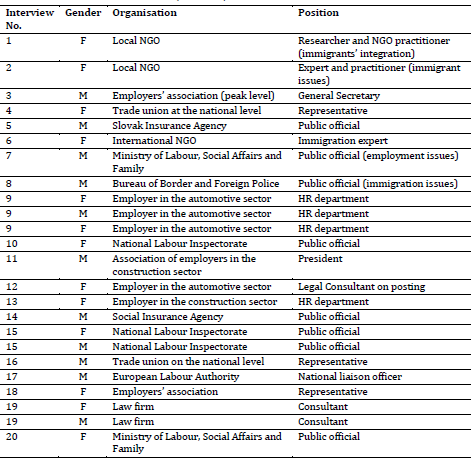
Notes: Interviews 1–13 were conducted in 2020 and interviews 14–20 in 2023. Two respondents were interviewed twice.
Copyright information
© The Author(s)
Open Access
This article is distributed under the terms of the Creative Commons Attribution 4.0 International License (http://creativecommons.org/licenses/by/4.0/), which permits unrestricted use, distribution, and reproduction in any medium, provided you give appropriate credit to the original author(s) and the source, provide a link to the Creative Commons license, and indicate if changes were made.
