



Migratory Readiness and Experiences of Mobility in Polish Emerging Adults
-
Author(s):Walczak, AnnaWalczak, BartłomiejPublished in:Central and Eastern European Migration Review, Vol. 15, No. 1, 2026, pp. 163-178DOI: 10.54667/ceemr.2026.11Received:
15 January 2025
Accepted:8 June 2026
Views: 595
This paper focuses on a relatively under-researched group of emerging adults. The main goal was to see whether gendered patterns, inherited cultural capital, economic situation and domicile specifics – as well as available mobility strategies reproduced in internationally mobile families and mobile peer networks – correlate with the current and future mobility of emerging adults. The survey was based on a random sample of 302 Poles aged between 18 and 29. The level of migratory readiness and mobility experiences is higher than in older cohorts. The logistic regression models show that migratory readiness diminishes with age and increases with a higher level of inherited cultural capital and in respondents who socialise in transnational families. Respondents from internationally mobile families were also more mobile. Interestingly, while gender is not associated with migratory readiness, it correlates with past mobility, with a higher level of mobility among males. The transition to adulthood, requiring entering new social roles, reduces the readiness but not the actual mobility. The only factor associated with both migratory readiness and past mobility was socialisation in internationally mobile families. This underlines the role of reproduction of the migratory culture.
Introduction
In this paper, we want to explore emerging adults’ migratory readiness and international mobility experiences. Mobility is a part of the contemporary social world (Castles and Miller 2011), especially for the youngest generations (Frändberg 2014; Robertson, Harris and Baldassar 2018); however, youths’ and emerging adults’ mobility is located on the margins of migratory studies (Geisen 2010). The inclusion of the mobility plans, apart from the actual migration, brings insights into future-oriented data, which can reveal additional aspects (Kaufmann, Bergman and Joye 2004). Following Cuzzocrea and Mandich (2016), we assume that it allows for the investigation of the way in which emerging adults anticipate their life strategies and thus constitute their subjectivities (Appadurai 2005).
We test associations between mobility experiences and migratory readiness with micro-level characteristics, such as gender, domicile sizes, father’s educational level and economic situation. We assume that, apart from typical push-out factors, such as the economic situation and available life strategies dependent on the domicile specifics, the inherited cultural capital and gender patterns may be associated with emerging adults’ mobility. We also want to see whether the local migration cultures play a role in current and planned mobility. The reproduction of the cultures of migration are explored in relation to two networks: family and peers. Our hypothesis is that the patterns of mobility in the familial and peer networks should be associated with emerging adults’ individual mobility strategies. The empirical basis is a survey on a random sample of 302 Poles aged 18–29. We used cross-tab analysis and logistic regression models to address the research questions.
Research on emerging adults’ mobility is scarce, as this group is usually not distinguished from other age cohorts. In our paper, we want to fill the gap in the literature. We assume that mobility in the transition from adolescence to adulthood can give insights into the role of migration – as an experience and a cultural concept – in the rite de passage. Following this anthropological metaphor, emerging adulthood can be seen as a liminal period. The decisions the emerging adults make are crucial for their future biography (Tanner 2006: 21–24), therefore the research on this specific age cohort can bring predictions for future generations’ mobility strategies.
Emerging adults
Global North societies are characterised by the enlarging gap between adolescence and adulthood. It results from the following changes: the technological revolution, the sexual revolution and women and youth emancipation which started in the 1960s and 1970s (Arnett 2024: 3). The increasing role of knowledge and skills in the job market raised educational requirements for the new labour force, prolonging the educational trajectories. Simultaneously, the sexual revolution and women’s engagement in the job market delayed the average matrimonial and reproduction decisions (Castells 2013). Young adults did not prioritise starting their own families. They still assumed that it was an important goal associated with stability but that it was also the end of independence and spontaneity (Arnett 2024). The socially constructed definition of adulthood has changed. Out of the traditional ‘Big Five’ markers – completing one’s education, obtaining a job, leaving the parental home, getting married and having children, which indicate social roles and responsibilities obtained (Settersten, Ottusch and Schneider 2015) – the significance of the last two diminished and the length of necessary education was prolonged (Nelson, Padilla-Walker, Carroll, Madsen, McNamara Barry and Badger 2007).
The term ‘emerging adults’, describing the distinctive life stage, was introduced into the literature by Jeffrey Arnett (2000). Arnett was initially referreing to 18–24 year olds but, considering their prolonged educational trajectories, he finally established the upper margin at 29 years (Arnett 2000). The stage of emerging adulthood is characterised by identity exploration, instability, self-focus, a feeling of ‘in-betweenness’ in adolescence and adulthood, a sense of possibility or optimism (Arnett 1998, 2000: 200; Nelson et al. 2007) and control over life markers (Grob, Krings and Bangerter 2001: 182). As a transition period, it is inevitably coined with a feeling of insecurity but, when we add mobility to this equation, the challenge increases. Mobile emerging adults have not only to face changes in their societal and familial roles – passing through adulthood markers – but also to position themselves in a different societal and cultural environment (Geisen 2010).
Migration, migration cultures and internationally mobile families
In this paper, we understand migration as any transnational mobility undertaken due to goals other than leisure or tourism (Kaczmarczyk, Kępińska and Napierała 2008; Kawczyńska-Butrym 2009; Napierała 2008). This understanding of migration, independent of the time frames assumed in advance, aligns with the understanding of migration as a (permanent) life strategy and (temporary) settlement in the receiving country (Cohen and Sirkeci 2011; Morokvasic-Muller 2004). We want to research both experienced and planned mobility. Although the latter is more volatile and changes with age (Zaiceva 2014), it reveals individual attitudes towards mobility (Blynova, Popovych, Bokshan, Tsilmak and Zavatska 2019) and can show to what extent migration is normalised in the culture as a normative strategy (Cohen and Sirkeci 2011).
Migratory decisions and strategies are not developed in a vacuum. The role of the closest networks is crucial to understanding the mobility patterns (Cohen and Sirkeci 2011). They are a key part of the complex called migration culture (Cohen and Sirkeci 2011; Kandel and Massey 2002), which is a mechanism of the intra-community and inter-generational transfer of socially shared assumptions about mobility (Cohen 2004). When migration is socially accepted as a life strategy (Geisen 2010), it becomes normalised and forms a part of the symbolic transition between adolescence and adulthood (Bagnoli 2009; Madianou and Miller 2012; Robertson et al. 2018; Suárez-Orozco and Suárez-Orozco 2002). Migratory culture shapes the identities not only of mobile individuals but also of immobile individuals too (Chan 2017).
We decided to focus on two sites of reproduction (Cohen and Sirkeci 2011) of the migratory culture: internationally mobile families and peers’ networks. The internationally mobile family is understood here as a modified extended family temporally divided by the administrative borders created by national states (cf. Chavez 1992; Parreñas 2001a, 2001b, 2005). Previous research proved that socialisation in transnational settings increases the willingness for mobility. This association can be theorised not only as the development of particular life strategies and modelling through socialisation but also as delivering the resources necessary for mobility (Walczak 2016). The available literature shows the significant role of attitudes to migration as a strategy among peers and the availability of mobile peer networks as a crucial factor shaping individual mobility trajectories (Herz, Díaz-Chorne, Díaz-Catalán, Altissimo and Carignani 2018; Mani and Riley 2019; Ogden and Mazzucato 2022).
Methods
Participants
The results presented below come from a survey on a random sample of Polish citizens aged 18–29, stratified by gender and locality type. Respondents were recruited from the Norstat Poland internet panel, therefore the sample, albeit random, cannot be considered representative. Norstat’s panel consists of over 257,000 respondents who registered voluntarily, which may be a source of bias. The online questionnaires were distributed via email in October 2022 and 303 complete answers were obtained. The average completion time was 12 minutes, with a maximum of 49 minutes and a minimum of 3. The structure of the final sample does not differ from the census data (Statistics Poland 2023) in terms of gender (chi2(1, n=302)=0.013; p=0.908), age (chi2(11, n=303)=17.585; p=0.092) and regional distribution (chi2(15, n=303)=14.644; p=0.66). The maximum error of proportion for the 95 per cent confidence level was +/-5.8 per cent. The study received positive feedback from the ethical commission of the Christian Theological Academy in Warsaw.
Table 1. Sample descriptives
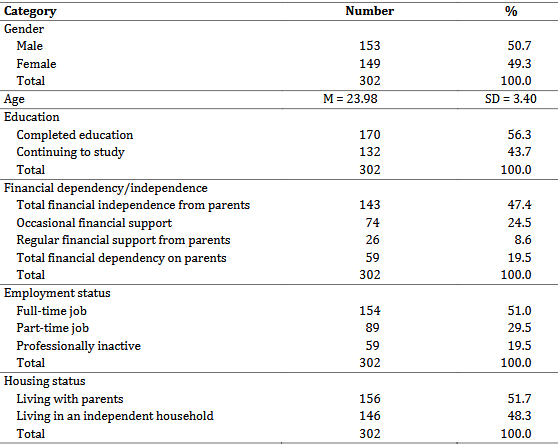
Some 50.5 per cent of the respondents were males, 49.2 per cent were females and 0.3 per cent declared a non-binary gender identification. As a non-binary gender was declared by one respondent only, we had to exclude it from further analysis. It reduced the gross sample size in the results section to 302.
The mean age was 23.9 years (SD=3.41). Some 56.1 per cent had already finished their education, while 43.9 per cent continued studying at post-secondary school or at university. Furthermore, 47.2 per cent declared total financial independence and 24.4 per cent occasional independence, while 8.6 per cent received regular support from their parents. Of the sample, 19.8 per cent were completely financially dependent on their parents, slightly more than half (50.8 per cent) had a full-time job and fewer than one-fifth (19.5 per cent) were not active on the job market. Just over half (51.8 per cent) lived with their parents. The detailed descriptives are enclosed in Table 1.
Measures
- Internationally mobile family
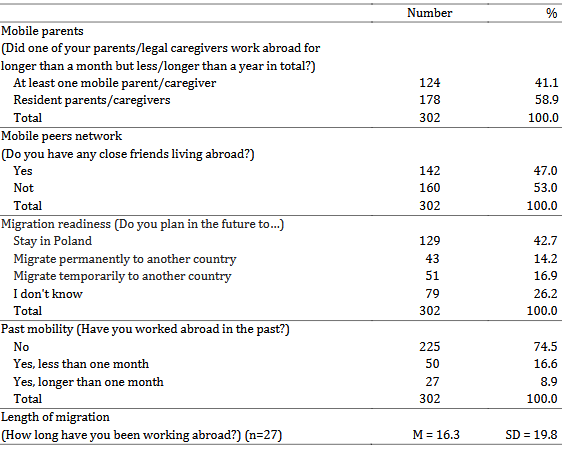
To measure the experience of being raised in a family of mobile parents, we asked about the total length of international economic migration of the respondent’s mother and father or legal caregivers. If at least one parent/legal caregiver has spent over one month working abroad, the family is classified as applying an international mobility strategy. It resulted in 41.3 per cent of emerging adults in the study experienced temporary separation from at least one parent due to labour migration (see Table 2).
- Mobile peers’ network
Through a dichotomous question about having close friends living abroad, we found that slightly over 47 per cent of our respondents declared having mobile peers in their network (see Table 2).
- Migration readiness
We measured migration readiness with a 4-item question about future settlement plans. Respondents could declare staying in Poland (42.6 per cent), permanent migration to another country (14.5 per cent), temporary migration to another country (16.8 per cent) or a lack of plans (26.1 per cent). We use a recoded version of this variable in subsequent models. Both permanent and temporary plans are coded as a declaration of mobility or of non-mobility – staying in Poland – while the missing answers are excluded.
- Past mobility
We asked the respondents about their experiences of working abroad. Almost 17 per cent (16.8) spent less than one month working abroad and 8.9 per cent more than one month (16 months on average). Almost three-quarters (74.3 per cent) had not experienced labour migration (see Table 2). In the subsequent models, we use two combinations of these values as outcome variables: any past mobility (respondents declaring any length of migration) and mobility exceeding one month.
Table 2. Measures
Data analysis
The analysis is divided into two sections: on respondents’ migratory readiness and on their migratory experience. In each section, we start by presenting descriptive statistics, followed by the cross-tab analysis with the use of a non-parametric test. The section on migratory readiness includes two logistic regression models, the first covering sociodemographic predictors and the second adding the role of internationally mobile families and mobile peer networks. In the migratory experience section, we use two logistic models with the same set of predictors but with two outcome variables: experience of mobility without any time limits and mobility exceeding one month. All the analysis was performed with an SPSS package v. 29.
Results
Migration readiness
As mentioned above, less than one-third (31.3 per cent) of emerging adults foresee their mobility: 42.6 per cent plan to live in Poland, while 16.8 per cent intend to move permanently to another country and 14.5 per cent to move temporarily. Over a quarter (26.1 per cent) reported a lack of plans.
The mobility plans are not associated with gender (chi2(2, n=302)=2.617; p>0.05), size of domicile (chi2(9, n=302)=14.020; p>0.05), father’s education (chi2(6, n=279)=12.186; p=0.058) or evaluation of the economic situation (chi2(3, n=302)=0.500; p>0.05). The significance of association with the father’s educational level is only 0.8 percentage points lower than the assumed 95 per cent confidence level. The only significant association is age: the younger the respondents are, the more of them voice plans for permanent or temporary migration abroad (chi2(9, n=302)=23.142; p=0.006). After excluding respondents who did not have a plan at the time, the difference between the 18–20 cohort (36.4 per cent) and the 27–29 (69.1 per cent) group is almost double (see Table 3).
Table 3. Associations between migration readiness and demographic and social status
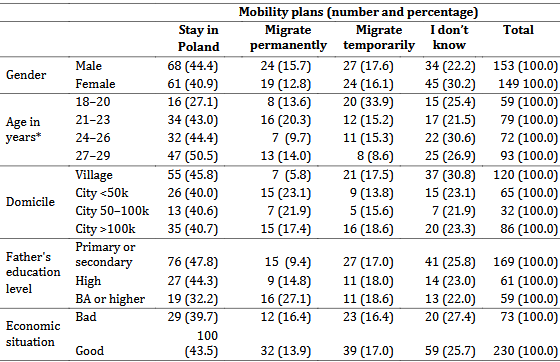
* p<0.05.
In the first logistic regression model (Table 4), we used gender, age, domicile size and respondent’s father’s educational level as predictors. Migratory readiness was recoded to the dichotomous variable: 0 – plan to stay in Poland, 1 – plan to move temporarily or permanently. We excluded respondents who were not able to declare their plans. The model fit the data (p>0.05 in H-L test) and explained 13.8 per cent of the probability of changes in a respondent’s migratory readiness (R2N=0.136). Two predictors showed significant results. Being in the youngest, 18–20, cohort increased the probability of declaring future mobility by 4.5 times (OR=4.491, p=0.001, 95 per cent CI [1.827 4.934]) and having a father with a university diploma increased it more than two times (OR=2.193, p=0.041 95 per cent CI [1.034 4.652]).
Table 4. Sociodemographic associations of migration readiness
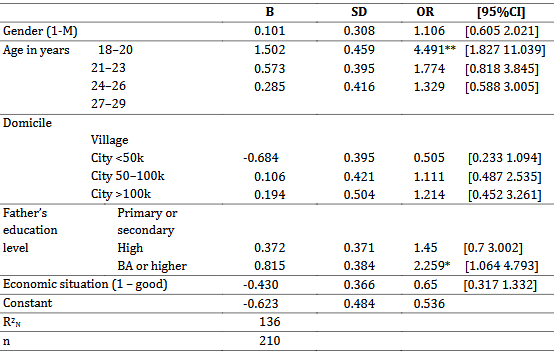
* p<0.05; ** p<0.001.
The role of socialisation in transnationalism in migration readiness
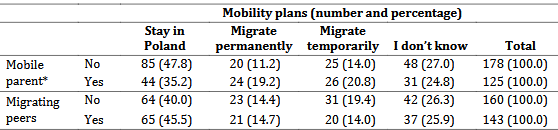
The experience of growing up in a family using an international mobility strategy was associated with migratory readiness (chi2(3, n=302)=8.048, p=0.045). The children of mobile parents more often indicated having plans for permanent or temporary migration (by 14.8 pp.) and were slightly less likely to report a lack of any plans (2.2 percentage point difference). There was no association with their peers’ mobility (chi2(3, n=302)=1.84, p>0.05). Crosstabs are shown in Table 5.
Table 5. Associations between migration readiness and internationally mobile family and peer networks
* p<0,05.
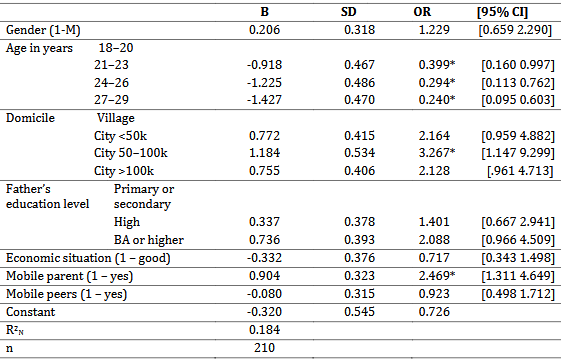
In the second logistic regression model (Table 6), we added socialisation in internationally mobile families and having mobile peers – both to gender, age, domicile size and respondent’s father’s educational level – as predictors. Migration readiness was used as an outcome variable. The model fit with the data (H-L test) was insignificant and explained the 18.4 per cent of changes in migratory readiness (R2N=0.184). The strongest predictor was living in a city of between 50,000 and 100,000 inhabitants. It raised the probability of declaring migration readiness by 3.2 times (OR=3.267, p=0.027, 95 per cent CI [1.147 9.299]). The association with growing up with at least one mobile parent was also strong, increasing migration readiness by 147 per cent (OR=2.469, p=0.005, 95 per cent CI [1.311 4.649]). We also observed the role of age. The model confirmed that the youngest respondents have the highest level of migratory readiness. Being a member of each older cohort reduced the probability of declaring a willingness to live abroad by 60 per cent (cohort 21-23, OR=0.399, p=0,049, 95 per cent CI [0.160 0.997], 71 per cent (cohort 24-26, OR=0.294, p=0.012, 95 per cent CI [0.113 0.762], and 76 per cent (cohort 27–29, OR=0.240, p=0.002, 95 per cent CI [0.095 0.603].
Table 6. Socialisation to transnationalism, sociodemographic factors and migration readiness
* p<0.05.
The role of socialisation in transnationalism in past mobility
Emerging adults are a relatively mobile group. Over a quarter already had experience working abroad: 16.8 per cent less than one month and 8.9 per cent a longer period (M=16 months, Mdn=8, SD=19.8 in that group).
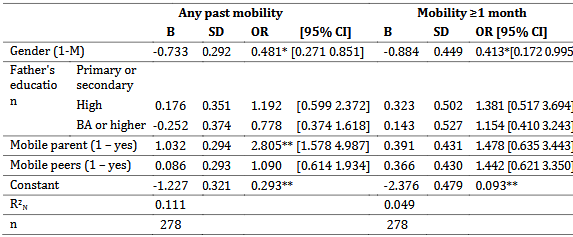
To see the role of socialisation in transnationalism, we constructed two logistic regression models. In the first, we used any past mobility as an outcome variable; in the second, we used mobility no shorter than one month. Two predictors indicated different modes of socialisation: being raised in a family of mobile parent(s) and having peers with mobility experience in a network. We included two additional predictors: gender and respondent’s father’s educational level to control for the moderators described in the literature. Our models fit the data, as the results of the Hosmer-Lemeshow tests were insignificant (p>0.05) but their quality was low and varied from 11 per cent (R2N=0.111) for the first one to 5 per cent (R2N=0.049) for the second. The only significant predictor in both models was gender. Being a female reduced the probability of past mobility by 52 per cent for any duration of stay abroad (OR=0.481, p=0.012, 95 per cent CI [0.271 0.851]) and by almost 59 per cent for longer stays (OR=0.413, p=0.049 95 per cent CI [0.172 0.995]). The experience of being raised by a mobile parent is a strong, significant predictor of undertaking any mobility, increasing the probability of any form of it almost three times (OR=2.805, p<0.001, 95 per cent CI [1.578 4.987]) – however, it was not associated with longer migrations (OR=1.478, p>0.05, 95 per cent CI[0.635 3.443]).
Table 7. Associations between gender, inherited cultural capital, socialisation in internationally mobile families and mobile peer networks and past mobility
* p<0.05; ** p<0.001.
Discussion
Almost one-third (31.3 per cent) of emerging adults plan transnational mobility. This share is significantly lower than the migratory readiness of Polish youths reported in scarce research published in the last two decades. In Cieślińska’s (2008) study among junior- and high-school students, it was slightly over 46 per cent. In Walczak’s (2018) 2014 survey, the level of migratory readiness among high-school students reached almost 53 per cent. The sample of medical students from major Polish cities revealed a migratory readiness in 41–43 per cent of respondents (Bojarczuk, Duszczyk, Matuszczyk and Pszczółkowska 2022; Bojarczuk, Duszczyk, Matuszczyk, Pszczółkowska and Szyszkowska 2022). The sample specifics may cause a discrepancy between our results and those of other studies. Cieślińska and Walczak both sampled slightly younger respondents, while Bojarczuk et al. researched a specific professional group. The 2019 CBOS survey offers results similar to ours: among respondents younger than 30 years, migratory readiness was at 27 per cent. The level of migratory readiness may be affected by the overall economic situation and migrational landscape, as Poland is turning into an immigration country with a relatively good economy. For example, in Bosnia and Herzegovina, migratory readiness reached 47 per cent (Soldo, Spahić and Hasić 2021) while, in Irish students, surveyed shortly after the 2008 crisis, the figure skyrocketed to 59–62 per cent (Cairns 2014; Cairns, Growiec and Smyth 2012). It shows the volatility of migratory cultures (Cohen and Sirkeci 2011; Madianou and Miller 2012). Our data do not provide an answer to the question about the cause of the change. It can be hypothesised that this is a result of the overall economic situation, the main migration driver (Rosińska 2024; Tufiș and Sandu 2023). However, other drivers, in particular socio-cultural ones, may play a role here. On the one hand, the decrease may result from changes in the perceptions of potential destinations, rationalising the myth of the receiving country (Chavez 1992). On the other hand, the growing anti-migration discourse in Poland may affect pro-mobility attitudes (Łodziński 2017). Given our results, a decrease in migration readiness when compared with pre-2022 data, it seems that security-driven motivation (the war in Ukraine) does not affect mobility plans.
Migratory readiness decreases with age; people aged under 30 are the most-ready-to-go group (Cairns 2014; CBOS 2018; King and Ruiz-Gelices 2006; Zaiceva 2014). Therefore, we can assume that passing through adulthood markers is negatively associated with migratory readiness. As Cuzzocrea and Mandich (2016) pointed out, referring to Erikson’s theory, engaging in the exploration of possible life strategies is typical for younger cohorts and constitutive of their agency. It intertwines with the mobile turn (Urry 2009): younger people are more familiar with shrinking physical distance in their life management (Cuzzocrea and Mandich 2016).
Surprisingly, a high share (26.1 per cent) of emerging adults were not able to declare mobility or immobility plans. It is strikingly higher than the 1 per cent share reported for all age brackets (CBOS 2019) and may indicate uncertainty, as reported in research on the transition to adulthood (Leccardi 2005). The source of uncertainty may lie in the changing life and work situation but it is also possible that it indicates the possibility to choose (Frändberg 2014). It aligns with the sense of ‘in-betweenness’, instability and exploration related to emerging adults (Arnett 1998, 2000; Geisen 2010; Nelson et al. 2007).
Migration readiness is associated with age and the father’s educational level. The younger the respondents are, the higher their inherited cultural capital and the greater their readiness for mobility. The association with age follows a general pattern: younger people are generally more mobile (Zaiceva 2014). The significance of age on mobility was explained by several factors, including a higher level of possible gains from migration and fewer psychological barriers, usually argued to be caused by the involvement in familial roles (Goss and Paul 1986; Lewis 1977). The question is why age differentiates migratory readiness within a relatively narrow age cohort. We assume that passing (or attempting to pass) the adulthood markers may limit planned mobility when individuals take over responsibilities attributed to new social roles (Grob et al. 2001).
The second significant predictor – parental educational level – shows that mobility strategies can be more accessible to specific social classes, which has already been confirmed in research (Cairns 2014; Jeffrey and Mcdowell 2004). Inherited cultural capital (Bourdieu 1986) can be converted into mobility capital (Finn 2017). It somehow aligns with the neoliberal concept of a cosmopolitan, entrepreneurial young agent benefiting from middle-class privileges (Bennett 1999; Harris and Raffaetà 2021; Skrbis, Woodward and Bean 2014; Yoon 2014), reproduced globally by the media (Jeffrey 2010); on an operational level, it can be represented by the ‘hyper-mobility’ of middle-class students seeking new distinctions (Finn 2017). Thus, mobility remains the distinctive rite de passage, marking the transition to adulthood (Bagnoli 2009; Madianou and Miller 2012;Silver 2006; Suárez-Orozco and Suárez-Orozco 2002) – although mainly for the privileged groups.
When adding socialisation in mobile parent(s) families, we identified a role of the migratory culture: being raised by mobile parents and growing up in medium-sized towns (cf. Weiss, Ferrante and Soler-Porta 2021) affects migratory readiness. Contrary to the other results (Azaola 2012; Growiec 2010; Punch 2002; Walczak 2018), there is no association with peer network mobility.
Over a quarter (25.7 per cent) of our sample declared past mobility, which is slightly higher than the 22 per cent reported for the general population (CBOS 2019). Male respondents were more mobile than females, reflecting a general population trend (CBOS 2019; Grabowska-Lusińska and Okólski 2009). Gender is an element of a realised trajectory but it is not embedded in a migratory readiness, at least not in this age group (Thomson and Taylor 2005). Growing up in a family involved in transnational mobility is a significant predictor, so we may assume that strategies learnt from mobile parents affect emerging adults’ mobility transitions (Cohen 2004). It is associated with general mobility but not with longer migration periods. We suppose that being raised in an internationally mobile family provides emerging adults with a strategy that is apparently tested but not always continued.
The study presented is not free from drawbacks. The main limitation is the sample representativeness. Although random, it is based on a voluntary access panel and not on the population as a whole. Therefore, the conclusions should not be extrapolated to the population (Blom, Bosnjak, Cornilleau, Cousteaux, Das, Douhou and Krieger 2016). The main criticism of internet-based panels is the reproduction of the digital divide in social research (Leenheer and Scherpenzeel 2013). This limitation is only partially relevant to emerging adults, as internet use for this age cohort is almost equal to 100 per cent (Staistics Poland 2023). Another limitation refers to the analysis. The dichotomical construction of two main outcome variables may be criticised for a binary recognition of mobility (Harris and Raffaetà 2021).
Polish emerging adults are a particularly interesting and challenging group for migrational studies for a couple of reasons. By definition, they are a group in transition – but so is the migratory context in which they live. Poland pivots from being an emigration country to being an immigration country, which will change the migratory cultures and, in a long-term perspective, mobility strategies of the youngest generations.
Emerging adults have a high level of migration capital in terms of access and competence (Kaufmann et al. 2004). They come from a culture with a well-established migratory tradition and network. Most of them have migrants in their kinship and peer groups and many have experienced their parents’ mobility. If they decide to move abroad, they will experience fewer constraints compared to previous generations. The high level of migratory readiness indicates that appropriation (Kaufmann et al. 2004) should also increase mobility, which may be a normalised path along which to pursue their life course (Robertson et al. 2018). In fact, as stated by Thomas Geisen (2010: 13), it should be considered as a structural process of developing a biography, not a unique event.
Funding
The research was supported by an internal grant from the Christian Theological Academy in Warsaw.
Conflict of interest statement
No conflict of interest was reported by the authors.
AI use disclosure
Grammarly was used for language editing during the preparation of this manuscript. No AI tool was used to generate content, analyse data or develop the arguments presented in the article.
ORCID IDs
Anna Walczak  https://orcid.org/0000-0003-4099-0558
Bartlomiej Walczak  https://orcid.org/0000-0002-0346-712X
References
Appadurai A. (2005). Nowoczesność bez granic. Kulturowe wymiary globalizacji. Kraków: Universitas.
Arnett J.J. (1998). Learning to Stand Alone: The Contemporary American Transition to Adulthood in Cultural and Historical Context. Human Development 41(5–6): 295–315.
Arnett J.J. (2000). Emerging Adulthood: A Theory of Development from the Late Teens through the Twenties. American Psychologist 55(5): 469–480.
Arnett J.J. (2024). Emerging Adulthood: The Winding Road from the Late Teens through the Twenties. Oxford: Oxford University Press.
Azaola M.C. (2012). Becoming a Migrant: Aspirations of Youths during Their Transition to Adulthood in Rural Mexico. Journal of Youth Studies 15(7): 875–889.
Bagnoli A. (2009). ‘On An Introspective Journey’: Identities and Travel in Young People’s Lives. European Societies 11(3): 325–345.
Bennett A. (1999). Subcultures or Neo-Tribes? Rethinking the Relationship between Youth, Style and Musical Taste. Sociology 33(3): 599–617.
Blom A.G., Bosnjak M., Cornilleau A., Cousteaux A.-S., Das M., Douhou S., Krieger U. (2016). A Comparison of Four Probability-Based Online and Mixed-Mode Panels in Europe. Social Science Computer Review 34(1): 8–25.
Blynova O., Popovych I., Bokshan H., Tsilmak O., Zavatska N. (2019). Social and Psychological Factors of Migration Readiness of Ukrainian Students. Espacios 40(36): 1–10.
Bojarczuk S., Duszczyk M., Matuszczyk K., Pszczółkowska D. (2022). Plany migracyjne studentów uczelni medycznych oraz ich faktyczna realizacja. czy naprawdę wyjadą? Skrócony raport z pierwszego etapu badania – luty 2022. Warsaw: Centre of Migration Research, University of Warsaw.
Bojarczuk S. Duszczyk M., Matuszczyk K., Pszczółkowska D., Szyszkowska E. (2022). Plany migracyjne studentów uczelni medycznych oraz ich faktyczna realizacja. Czy naprawdę wyjadą? Wstępny raport z drugiego etapu badania – 2023 rok. Warsaw: Centre of Migration Research, University of Warsaw.
Bourdieu P. (1986). The Forms of Capital, in: J.G. Richardson (ed.) Handbook of Theory and Research for the Sociology of Education, pp. 241–258. Westport, Conn: Greenwood Press.
Cairns D. (2014). ‘I Wouldn’t Stay Here’: Economic Crisis and Youth Mobility in Ireland. International Migration 52(3): 236–249.
Cairns D., Growiec K., Smyth J. (2012). Spatial Reflexivity and Undergraduate Transitions in the Republic of Ireland after the Celtic Tiger. Journal of Youth Studies 15(7): 841–857.
Castells M. (2013). Społeczeństwo sieci. Warsaw: Wydawnictwo Naukowe PWN.
Castles S., Miller M.J. (2011). Migracje we współczesnym świecie. Warsaw: Wydawnictwo Naukowe PWN.
CBOS (2018). Wyjazdy do pracy za granicę. No. 146/2018. Centrum Badania Opinii Społecznej. https://cbos.pl/SPISKOM.POL/2018/K_146_18.PDF (accessed 30 June 2026).
CBOS (2019). Wyjazdy Polaków do pracy za granicę. No. 140/2019. Centrum Badania Opinii Społecznej. https://www.cbos.pl/SPISKOM.POL/2019/K_140_19.PDF (accessed 30 June 2026).
Chan C. (2017). In Between Leaving and Being Left Behind: Mediating the Mobilities and Immobilities of Indonesian Non-Migrants. Global Networks 17(4): 554–573.
Chavez L.R. (1992). Shadowed Lives. Undocumented Immigrants in American Society. San Diego, Ca: Harcourt Brace College Publishers.
Cieślińska B. (2008). Labour Emigration in Social Debate and Public Opinion (the Case of Białystok). CMR Working Papers 39, 97. Warsaw: Centre of Migration Research, University of Warsaw.
Cohen J. (2004). The Cultures of Migration on Southern Mexico. Austin, Texas: University of Texas Press.
Cohen J., Sirkeci I. (2011). Cultures of Migration. The Global Nature of Contemporary Mobility. Austin, Texas: University of Texas Press.
Cuzzocrea V., Mandich G. (2016). Students’ Narratives of the Future: Imagined Mobilities as Forms of Youth Agency? Journal of Youth Studies 19(4): 552–567.
Finn K. (2017). Multiple, Relational and Emotional Mobilities: Understanding Student Mobilities in Higher Education as More Than ‘Staying Local’ and ‘Going Away’. British Educational Research Journal 43(4): 743–758.
Frändberg L. (2014). Temporary Transnational Youth Migration and Its Mobility Links. Mobilities 9(1): 146–164.
Geisen T. (2010). New Perspectives on Youth and Migration: Belonging, Cultural Repositioning and Social Mobility, in: D. Cairns (ed.) Youth on the Move. European Youth and Geographical Mobility, pp.11–21. Berlin, Heidelberg, Dordrecht, New York: Springer VS.
Goss E.P., Paul C. (1986). Age and Work Experience in the Decision to Migrate. The Journal of Human Resources 21(3): 397–405.
Grabowska-Lusińska I., Okólski M. (2009). Emigracja ostatnia? Warsaw: Wydawnictwo Naukowe Scholar.
Grob A. Krings F., Bangerter A. (2001). Life Markers in Biographical Narratives of People from Three Cohorts: A Life Span Perspective in Its Historical Context. Human Development 44(4): 171–190.
Growiec K. (2010). Social Capital and Migration: The Case of Polish Youth, in: D. Cairns (ed.) Youth on the Move. European Youth and Geographical Mobility, pp. 35–45. Berlin, Heidelberg, Dordrecht, New York: Springer VS.
Harris A., Raffaetà R. (2021). Migrant Youth ‘Between Mobilities’: Sessility as a Working Concept. Global Networks 21(4): 822–836.
Herz A., Díaz-Chorne L., Díaz-Catalán C., Altissimo A., Carignani S.S. (2018). Are You Mobile Too? The Role Played by Social Networks in the Intention to Move Abroad among Youth in Europe. Migration Letters 16(1): 93–104.
Jeffrey C. (2010). Geographies of Children and Youth I: Eroding Maps of Life. Progress in Human Geography 34(4): 496–505.
Jeffrey C., Mcdowell L. (2004). Youth in a Comparative Perspective: Global Change, Local Lives. Youth and Society 36(2): 131–142.
Kaczmarczyk P., Kępińska E., Napierała J. (2008). Próba oceny ‘natężenia’ migracji w regionach wysyłających przez pryzmat gospodarstw domowych, in: P. Kaczmarczyk (ed.) Współczesne migracje zagraniczne Polaków. aspekty lokalne i regionalne. Warsaw: Centre of Migration Research, University of Warsaw.
Kandel W., Massey D. (2002). The Culture of Mexican Migration: A Theorethical and Empirical Analysis. Social Forces 80(3): 981–1004.
Kaufmann V., Bergman M.M., Joye D. (2004). Motility: Mobility as Capital. International Journal of Urban and Regional Research 28(4): 745–756.
Kawczyńska-Butrym Z. (2009). Migracje. Wybrane zagadnienia. Lublin: Wydawnictwo Uniwersytetu Marii Curie-Skłodowskiej.
King R., Ruiz-Gelices E. (2006). International Student Migration and the European Year Abroad: Effects on European Identity and Subsequent Migration Behaviour. International Journal of Population Geography 9(3): 229–223.
Leccardi C. (2005). Facing Uncertainty: Temporality and Biographies in the New Century. Young 13(2): 123–146.
Leenheer J., Scherpenzeel A. (2013). Does It Pay Off to Include Non-Internet Households in an Internet Panel? International Journal of Internet Science 8(1): 17–29.
Lewis W.C. (1977). The Role of Age in the Decision to Migrate. The Annals of Regional Science 11(3): 51–60.
Łodziński S. (2017). Uchodźcy jako ‘społeczność podejrzana’ (suspected community). Polska opinia publiczna wobec udzielania pomocy uchodźcom w okresie maj 2015 – maj 2017, in: A. Górny (ed.) Uchodźcy w Polsce. Sytuacja prawna, skala napływu i integracja w społeczeństwie polskim oraz rekomendacje. Kraków, Warsaw: Komitet Badań nad Migracjami PAN.
Madianou M., Miller D. (2012). Migration and New Media. Transnational Families and Polymedia. Abingdon: Routledge.
Mani A., Riley E. (2019). Social Networks, Role Models, Peer Effects, and Aspirations. Working Paper 120. Helsinki: UNU-WIDER.
Morokvasic-Muller M. (2004). Europe: A Continent of (Im)Migration, in: C.G. Hernandez, S. Angenendt (eds) Foreign Workers, Refugees, and Irregular Immigrants: Political Challenges and Perspectives for Asia–Europe Cooperation, pp. 29–70. Tokyo: Council for Asia-Europe Cooperation, Institute for Strategic and Development Studies.
Napierała J. (2008). Regionalne aspekty zróżnicowania mobilności Polaków w świetle wyników sondażu, in: P. Kaczmarczyk (ed.) Współczesne migracje zagraniczne Polaków. Aspekty lokalne i regionalne, pp. 133–158. Warsaw: Centre of Migration Research, University of Warsaw.
Nelson L.J., Padilla-Walker L.M., Carroll J.S., Madsen S.D., Barry C.M., Badger S. (2007). ‘If You Want Me to Treat You Like An Adult, Start Acting Like One!’ Comparing the Criteria That Emerging Adults and Their Parents Have for Adulthood. Journal of Family Psychology 21(4): 665–674.
Ogden L.J., Mazzucato V. (2022). Transnational Peer Relationships as Social Capital: Mobile Migrant Youth between Ghana and Germany. Journal of Youth Studies 25(3): 344–361.
Parreñas R.S. (2001a). Mothering from a Distance: Emotions, Gender, and Intergenerational Relations in Filipino Transnational Families. Feminist Studies 27(2): 361–390.
Parreñas R.S. (2001b). Servants of Globalization. Women, Migration and Domestic Work. Redwood City: Stanford University Press.
Parreñas R.S. (2005). Children of Global Migration. Transnational Families and Gendered Woes. Redwood City: Stanford Univeristy Press.
Punch S. (2002). Youth Transitions and Interdependent Adult–Child Relations in Rural Bolivia. Journal of Rural Studies 18(2): 123–133.
Robertson S., Harris A., Baldassar L. (2018). Mobile Transitions: A Conceptual Framework for Researching a Generation on the Move. Journal of Youth Studies 21(2): 203–217.
Rosińska A. (2024). Drivers of Migration. Dimensions and Indicators: A Policy Oriented Literature Review. Publications Office of the European Union. https://data.europa.eu/doi/10.2760/5771973 (accessed 30 June 2026).
Settersten R.A., Ottusch T.M., Schneider B. (2015). Becoming Adult: Meanings of Markers to Adulthood, in: R.A. Scott, S.M Kosslyn (eds) Emerging Trends in the Social and Behavioral Sciences, pp. 1–17. New Jersey: Wiley.
Silver A. (2006). Families Across Borders: The Effects of Migration on Family Members Remaining at Home. Ann Arbor: The University of North Carolina at Chapel Hill.
Skrbis Z., Woodward I., Bean C. (2014). Seeds of Cosmopolitan Future? Young People and Their Aspirations for Future Mobility. Journal of Youth Studies 17(5): 614–625.
Soldo A., Spahić L., Hasić J. (2021). Survey on Youth Emigration in Bosnia and Herzegovina. Research Report. UNFPA BiH, proMENTE and Ipsos. https://ba.unfpa.org/sites/default/files/pub-pdf/youth_emigration_survey... (accessed 30 June 2022).
Statistics Poland (2023). Information Society in Poland in 2023. https://stat.gov.pl/download/gfx/portalinformacyjny/pl/defaultaktualnosc... (accessed 30 June 2026).
Suárez-Orozco C., Suárez-Orozco M. (2002). Children of Immigration. Cambridge: Harvard University Press.
Tanner J.L. (2006). Recentering During Emerging Adulthood: A Critical Turning Point in Life Span Human Development, in: J.J. Arnett, J.L. Tanner (eds) Emerging Adults in America: Coming of Age in the 21st Century, pp. 21–55. Washington: American Psychological Association.
Thomson R., Taylor R. (2005). Between Cosmopolitanism and the Locals: Mobility as a Resource in the Transition to Adulthood. Young 13(4): 327–342.
Tufiș P.A., Sandu D. (2023). Motivation in the Dynamics of European Youth Migration. European Societies 25(5): 829–858.
Urry J. (2009). Socjologia mobilności. Warsaw: Wydawnistwo Naukowe PWN.
Walczak B. (2016). Rodzina transnarodowa : konteksty i implikacje. Warsaw: Wydawnictwo Naukowe Scholar.
Walczak B. (2018). Transmission of the Culture of Migration: Growing Up to Transnationalism, in: M. Ślusarczyk, P. Pustułka, J. Struzik (eds) Contemporary Migrant Families: Actors and Issues, pp. 207–223. Newcastle upon Tyne: Cambridge Scholars Publishers.
Weiss J., Ferrante L., Soler-Porta M. (2021). There Is No Place Like Home! How Willing Are Young Adults to Move to Find a Job? Sustainability 13(13): 7494.
Yoon K. (2014). Transnational Youth Mobility in the Neoliberal Economy of Experience. Journal of Youth Studies 17(8): 1014–1028.
Zaiceva A. (2014). The Impact of Aging on the Scale of Migration. IZA World of Labor: 99.
Copyright information
© The Author(s)
Open Access
This article is distributed under the terms of the Creative Commons Attribution 4.0 International License (http://creativecommons.org/licenses/by/4.0/), which permits unrestricted use, distribution, and reproduction in any medium, provided you give appropriate credit to the original author(s) and the source, provide a link to the Creative Commons license, and indicate if changes were made.
