



The Emergence and Aftermath of Proactive Transnational Politics in Turkey: A Case Study on Ethnoreligious Communities in Germany
-
Author(s):Bayad, AydınSandal-Önal, ElifDüzen, EkremPublished in:Central and Eastern European Migration Review, Vol. , No. online first, 2026, pp. 1-19DOI: 10.54667/ceemr.2026.17Received:
15 March 2025
Accepted:29 September 2026
Published:12 November 2026
Views: 48
In recent years, the social integration of migrants in Europe has faced challenges due to the rise of populism. Migrants are often seen as living in ‘parallel societies’ supposedly due to their ‘failed’ integration. Turkish communities in Europe are torn between cultural assimilation in their host countries and the Turkish nationalism promoted by Turkey. This dilemma is heightened by Turkey’s diaspora policies, which aim to use Turkish communities abroad as political tools, reinforcing a sense of Turkish identity through an idealised portrayal of the Ottoman past. Our study investigates the impact of these policies on the identity expressions of Turkish migrants, particularly within ethnoreligious communities. Through interviews and ethnographic observations in a mid-sized city in Germany, we found that Turkish migrants express diverse identities shaped by their socio-political connections in Germany. While some groups align more with an inclusive Muslim identity, other communities – organised around state-led organisations, which are more exposed to Turkey’s diaspora policies – tend to merge Islam and Turkishness, often emphasising a national pride tied closely to Turkey and its political ambitions. Despite these variations, all participants maintained strong symbolic or real connections to Turkey. This research provides new insights into how Turkey’s diaspora policies affect identity expressions among Turkish postmigrants.
Introduction
Migrants face sociocultural, economic and political challenges that obstruct integration, hinder political participation and undermine well-being. In the past decade, the idea of integration of migrants has been challenged in Europe with the rise of populist politics and movements across the continent (Gidron and Hall 2020; Inglehart and Norris 2016). Migrants are increasingly alleged to constitute ‘parallel societies’ and seen as ‘radicalised’ based on a ‘failed integration’ hypothesis (Hiscott 2005). Rahimi and Graumans argue that, although the correlational data concerning failed integration or radicalisation are difficult to ignore, the phenomenon ‘needs to be always contextualised’ (2015: 47). By a similar reasoning, the integration processes of migrants might be influenced by their relations to their country of origin. During the last decades, transnationalism research has put forward that migrants live not in a single society but in a transnational social space created by the interaction between the country of origin and that of residence (Faist and Özveren 2004). Consequently, factors associated to the country of residence merge with factors associated to the country of origin and add together to the difficulties migrants experience in such matters as social cohesion.
The case of Turkish postmigrants1 in Germany could be pointed out as an illustrative example for this premise. Due to rising right-wing authoritarianism (Baser and Öztürk 2019) and populism (Akçay 2018) in Turkey, people of Turkish descent in Europe are finding themselves in a dilemma (Amelina and Faist 2008; Kaya 2019): they are torn between the integration policies of Germany and the nationalistic policies of Turkey in such a way that it affects their priorities of social identification and belongingness. Concerning this, Sauer (2018) recently reported that a sense of belonging to Turkey is strikingly strong among Turkish postmigrants in Germany whereas a sense of belonging to Germany or to ‘both countries’ is declining. Several studies have attempted to explain this recent transformation either through the voting behaviour (Goerres, Elis, Mayer and Spies 2025) and political attitudes (Adar 2019) of Turkish postmigrants or through the citizenship regimes of both countries (Yıldırım-Sungur and Schwarz 2021) and the diaspora policy of the Turkish state (Arkilic 2021; Mencütek and Baser 2018).
However, little is known about the actual effect of emerging right-wing populism in Turkey and its transnational influences on Turkish postmigrants’ everyday lives. In this paper, we focus on the ethnonational identifications of Turkish postmigrants across ethnoreligious communities through an ethnographic case study in order to examine the overlaps and divergences between their changing priorities of identification and belongingness in relation to their country of residence – Germany. More specifically, we aspire to answer the following question: How do Turkish postmigrants’ everyday lives and identity expressions relate to the dominant political discourse of Turkey under its new diaspora policy?
Identity expressions as the manifestation of the group interest
From a socio-psychological perspective, people tend to associate with pre-existing hierarchic social categories which become their social identity and allow them to engage in the world of inter-group relations (Hornsey and Hogg 2000; Tajfel 1982). Nevertheless, social identity is not free from pitfalls since identities are not only about being but also about becoming (Hall 2000), especially when different social categories are present – as is the case for people with a migration background (Deaux 2006). It has been argued that the relationship between sub- and superordinate categories (e.g., ethnic and national) is dependent on the macro-political context rather than a simple dichotomic categorisation (Chryssochoou and Lyons 2011). Accordingly, social identities are considered not as stable cognitive categories but as expressions of group interests and norms in a given inter-group context. People may use ‘physical action and the manipulation of physical appearance as well as the verbal expression of representations and attitudes viewed as normative of the in-group’ to express their identity (Klein, Spears and Reicher 2007: 30).
A transnational setting where cultures, religions and identities continuously encounter one another warrants such an instrumental approach in order to reveal any changing identification patterns. Studies have shown that identity expressions by Turkish postmigrants almost always take part in negotiations for individual identification or group formation (Ehrkamp 2006). An indicative example is the strategic use of a ‘reactive ethnicity’ among Turkish postmigrants in the face of discrimination (Holtz, Dahinden and Wagner 2013). According to Kaya (2019), however, this is not particular to Turkish postmigrants; rather, we are witnessing an essentialist turn in the cultural identities across Europe, characterised by glorifying the past such that the saliency of ethnocultural and religious boundaries work like a strategic tool to resist the structural constraints of deindustrialisation and neoliberal governance. Consequently, essentialisation may function as a reciprocal process: on one hand, Turkish postmigrants face stigmatisation regarding their cultural and religious heterogeneities in their countries of residence, a symptom of broader problems such as structural discrimination and social exclusion (Ramm 2010). On the other hand, they are targeted by Turkey’s diaspora policies transporting a national nostalgia through the myths and memories of a glorious past, including motifs from religion, nativity and Ottoman heritage.
There is a large body of literature about how history and emotions are attached to identity (Hirst, Yamashiro and Coman 2018) – such as collective or national nostalgia – and how they are influential in social relations (Wildschut, Bruder, Robertson, van Tilburg and Sedikides 2014). A sentimental longing for the ‘good old days of the nation’ is a strong narrative exploited particularly by right-wing populist politics (Öktem 2014). It was assumed that it would provide an important answer to the ‘Who are we?’ question, depending on differing interpretations and understandings of national history (Smeekes 2015) – therefore, the emotions attached to it. Those sentiments are seen as useful by many societies in boundary-making and strengthen the sense of ‘we’. Adherence to the group history and longing for the past provides group members with the information that connects them to their past, present and future, establishing collective continuity (Sani, Bowe and Herrera 2008). This is the case not only for citizens but also for migrants and expatriates living in the diaspora (Arkilic 2021).
Up until now, migrant populations attracted researchers’ attention thanks to their integration and participation in their countries of residence but not because of ‘diaspora governance’ by their home states (Glasius 2018). Besides, there are few comprehensive studies, to the best of our knowledge, which concentrate on the recent double pressure of belonging that Turkish postmigrants have been exposed to (for an exception see Kaya 2019). In the next section, we summarise Turkey’s transforming diaspora policy and its outreach towards Turkish postmigrants in Germany, presenting an in-depth look at the evolution of Turkish transnational space with a particular emphasis on nationalist and ethnoreligious organisations.
Contextualising Turkish transnational space
Transnational studies on Turkish postmigrants focus generally on their institutional ties, ethnoreligious communities or political organisations – all of which are hubs for transnational exchange whereby people of Turkish descent may come together (Østergaard-Nielsen 2001). These transnational organisations are very diverse and attentive to their society of residence – their aim is to develop strategies enabling migrants to participate in the political opportunity structures provided by the countries of residence (Kortmann 2015). On the other hand, transnational organisations maintain their cultural, religious and political interests within their heterogeneities transmitted from their country of origin (Amelina and Faist 2008). A major catch is the Turkish-Islamic Union for Religious Affairs (Diyanet İşleri Türk İslam Birliği, DITIB), established in the 1980s as an extension of the Presidency of Religious Affairs of Turkey (Diyanet) and which grew into one of the largest religious organisations in Germany (Riexinger 2005). Furthermore, other religious sects and cults were organised across Europe; these were characterised by opposing the state-supported, secular understanding of Islam in Turkey. The National Vision (Islamische Gemeinschaft Millî Görüş) or Süleymancılar (Der Verband der Islamischen Kulturzentren, e.V, VIKZ) are examples of such movements that represent major independent Islamic sentiments (Sunier and Landman 2015). Moreover, Turkish ultra-nationalist groups also found a fertile ground among guestworkers back in the 1970s and managed to organise themselves across Europe (Arslan 2004; Bozay and Mangitay 2024).
Şenay (2012) posits that the fragmented structure and the diversity of migrant organisations can be understood to be a result of the official state ideology (i.e., Kemalism) that enabled the diaspora governance to give priority to economic interests and secularist nation-building terms. Diaspora governance under Trans-Kemalism, as Şenay (2012) called it, was restricted to those who have Turkish citizenship, with the ultimate goal to secure Turkish postmigrants’ connection to the Turkish ‘nation’ and ‘language’. For instance, Turkey aimed to promote official secular ‘Turkified’ Islam abroad even though it created a tension between competing religious communities due to their distinct understanding of Islam. Having said that, Turkey’s political paradigm, together with its diaspora governance, has been extensively changed after the Justice and Development Party (Adalet ve Kalkınma Partisi, AKP) came to power in Turkey.
In concert with domestic and international socioeconomic developments, Turkish postmigrants gained additional political importance for Turkey, especially during EU membership negotiations, which identified them as ‘soft power’ under the label of ‘Euro-Turks’ (Adamson 2019; Kaya and Kentel 2005; Østergaard-Nielsen 2001). Upon securing economic growth and prioritising the Europeanisation of Turkey in its early years, the AKP started to fight against Kemalist elites in all state institutions – and consolidated its power (Yılmaz 2016). At this stage, the AKP also empowered previously stigmatised Islamist groups such as The National Vision and the Gülen movement, without ceasing to redesignate Diyanet’s ‘official Islam’ more towards a more conventional Sunni Islam than a secular one.
Baser and Öztürk (2019) note that the central importance of these developments marked by the early 2000s is a change in mentality. Instead of the nation-hiding character of previous diaspora policies, a nation-branding strategy started to epitomise Turkey’s diaspora governance. Nevertheless, that strategy was bound to encounter the resonance it created. A number of national and international developments (a failed coup in July 2016, declining economic indicators, a worsening Syrian civil war, etc.) opened the way for the AKP to launch a competitive authoritarian political regime (Akçay 2018). This way, the AKP left its moderate agenda behind and grew into a ‘hegemony-seeking’ party (Bashirov and Lancaster 2018; Solomon 2019). To achieve a new executive presidency system, the AKP formed a coalition with the far-right Nationalist Movement Party (Milliyetçi Hareket Partisi) in order to suppress their opponents domestically and internationally (Taşkın 2019). From this momentum towards authoritarianism on, Turkey’s ambitious diaspora policy appeared more problematic for Europe (Gezer and Reiman 2011), as Erdoğan’s famous maxim in 2011 in Düsseldorf ‘Integrate but don’t assimilate’ seemed to have a real effect.
Substantial modifications in diaspora governance are expected to have a substantial transnational impact, bearing a high relevance when analysing identity expressions. First, the dissemination of right-wing populist propaganda across diaspora networks promoted a top-down ethnonationalism and played a critical role in a referendum for the presidency system (Adar 2019; Yener-Roderburg 2020). Secondly, diaspora shaping has triggered controversial debates in the German media on the loyalty of Turkish postmigrants due to their voting preference (Goerres et al. 2025). Thirdly, domestic conflicts in Turkey spread to the international arena whereby the Turkish government persecuted its opponents via transnational institutions worldwide (Watmough and Öztürk 2018). Finally, the AKP’s satellite allies – such as the Union of International Democrats and Germanic Ottomans (Osmanen Germania) – emerged across Europe; with their illegal activities, they could have possibly hindered Turkish postmigrants’ political engagement or threatened other Turkish postmigrants’ communities (MEE Correspondent 2017).
Recent political turmoil and its influence on the voting behaviour of Turkish postmigrants has found some place in scholarly debate (Adamson 2019; Adar 2019; Goerres et al. 2025; Yener-Roderburg 2020); however, research on social-psychological reflections of the current policy change on Turkish postmigrants is still very limited. In this paper, we argue that the new political paradigm of Turkey – based on a Neo-Ottomanist strategy and its professional transnational outreach – is not void of influence. Nevertheless, it is also not very visible in the public space in Germany due to its perceived threat both within and across postmigrant communities, especially after the failed coup in 2016. Notwithstanding, it represents a contextual factor and overlaps with the essentialist turn in Europe (Kaya 2019) that might affect Turkish postmigrants’ identity expressions, social network and ties with the homeland across communities. To this end, we present an ethnographic neighbourhood case study, examining overlaps and divergences between identity expressions of Turkish ethnoreligious communities in a mid-sized city in Germany and their relations to their country of origin and residence.
Method
To reach our aims, we combined 2 qualitative methods throughout our data collection and analysis. For entering the field and collecting contextual information, we followed an ethnographical approach to uncover the shared practices, spaces, meanings and expressions of identity in different Turkish postmigrant communities (see Griffin and Bengry-Howell 2017). For the analysis of the interviews, we implemented a thematic approach (Braun and Clarke 2006) that enabled us to reveal patterns among participants’ articulations. The use of these two methods in the same study is not common but there are well-applied studies in a number of areas which do use them (e.g. Gerritse, Hartman, Antonides, Wensing-Kruger, de Vries and Molewijk 2018).
Against this background, the case study presented has been realised in Brackwede, a southern neighbourhood in the city of Bielefeld. The city is located in the state of North Rhine-Westphalia (NRW) and is the state’s eighth largest city (Grewe 2018). Brackwede is a predominantly Turkish district, with restaurants, import–export stores, real-estate agents, mosques and tea-houses due to the history of its steel industry, which goes back to the early 20th century. Since the current distribution of the Turkish inhabitants is fragmented across the city (Grewe 2018), we did not restrict ourselves only to the Brackwede district. Rather, under the guidance of the municipal integration centre of the city hall, we selected communities and organisations representing important aggregation centres for Turkish postmigrants – centres that are well-known among the local Turkish communities (Salentin 2014).
In light of the fragile political atmosphere in a diaspora context, we proceeded with a mixture of quota and snowball sampling in a bid to overcome selection bias and societal marginalisation (Cohen and Arieli 2011). Then, with the approval of the Ethics Review Board of Bielefeld University (No: 2018-154), we first identified a single reliable contact for each community, through whom we conducted formal and informal visits and followed multiple snowball procedures enabling us to conduct semi-structured in-depth and focus-group interviews. The interviewees were recruited from a mosque connected to a Turkish Muslim cult (i.e., Süleymancılar) representing grass-root religious organisations; two DITIB-affiliated mosques representing state-led religious organisations; and from a Turkish nationalist community (i.e., Grey Wolves) representing ultra-nationalist organisations.
The first author (FA) introduced himself as a student studying Turkish identity in Germany – a positioning that facilitated participant observations and interviews. Having been accepted as an in-group member helped to overcome the social desirability effect and gradually established a rapport. The co-authors provided support and supervision during the field research and contributed to the analysis at a later stage. All the authors were born and raised in Turkey and are familiar with the socio-cultural background of the sample. At the same time, the use of Turkish as the primary language of communication may have limited participation for individuals with a lower proficiency in Turkish or weaker connections to Turkey.
Between March and December 2018, the FA carried out 10 visits and, when it was convenient for the participants, conducted 8 individual and 2 focus-group interviews lasting between 30 and 90 minutes. This made a total of 13 interviewees, all of whom were male (M(age) = 39.1) across 3 aggregation centres. All interviews were fully cleared of any personal information in order to anonymise participants and were transcribed verbatim. Then, we coded the data-corpus inductively based on a Thematic Analysis (Braun and Clarke 2006). Since we are interested in how people express their identity, how they interact with their social networks in Germany and how they built their connection to Turkey, we analysed the data in three broad sections: a) identity expressions, b) social networks in Germany and c) ties to the country of origin.
Results
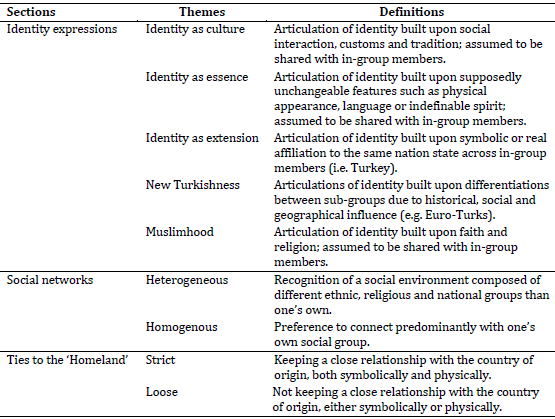
After the authors became familiar with the interview and focus-group narratives, the data were subjected to an initial coding process. Preliminary sub-themes were then identified, followed by a search for broader interpretative patterns and overarching themes. In the final stage, the themes that reflect the patterns of articulation were reviewed and refined, leading to a further modification and consolidation of the thematic structure shown in Table 1.
In the following sections we present a detailed analysis of the interviews, with exemplary excerpts of the themes revealed as well as ethnographic observations about each community. It is important to note that, as part of our ethnographic approach, the findings and interpretations are presented in an integrated manner. Due to space limitations, we focus primarily on the most prevalent forms of identity expression within each respective community and present one excerpt for each theme as the most exemplary illustration of the case.
Table 1. Themes revealed in the articulation of ethnonational identity, social networks in Germany and ties to the ‘Homeland’
A self-sufficient cult: Süleymancılar
Our first visit was to the first mosque located in the city centre, where a regular residence is transformed into a mosque and training centre. This mosque is affiliated with the VIKZ and is a part of the Süleymancılar movement. According to the account of the person in charge, the mosque community takes responsibility for and provides support in organising religious training and worship. Donations from the community fully cover the expenses, implying that the mosque is not a Turkish state-funded institution but a grassroots organisation (Sunier and Landman 2015).
Nevertheless, the imams who are serving the community maintain connections with Turkey to continue their religious instruction. For instance, a 26-year-old imam who was born and raised in Germany still had to go to Turkey and get religious training in order to be able to serve in the facility. He was responsible for teaching children their primary religious instructions in German as it is the predominant language among them. Religious training also involves students who came from Turkey to pursue higher education in Germany. A small dormitory in the facility is reserved for them. Most of the time, their family has a connection with the cult and sends their children to Germany for a better education. In such cases, the mosque provides accommodation and food and includes them in the religious training scheme by demanding that they speak the Turkish language in exchange. The same grounds of intra-community solidarity applies as well to the economic domain – such as buying goods, furniture, electronics, etc. – though only from providers who are members of the cult.
Intra-community networks were also a very prominent theme in the interviews. The participants from this mosque were those who most mentioned the social homogeneity theme across all of the interviewees in aggregation centres. For instance, a 23-year-old visitor to the mosque stated:
It happens that I spend most of my time with Turks, on [religious] courses, in the mosque. My closeness to them is special anyway.
The social network of the community was concentrated around the mosque, where encounters with those from non-Turkish milieus rarely occur, except for work settings. This is not a random occurance but a preferred way of interaction for the adherents, including their families. A 51-year-old member explained the reason behind such an intense attachment in a detailed way:
Now the Germans are a nation that even quit the church [attendance] and become an individualised nation. Unfortunately, this disease infects us too. When you look at it in this context, [the mosque is] an environment where our folks [Turks] who are left alone and are unaccepted would be comfortable. I’m not saying this is a good thing but, when looking for alternatives, you have to make do with whatever you have. There are tea houses, game halls, but [in these places] Turks became predominant [and] Germans disappeared. Then, when you look at it, mosque associations remain as an alternative.
In this quote, mosques are pointed out as the primary alternative where at least some Turkish postmigrants in Germany can feel welcome and, at the same time, continue with their Turkishness. Other real or imaginary places are portrayed as threatening paths potentially conveying a collective ‘disease’ that even Germans are suffering from: individualism. There is also room for grievances about being choiceless in Germany. Attempts to socialise with Germans such as spending time at game halls were deemed unsuccessful initiations where the Turks experienced being left alone and ‘decadence’, both attributed to individualism. That is why mosques become not only a sacred but also a cultural space for some Turkish postmigrants in Germany.
The merge of culture and religion among the interviewees is also very prominent when expressing their identity. The interviews took place under a giant Turkish flag engraved on the wall of the leisure room. In comparison to other communities, they made the most extensive articulation of the theme of Muslimhood as their primary identity – a term that best defines them in Germany. Islam and Muslimhood were believed to be their destiny. They were honoured by it and did not have to choose it. At this, a 51-year-old interviewee mentioned a more pragmatic reason to express himself as Muslim in everyday life.
As an identity, I say ‘Alhamdulillah I am Muslim’ by sealing off myself from others’ [identities]. When you go to any institution or organisation and say ‘Alhamdulillah I am Muslim’, you enter an environment that includes all identities, without your identity being questioned. But, on the other hand, for some reason, I am saying it within Germany; when you say [I am] the word ‘Turk’ nowadays, some might feel uncomfortable – or when you say ‘I am this or I am that’ another might feel uncomfortable. At that point, the identity that defines me more is obviously the religious thought, the fact that my lifestyle defines me here because I am not comfortable in any other setting, neither with my Turkishness nor my Germanness.
In this quotation, Muslimhood becomes a solution for the incompatibility between ethnonational identities. Muslimhood, being a superordinate category above and beyond ethnic and national categories (Chryssochoou and Lyons 2011), becomes an advantage to make social encounters more inclusive. These findings are in line with Sunier and Landman’s (2015) analysis that the Süleymancılar prioritise the spiritual dimension of the religion and create their own niche among Turkish postmigrants based on a dedicative religious training.
A state-funded community: DITIB mosques
Our initial contact with Süleymancılar allowed us to build new connections with other religious groups. After our initial contact in the first mosque, FA visited a second mosque which is affiliated to DITIB. This facility is built to serve a mosque in its own right. It is open not only for public prayers or religious training but also for commemorations, funeral ceremonies or circumcision feasts. In a small cafeteria visitors may spend leisure time between services. The DITIB mosque creates a much more eventful social space than the previous one and the presence of the Turkish state is more salient due to the activity announcements posted by the Turkish consulate around the facility. On the other hand, talking to the members or conducting interviews were relatively difficult. The person in charge wanted to attend the interviews and FA was not allowed to interview people randomly. Instead, the FA was invited to meet people who were selected by an authorised person in subsequent visits. The uncertain political atmosphere due to the failed coup back in 2016 was obscuring trustfull communication even with a ‘familiar’ foreigner, as was the case with FA (see Cohen and Arieli 2011).
This mosque was built in 2004 basically through the donations of the Turkish community. Particular attention was paid to achieve a conventional Turkish-style mosque. According to its website, the interior decoration and tiling were made by calligraphy masters from Turkey. The visually evident connection with Turkey was explicitly articulated – and highly favoured in interviews as well. Interviewees from this mosque make the most extensive use of the strict ties to the homeland theme in comparison to other groups. Below is the response of a 47-year-old interviewee to the question ‘How would you describe your relations with Turkey? Do you visit there?’
Of course, of course. My mother is there, my father died [there]. How shall I define Turkey to you? Indispensable! Turks will never give up their homeland, but won’t betray Germany, either. Turks living in Germany give up neither their homeland nor their Turkishness, nor their flag, nor their motherland, never ever. Nobody is capable of making that happen, never. No one should beat the air. No one should dare say, like ‘Let’s make them moderate Islam or isolate them’. All these are useless efforts. Turks never give up their motherland [nor their] flag.
Here we see that Turkey, as the motherland, is prominent for the interviewee in determining his priority of belonging. Notwithstanding its culture or heritage, the Turkish motherland and its state flag instrumentalise how he describes his commitment to his origins. A 49-year-old interviewee underlined the Identity as Extension theme to express his identity and stated:
I feel like a Turk who managed to remain connected to his roots as much as it gets.
FA: What do you mean by roots here?
Our culture, language, customs and traditions. For instance, when an elderly person comes home, the children should at least behave themselves, [make] a small talk, [give] a greeting, visiting [them] on feast days: prioritising the elderly. [I am] A person trying to live whatever belongs to Turkey, such as cultural or religious [customs].
Here, Turkey is the source of identity beyond and above culture, with religion and customs originating from there. Among the interviewees from this mosque, Turkey, with its symbolic as well as official manifestations, is framed as the source of culture and heritage, as if migrants are extensions of the country rather than someone who migrated from there.
The third mosque that FA visited was another DITIB mosque in another district of the city. Like the previous mosque, it is a prominent architectural complex consisting of two areas of prayer assigned to men and women separately, a cafeteria, a billiards saloon, rooms for seminars and training and funeral undertaking. This mosque was the busiest social space among the aggregation centres we visited. It is a hub for other DITIB-linked mosques in adjacent towns, where imams and representatives visit regularly. Generally, after the evening prayer, people gather at the cafeteria and billiard saloon to socialise, conduct business, discuss politics, etc. During all of our visits, the TV in the cafeteria was always tuned to A-Haber – a government-led TV channel broadcasting mostly political news – signalling a transnational political connection (see Ehrkamp 2006).
In the first visit, the presence of FA was felt to be a bit uncomfortable and community members avoided talking on political topics. However, FA managed to make himself a familiar face by paying several visits and attending two public events that took place within the facility. One of these events was a regular religious training course targeting the youth – it was held in the Turkish language because of the newly arrived imam appointed by Diyanet. The youngsters were all male and were members of a university student club promoting the preservation of the ‘Turkish culture’. For them, preserving the culture was not only a formal duty but a priority that was noticeably salient throughout the mosque visits and interviews. It seemed that the subjects of ‘customs and traditions’ were markers of their identities, as exemplified by this 50-year-old:
You know, what matters is to uphold each other. If we can find a common point without interfering, without meddling with anyone’s opinion or anything, that would be very nice. That common point is life. I mean, here, it is how you earn your living. Job, work environment, familial chores, [things] in common areas, you see, everybody comes and goes to their mosque... They interact with each other, with their culture.
FA: Then, is it the culture you have in common?
Culture, as well. Their common point is culture, so to say. There is this thing everyone from Turkey does; whoever you visit there is this hospitality. We, anyone from Turkey, have this toleration, generosity. But Germans, they do not have it.
Here we see that a kind of ‘spirit of sharing’ or solidarity, featuring their culture, is implied to demarcate Turks from Germans. Identity as Culture is a common theme observed across interviews in this mosque whenever ingroup heterogeneity comes to mind. The concept of culture is filled with social interaction styles, customs and, sometimes, nostalgic images to homogenise the community. It is important to note that this mosque was a relatively inclusive place, compared to other aggregation centres, mostly thanks to its location and the capacity to make room for a bit of variety on political opinions and perspectives, as reflected in the interviews. For instance, the new Turkishness theme is only revealed here among both young and old participants. The new Turkishness is expressed with a more socio-geographic understanding, where the migration phenomenon is regarded as a fact that can influence and transform identity formation, as exemplified in a 24-year-old participant’s quotation below.
We also call the tribes in Central Asia [as] Turkic tribes, but they are not as we know them. There are differences. I say, [they were] significantly influenced by Russia. Or I say, if we consider it in terms of geography, we are Western European Turks. So to speak. If the architecture of the Turks or even the spices they use in their meals is different, this means we are different. Still, geographically, socio-culturally, we are affected by this geography.
This new understanding of Turkish identity was found only in the DITIB mosques visited by the FA and highlighted the extension assumption based on religion and/or nation. Interestingly, even among third-generation young people, there is a narration of ‘essence’ accompanying this new Turkish identity. For instance, a 27-year-old interviewee had difficulty defining his self-proclaimed ‘hybrid’ identity – as he could not put it – in cultural, ethnic or religious terms. Instead, he stated that:
Maybe you can’t really regard some of them [Turks] as Turks any more. One has got to have a certain… mindset! Now when we look at consumer culture, do we live truly like Turks? I mean, in our daily lives we do a lot of things that Germans do.
The interviewee instrumentalises the concept of mindset to define Turkishness in the new transnational setting, where consumption culture or individualism create a challenge in preserving their identity. This quotation is from a third-generation Turkish postmigrant, born and raised in Germany; it marks a transformation in identity understanding in response to socio-geographic changes observed in recent decades. There is also a reservation about this change in the form of a never-changing Identity as Essence such as a Turkish mindset. Nevertheless, these expressions are not unique to this interviewee; we experienced the Identity as Essence theme in subsequent interviews, mostly among Grey Wolves.
A political party under a dome: Ülkücüler
Towards the end of his field research, FA increased his familiarity with the Turkish community in the neighbourhood and finally was able to make contact with Grey Wolves through a secure reference from one of the previous DITIB mosques. Grey Wolves in Europe is a hard-to-reach group for researchers (see Arslan 2004), as we also experienced. Their office was located in the city centre but in a difficult-to-find blind alley which only interested or affiliated people would have known about. Interestingly, the office was in the form of a mosque with a dome and minaret – yet, on the entrance of the building there was a large political sign (i.e., three crescents) of their political party in Turkey. As a matter of fact, mosques display a vast diversity of style in non-Muslim contexts, where factors like the builder, local materials and resident culture jointly determine the architecture and design. In contemporary Turkey, however, Batuman (2016) argues that mosque architecture was always an element of political tension throughout the twentieth century and significant changes occurred during the AKP’s governance through which mosques were exploited to merge Turkishness and Islam in an ideological ‘simulacrum’.
Mosques have been an important part of the Grey Wolves organisation in Germany mainly because, there, it is ‘practical and legitimate to present oneselves as a religious group rather than a political organisation holding Turkish nationalist views’ (Arslan 2004: 134). Even so, hanging a political sign on a wall in a ‘sacred’ place is still a rare case, signalling the current ideological alliance between nationalist and Islamist movements back in Turkey. Such a policy can be evidence of a maximum benefit strategy of opportunity structures provided in both Germany and Turkey (Kortmann 2015). It appears that depicting themselves as a religious community is useful to facilitate legal procedures in Germany and being connected to German society. Concurrently, acting as a political organisation associated with an ultra-nationalist party in Turkey is a useful way to sustain socio-economic ties with Turkish communities in Germany while competing with other mosques.
In line with this rationale, interviewees from the Grey Wolves community revealed a unique form of identity expression and a social profile that differentiate them from other mosque communities. Until now, we met up with articulations at different levels and forms of social and cultural homogeneity in organisations previously visited. In contrast, the Grey Wolves barely exhibit any social homogeneity; rather, they encapsulate examples of social heterogeneity. For instance, a 45-year-old participant spoke on the issue of the frequency of attendance to ethnic or cultural events as follows:
I try to attend as often as I can – say, once in a month. I try to be active. I do not hide myself in this society, owing to being Turkish, being Muslim. I, too, exist [here]. In every respect, in every sense.
FA: Who do you spend the most time with?
My workmates, naturally. These [people] are multicultural; the whole lot [cultures]. Most of them are German but there are also [colleagues] from other countries.
Here we see that participation in society is not deemed as dangerous or risky, as in previous quotations, especially among the interviewees whose social life is restricted to mosque and family. Instead, here the interviewee aimed to take part in both cultural and civic participation in Germany. Likewise, each interviewee recruited from the Grey Wolves had a busy work life; most of them were workers, being able to visit their community centres only at weekends or during the holidays. There was only one member of staff taking care of the community building, a retired first-generation ‘guestworker’ living in the same building. The main activities were not praying or other religious activities but more political and social, such that members voluntarily visit and attend activities like the Mehter platoon (i.e., an Ottoman military band).
Such an openness to German society might be due to a consolidated identity concept. In contrast to former aggregation centres that portrayed a fragile identity based on culture or being an extension of Turkey, interviewees among the Grey Wolves predominantly expressed their identity via the Identity as Essence theme, as exemplified in the following quotation from the same interviewee:
FA: Which identity expresses you best in Germany? How would you introduce yourself to people?
With the Turkish identity I belong to. I can’t change that; it’s not in my hands. [And I introduce myself] in the way I look, in the way I feel myself.
FA: Well then, what does it mean to be a Turk?
Turkishness is belonging; it is destiny. If you go and ask a German what it means to be a German, [they] will give the same answer. ‘I was born that way’. Nobody can change this. This is an innate command; nobody can change or deny it. If you ask a German or an American the same question, you will get the same answer.
The assumption of the unchangeable characteristic of being a Turk was so deeply rooted among the Grey Wolves that sometimes our questions on Turkishness sounded odd. Among the Grey Wolves, physical appearance and language were the most critical features defining Turkishness in that they pay particular attention to safeguard it in their activities at the community centres. For them, it was crucial to look different from Germans and to speak Turkish as a sign of Turkish Identity as Essence.
Conclusion
This study traces the influences of Turkey’s proactive transnational policies on the ethnonational identity expressions of Turkey-origin people living in Germany by focusing on a sample of three ethnoreligious communities. It is important to note here that we rely on Anderson’s (1983) accounts on ethnicity in clarifying what we mean by ‘ethnonational’ (Verkuyten 2005). In view of this, ethnicity refers to the existence of an imagined community by means of a belief in a common or shared descent. In this sense, ethnic Turkishness is not necessarily based on an understanding of a common or shared descent but on the exclusion of others who do not subscribe to their ingroup. Against this background, we do not mean ‘identity formation’ by saying ‘ethnonational identity expression’. Instead, we mean the instrumentalisation of polar representations, either to consolidate group identity through an exclusionary and isolationist sentiment (such as being Turkish in Germany, i.e., ethnic) or to mobilise it by an inclusive and interactionist sentiment, such as being a German citizen/denizen – a national; see Klein et al. (2007).
A sentimental emphasis on the glorified past regarding the Ottoman era has been one of the pillars of the AKP’s domestic political discourse, accompanied by claims of creating ‘a new Turkey that has risen from its ashes’ (Elçi 2022: 698). As expected, this has also formed the backbone of the country’s foreign policy, if not only at the discursive level. The understanding of extended boundaries does not only include the Middle East but also portrays the ‘diaspora’ as members of the Turkish nation who are loyal to a strong Turkey and who would always act as the conveyors of this cultural heritage. (Karakaya 2020; Tokdoğan 2018). Our main finding is that identity expressions of the communities on which we have focused in this study bear clear indications of the impact desired by Turkey’s transnational policies. In other words, the strategy of reconstructing the identity and belongingness of transnational communities by the Turkish home-state and its political elites (Elçi 2022; Kaya 2019) could evidently be spotted, even in identity expressions among certain groups of postmigrants on a rhetorical level and in their bonds with their countries of origin and residence.
Our ethnographic field observation and analysis of in-depth interviews explicitly showed that almost all of the interviewees in all three communities define themselves as Turkish. Nevertheless, the way they express their identity and socio-political ties to their country of origin and the institutional connectedness to the proactive transnational mission of Turkey, as expected, have changed considerably and are open to broader interpretation (Adamson 2019; Glasius 2018; Kaya 2019; Sauer 2018). More specifically, the political use of history as a master narrative in reconstructing national identity can be seen as an accumulation of an emotional response to the collective nostalgia which, in turn, revealed itself in the Identity as Extension and New Turkishness themes – themes which are not distributed equally across communities. Both expressions are detectable across the sample but are more prevalent across DITIB mosques that act like a ‘hub’ for assorted identity expressions to be contained and exchanged among a broader diasporic community whose ties with Turkey and the Turkish state varies considerably. In other words, DITIB mosques deliver the service of bringing diverse identity expressions together like a patchwork rather than a melting pot. As such, the DITIB mirrors, at least in part, the transnational policies of the AKP to reach out to Turkish postmigrants by trying not to alienate other diasporic communities. Besides, diverging from the Identity as Culture theme, these forms of identity expressions point to the Turkish state or Turkishness as the elementary frame of reference and reconstruct postmigrants’ everyday interactions with their environment through the lenses of historical or geographical master narratives (Aydın-Düzgit 2017; Tokdoğan 2018). Identity expressions as extensions of the Turkish state or new varieties of expanded Turkishness were much more frequent among the interviewees recruited from the DITIB mosques, where their physical and symbolic signs of connection to Turkey were outstandingly visible compared to other communities (also see Arkilic 2021; Mencutek and Baser 2018; Riexinger 2005). Their articulations revealed that they consider themselves as residents of Germany who have strong ties with their motherland, bearers of the heritage and who, at the same time, diligently differentiate themselves from other members of the receiving society. Interestingly, the rigid anti-European/anti-Western rhetoric, utilised by the AKP as part of the new Turkey narrative (Aydın-Düzgit 2017) and accompanied by nostalgic sentiments, does not seem to have a contradictory influence on Turkey’s targeted audience in the diaspora, at least on the identity-expression level. This also becomes a topic for future studies which would aim to explore the decreasing sense of belonging to Germany or ‘both countries’ among Turkish postmigrant communities (Sauer 2018).
In all three communities, being highly connected to the home state and its hegemonic political discourse goes hand in hand with a certain level of anxiety about losing their connection with the ‘motherland’. It seems that their concerns prevent them from merging with the society of their country of residence and drive them to act more vigilantly towards preserving their communities – with the exception of the Grey Wolves. The common identity expression among the Grey Wolves is basically an essentialist understanding that identity is something that cannot be changed (i.e., Identity as Essence). Unlike other communities, their identity expressions denote a two-fold recognition, one being a religious community in the civic domain of broader German society and the other being the ‘pioneer’ of ethnic Turks in the ethnoreligious domain of the Turkish postmigrant community (see Arslan 2004).
Finally, Muslim identity (Muslimhood), serving a superordinate category, did not overshadow Turkishness as a shared identity for those from the Süleymancılar cult. Their identity expression adjusts with the community’s interest to consolidate membership around Muslimhood without excluding any other ethnic group (Sunier and Landman 2015). In fact, they distanced themselves from both German and Turkish states and their approaches of recognition; instead, they relied on socio-economic solidarity networks rooted in the community. In this sense, as Kaya (2019) argued, they are on the edge of marginalisation and religious essentialisation in response to the structural constraints of deindustrialisation and neoliberal governance.
Last but not the least, our research has shed light on the convergences of communities via identity expressions accumulated around state-led organisations regarding their closeness to the existing hegemonic political discourse which is an extension of Turkey or representing a new kind of Turkishness in Europe. However, their commonalities, also evident by a culturalist understanding of identity (i.e., Identity as Culture), call for further research to understand their far-fetched connection despite their deep-rooted divergences. Although identity expressions may converge, crucial differences persist regarding these communities’ ties to Turkey and their social networks in their country of residence, which remains far from being a ‘parallel’ society.
This study is not free from limitations. Firstly, the sample consists exclusively of male participants, reflecting both the FA’s positionality and the gender-segregated structure of the communities under investigation; as such, the findings capture gender-specific experiences which cannot be extended to female Turkish postmigrants. Future research should develop targeted access strategies to include women, by working with female gatekeepers, researchers and alternative recruitment settings in which women’s participation is more visible. Secondly, the data collection was conducted primarily in Turkish, which may have limited the participation of individuals with lower Turkish proficiency or weaker ties to Turkey. Future studies should adopt multilingual approaches in order to better capture the variation in language use and proximity to Turkey. Finally, our analysis reflects a relatively early stage of Turkey’s proactive diaspora politics, which remains a significant force both domestically and internationally. As these dynamics evolve, our initial observations may shift; therefore, subsequent studies involving more diverse communities are essential for monitoring the ongoing influence of these policies on Turkish postmigrant populations in Germany and beyond.
Note
- Although the history of Turkish migration goes back to the 1960s, the ratio of those naturalised via citizenship (e.g., Turkish-Germans) is still very low and the term is not comprehensive enough to cover the diversity of migration from Turkey. Moreover, regardless of their personal migration experience, many individuals continue to be racialised and marginalised on the basis of their background in Germany (El-Tayeb 2016). Therefore, we use the term ‘Turkish postmigrants’ to refer to both migrants from Turkey and their descendants in Europe, irrespective of citizenship status or direct migration experience, in order to emphasise the continuity of marginalisation associated with this category.
Acknowledgements
We are utilising some of the unused data gathered during the first author’s PhD research, conducted under the supervision of Prof. Dr. Andreas Zick. We are deeply grateful for his valuable support and Dr. Arin H. Ayanian’s assistance throughout the course of the thesis.
Funding
Part of the research, specifically data collection, was funded by the Hans Böckler Stiftung between 2018 and 2021 as part of the first author’s PhD project (Funding No. 404447).
Conflict of interest statement
No conflict of interest was reported by the authors.
AI use disclosure
We did not use large language models (LLMs) for data handling, statistical analysis, or the interpretation of research findings. However, we used AI-assisted tools, including ChatGPT and/or Grammarly, for language editing and grammatical polishing during manuscript revisions.
ORCID IDs
Aydın Bayad  https://orcid.org/0000-0001-7015-6017
Elif Sandal-Önal  https://orcid.org/0000-0002-2611-8678
N. Ekrem Düzen  https://orcid.org/0000-0003-1547-3874
References
Adamson F.B. (2019). Sending States and the Making of Intra-Diasporic Politics: Turkey and Its Diaspora(s). International Migration Review 53(1): 210–236.
Adar S. (2019). Rethinking Political Attitudes of Migrants from Turkey and Their Germany-Born Children. Berlin: Stiftung Wissenschaft und Politik, SWP Research Paper 7/2019.
Akçay Ü. (2018). Neoliberal Populism in Turkey and Its Crisis. Berlin: Institute for International Political Economy, Berlin School of Economics and Law, Working Paper 100/2018.
Amelina A., Faist T. (2008). Turkish Migrant Associations in Germany: Between Integration Pressure and Transnational Linkages. Revue Européenne des Migrations Internationales 24(2): 91–120.
Anderson B. (1983). Imagined Communities: Reflections on the Origin and Spread of Nationalism. London: Verso.
Arkilic A. (2021). Explaining the Evolution of Turkey’s Diaspora Engagement Policy: A Holistic Approach. Diaspora Studies 14(1): 1–21.
Arslan E. (2004). Turkish Ultra-Nationalism in Germany: Its Transnational Dimensions, in: T. Faist, E. Özveren (eds) Transnational Social Spaces: Agents, Networks and Institutions, pp. 111–142. Aldershot: Ashgate.
Aydın-Düzgit S. (2017). Foreign Policy and Identity Change: Analysing Perceptions of Europe among the Turkish Public. Politics 38(1): 19–34.
Baser B., Öztürk A.E. (2019). Turkey’s Diaspora Governance Policies and Diasporas from Turkey in Germany: A Critical Reading, in: M. Hatay, Z. Tziarras (eds) Kinship and Diasporas in Turkish Foreign Policy: Examples from Europe, the Middle East and the Eastern Mediterranean, pp. 29–45. Oslo: PRIO.
Bashirov G., Lancaster C. (2018). End of Moderation: The Radicalization of AKP in Turkey. Democratization 25(7): 1210–1230.
Batuman B. (2016). Architectural Mimicry and the Politics of Mosque Building: Negotiating Islam and Nation in Turkey. The Journal of Architecture 21(3): 321–347.
Bozay K., Mangitay O. (2024). ‘Ich bin Stolz, Türke zu Sein!’ Graue Wölfe und Rechts-Nationalistische Einstellungen unter Türkischstämmigen in Deutschland. Wuppertal: Wuppertaler Initiative für Demokratie und Toleranz e.V.
Braun V., Clarke V. (2006). Using Thematic Analysis in Psychology. Qualitative Research in Psychology 3(2): 77–101.
Chryssochoou X., Lyons E. (2011). Perceptions of (In)Compatibility Between Identities and Participation in the National Polity of People Belonging to Ethnic Minorities, in: A.E. Azzi, X. Chryssochoou, B. Klandermans, B. Simon (eds) Identity and Participation in Culturally Diverse Societies, pp. 69–88. Chichester: Wiley-Blackwell.
Cohen N., Arieli T. (2011). Field Research in Conflict Environments: Methodological Challenges and Snowball Sampling. Journal of Peace Research 48(4): 423–435.
Deaux K. (2006). To Be an Immigrant. New York: Russell Sage Foundation.
Ehrkamp P. (2006). ‘We Turks Are No Germans’: Assimilation Discourses and the Dialectical Construction of Identities in Germany. Environment and Planning A: Economy and Space 38(9): 1673–1692.
Elçi E. (2022). Politics of Nostalgia and Populism: Evidence from Turkey. British Journal of Political Science 52(2): 697–714.
El-Tayeb F. (2016). Undeutsch: Die Konstruktion des Anderen in der Postmigrantischen Gesellschaft. Bielefeld: Transcript Verlag.
Faist T., Özveren E. (eds) (2004). Transnational Social Spaces: Agents, Networks and Institutions. Aldershot: Ashgate.
Gerritse K., Hartman L., Antonides M.F., Wensing-Kruger A., de Vries A.L.C., Molewijk B.C. (2018). Moral Challenges in Transgender Care: A Thematic Analysis Based on a Focused Ethnography. Archives of Sexual Behavior 47(8): 2319–2333.
Gezer Ö., Reiman A. (2011). Erdogan Urges Turks Not to Assimilate: ‘You Are Part of Germany, But Also Part of Our Great Turkey’. Der Spiegel, 28 February. https://www.spiegel.de/international/europe/erdogan-urges-turks-not-to-a... (accessed 18 October 2024).
Gidron N., Hall P.A. (2020). Populism as a Problem of Social Integration. Comparative Political Studies 53(7): 1027–1059.
Glasius M. (2018). Extraterritorial Authoritarian Practices: A Framework. Globalizations 15(2): 179–197.
Goerres A., Elis J., Mayer S.J., Spies D.C. (2025). Integration in the Host Country, Mean Political Interest and Focus Shift towards Host Country Politics: Patterns of Transnational Political Interest among Germans from Turkey. Political Studies 73(4): 1654–1674.
Grewe A. (2018). Integrationsmonitoring, Ausgabe 2018. Bielefeld: Stadt Bielefeld, Kommunales Integrationszentrum. https://ki-bielefeld.de/wp-content/uploads/2023/03/Integrationsmonitorin... (accessed 18 October 2024).
Griffin C., Bengry-Howell A. (2017). Ethnography, in: C. Willig, W. Stainton-Rogers (eds) The Sage Handbook of Qualitative Research in Psychology, pp. 38–54. London: Sage.
Hall S. (2000). Who Needs ‘Identity’?, in: P. du Gay, J. Evans, P. Redman (eds) Identity: A Reader, pp. 15–30. London: Sage.
Hirst W., Yamashiro J.K., Coman A. (2018). Collective Memory from a Psychological Perspective. Trends in Cognitive Sciences 22(5): 438–451.
Hiscott W. (2005). ‘Parallel Societies’ – A Neologism Gone Bad. Multicultural Center Prague, 1–15.
Holtz P., Dahinden J., Wagner W. (2013). German Muslims and the ‘Integration Debate’: Negotiating Identities in the Face of Discrimination. Integrative Psychological and Behavioral Science 47(2): 231–248.
Hornsey M.J., Hogg M.A. (2000). Assimilation and Diversity: An Integrative Model of Subgroup Relations. Personality and Social Psychology Review 4(2): 143–156.
Inglehart R.F., Norris P. (2016). Trump, Brexit, and the Rise of Populism: Economic Have-Nots and Cultural Backlash. Cambridge, MA: Harvard Kennedy School, HKS Faculty Research Working Paper Series RWP16-026.
Karakaya Y. (2020). The Conquest of Hearts: The Central Role of Ottoman Nostalgia within Contemporary Turkish Populism. American Journal of Cultural Sociology 8(2): 125–157.
Kaya A. (2019). Turkish Origin Migrants and Their Descendants: Hyphenated Identities in Transnational Space. Cham: Palgrave Pivot.
Kaya A., Kentel F. (2005). Euro-Turks: A Bridge, or a Breach between Turkey and the European Union? A Comparative Study of French-Turks and German-Turks. Brussels: Centre for European Policy Studies, CEPS EU-Turkey Working Paper 14.
Klein O., Spears R., Reicher S. (2007). Social Identity Performance: Extending the Strategic Side of SIDE. Personality and Social Psychology Review 11(1): 28–45.
Kortmann M. (2015). Asking Those Concerned: How Muslim Migrant Organisations Define Integration. A German-Dutch Comparison. Journal of International Migration and Integration 16(4): 1057–1080.
MEE Correspondent (2017). ‘Sons of AKP’: Turkish-German Biker Gang Accused of Aiding Turkish Spies. Middle East Eye, 24 October. https://www.middleeasteye.net/fr/news/sons-akp-turkish-german-biker-turk... (accessed 18 October 2024).
Mencütek Z.S., Baser B. (2018). Mobilizing Diasporas: Insights from Turkey’s Attempts to Reach Turkish Citizens Abroad. Journal of Balkan and Near Eastern Studies 20(1): 86–105.
Öktem K. (2014). Turkey’s New Diaspora Policy: The Challenge of Inclusivity, Outreach and Capacity. Istanbul: Istanbul Policy Center, Sabanci University, Stiftung Mercator Initiative.
Østergaard-Nielsen E.K. (2001). Transnational Political Practices and the Receiving State: Turks and Kurds in Germany and the Netherlands. Global Networks 1(3): 261–281.
Rahimi S., Graumans R. (2015). Reconsidering the Relationship Between Integration and Radicalization. Journal for Deradicalization 5: 28–62.
Ramm C. (2010). The Muslim Makers: How Germany ‘Islamizes’ Turkish Immigrants. Interventions 12(2): 183–197.
Riexinger M.T. (2005). Die DITIB eine Deutsch-Türkische Institution: Historische Erläuterungen zu Ihrer Entstehung. Berlin: Heinrich Böll Stiftung. https://pure.au.dk/portal/en/publications/die-ditib-eine-deutsch-t%C3%BC... (accessed 18 October 2024).
Salentin K. (2014). Sampling the Ethnic Minority Population in Germany. The Background to ‘Migration Background’. Methods, Data, Analyses 8(1): 25–52.
Sani F., Bowe M., Herrera M. (2008). Perceived Collective Continuity and Social Well-Being: Exploring the Connections. European Journal of Social Psychology 38(2): 365–374.
Sauer M. (2018). Identifikation und Politische Partizipation Türkeistämmiger Zugewanderter in Nordrhein-Westfalen und in Deutschland. Essen: Stiftung Zentrum für Türkeistudien und Integrationsforschung.
Şenay B. (2012). Trans-Kemalism: The Politics of the Turkish State in the Diaspora. Ethnic and Racial Studies 35(9): 1615–1633.
Smeekes A. (2015). National Nostalgia: A Group-Based Emotion that Benefits the In-Group but Hampers Intergroup Relations. International Journal of Intercultural Relations 49(45): 54–67.
Solomon H. (2019). Turkey’s AKP and the Myth of Islamist Moderation. Jewish Political Studies Review 30(3/4): 128–135.
Sunier T., Landman N. (2015). Transnational Turkish Islam. London: Palgrave Macmillan.
Tajfel H. (1982). Social Psychology of Intergroup Relations. Annual Review of Psychology 33(1): 1–39.
Taşkın Y. (2019). The Justice and Development Party (AKP), in: E. Özyürek, G. Özpınar, E. Altındiş (eds) Authoritarianism and Resistance in Turkey. Conversations on Democratic and Social Changes, pp. 75–80. Cham: Springer.
Tokdoğan N. (2018). Yeni Osmanlıcılık: Hınç, Nostalji, Narsisizm. Istanbul: İletişim Yayınları.
Verkuyten M. (2005). The Social Psychology of Ethnic Identity. London: Routledge.
Watmough S.P., Öztürk A.E. (2018). The Future of the Gülen Movement in Transnational Political Exile: Introduction to the Special Issue. Politics, Religion & Ideology 19(1): 1–10.
Wildschut T., Bruder M., Robertson S., van Tilburg W.A.P., Sedikides C. (2014). Collective Nostalgia: A Group-Level Emotion that Confers Unique Benefits on the Group. Journal of Personality and Social Psychology 107(5): 844–863.
Yener-Roderburg I.Ö. (2020). Party Organizations Across Borders, in: T. Kernalegenn, E. Van Haute (eds) Political Parties Abroad: A New Arena for Party Politics, pp. 218–237. Abingdon: Routledge.
Yıldırım-Sungur F., Schwarz O. (2021). Citizenship Regimes and Diaspora Politics: The Case of Politically Involved Turkish Migrants in Germany, in: M. Bayer, O. Schwarz, T. Stark (eds) Democratic Citizenship in Flux: Conceptions of Citizenship in the Light of Political and Social Fragmentation, pp. 101–126. Bielefeld: Transcript Verlag.
Yılmaz G. (2016). From Europeanization to De-Europeanization: The Europeanization Process of Turkey in 1999–2014. Journal of Contemporary European Studies 24(1): 86–100.
Copyright information
© The Author(s)
Open Access
This article is distributed under the terms of the Creative Commons Attribution 4.0 International License (http://creativecommons.org/licenses/by/4.0/), which permits unrestricted use, distribution, and reproduction in any medium, provided you give appropriate credit to the original author(s) and the source, provide a link to the Creative Commons license, and indicate if changes were made.
