



Neither Here, Nor There: The Vicious Circle of Liminality among Ukrainian Forced Migrants in Poland
-
Author(s):Kyliushyk, IvannaWinogrodzka, DominikaChról, EmilPublished in:Central and Eastern European Migration Review, Vol. 15, No. 1, 2026, pp. 267-292DOI: 10.54667/ceemr.2026.15Received:
7 April 2025
Accepted:12 January 2026
Views: 1323
The full-scale Russian invasion of Ukraine in 2022 forced many Ukrainians – including highly educated, middle-aged women with no previous migration experience – to migrate. As a result, they found themselves in liminality – suspended between past and future, old and new identities and different socio-political contexts; they are ‘no longer there’ (in Ukraine) and they are ‘not yet’ fully ‘here’ (in Poland). This article explores three different sources of this state among Ukrainian women: disrupted life paths, fractured identity and belonging tensions. The first source is related to the experience of war and forced migration, which has led to an existential crisis characterised by a sense of uncertainty, disorientation and limited agency. The second source is fractured identity, which involves an identity crisis manifested in self-perception dissonance, the reconfiguration of socio-professional roles and processes of self-redefinition. The final source is belonging tensions, which caused a belonging crisis marked by experiences of marginalisation and social exclusion by both Ukrainian and Polish society, which necessitates a constant renegotiation of social perception. This multifaceted crisis generates a vicious circle of liminality among migrant women which is challenging to overcome. This article demonstrates that liminality is a multidimensional, intersectional and dynamic process, characterised by continuous shifts and transformations.
Introduction
Ukraine has a long history of migration with particular intensification after independence, resulting in more than 1,351 million Ukrainian labour migrants residing in Poland before the refugee crisis (Statistics Poland 2020). The full-scale Russian invasion of Ukraine in February 2022, however, ‘uprooted’ even those who had never considered migration due to a previously stable and satisfactory socio-economic situation in Ukraine. This event triggered a major refugee crisis, with millions of Ukrainians fleeing to neighbouring countries, especially Poland, where the number of forced migrants was 947,031 in 2024 (USC 2024). A significant proportion of those fleeing were women, accounting for 80 per cent of the total, with 32 per cent aged 40–59 and 55 per cent aged 18–39 (Jirka, Kamionka and Macková 2023). The majority of forced migrants (over 66 per cent) went to Poland with their children (Górny and Kaczmarczyk 2023), for whom ensuring safety and access to education and healthcare was a key motivation to leave the country (Baran, Grzymała-Moszczyńska, Zjawińska, Sugay, Pujszo, Ovsiienko, Naritsa, Niedziałek and Boczkowska 2024). Most of the women had higher education (Górny and Kaczmarczyk 2023).
In response to the unprecedented scale of displacement, the European Union (EU) introduced temporary protection measures, granting Ukrainian forced migrants a legal status and access to essential services in countries of residence – including access to humanitarian aid, housing and social and health insurance – and the opportunity to access the labour market. As a result of these measures, which were also implemented in Poland, Ukrainian forced migrants have shown relatively high employment rates (Górny and Kaczmarczyk 2023). However, there is a notable skill mismatch, with many well-educated migrants working in elementary occupations due to language barriers and the need for immediate income (Jirka et al. 2023). Furthermore, forced migrants faced significant mental-health challenges, including PTSD, anxiety and depression, due to the trauma of war and displacement (Baran et al. 2024). Confronted with an ongoing war and an uncertain future, Ukrainian women experienced a profound sense of temporariness (Griffiths, Rogers and Anderson 2013), which led them to prioritise the present and abandon long-term planning. This period of uncertainty resulted in significant changes to their self-perceptions, values and relationships. Forced migration has affected traditional gender roles as women have taken on more caregiving responsibilities and non-traditional responsibilities for Ukrainian society as head of the household and primary breadwinner (Wolfensohn 2023).
This article analyses the sources of liminality experienced by Ukrainian women forced, by the war, to migrate to Poland. Liminality is understood here as a state of suspension – a transitional space ‘in-between’ characterised by uncertainty and ambivalence (Horvath, Thomassen and Wydra 2015; Marotta 2025; Turner 1969; van Gennep 1909). The analysis is based on 20 individual in-depth interviews.
The article is structured as follows: The first section outlines the key theoretical foundations of liminality, along with other theoretical approaches that describe the state of uncertainty among migrants. The second section presents the research methodology and provides an overview of the study participants. The following section presents the findings and consists of three parts, each focusing on a different source of liminality among Ukrainian women: disrupted life paths, fractured identity and the belonging tensions. All of these factors contribute to the multidimensional crisis, that generates a vicious circle of liminality among forced migrants, as summarised in the final section of this article.
Neither here nor there: the concept of liminality in migration studies
In migration studies, numerous concepts have been developed to describe the experiences of migrants and refugees concerning temporalities and uncertainty (Griffiths et al. 2013). One of these concepts – ‘suspended lives’ – captures the prolonged state of legal, social and existential suspension experienced by migrants due to restrictive immigration policies, border regimes, bureaucratic delays and precarity spaces – such as camps, detention centres and urban peripheries – where migrants are often immobilised (Menin 2017, cf. Dennler 2023). This concept enables a shift in focus to the nexus of time, legality and agency, thereby illuminating how the futures of migrants are perpetually postponed by exclusionary structures.
A similar concept of ‘stuckness’ describes a state of involuntary immobility experienced by migrants, who find themselves ‘locked in’ due to various external factors. These factors may include legal procedures, local labour-market entrapment or socio-economic dependencies (Pustelnikovaite 2020). As a result of a state of stuckness, migrants find themselves unable to advance in their migration trajectory or face difficulties in fully settling or integrating into their new environment. This creates a situation in which migrants find themselves in positions of disadvantage, such as socio-spatial exclusion (Shen 2017) or professional stagnation (Pustelnikovaite 2020).
The next concept is ‘protracted displacement’, conceptualised as a condition in which migrants remain physically dislocated and socially disrupted for extended periods and unable to return to their previous places of residence. This state is often characterised by a sense of ‘permanent impermanence’ (cf. Bammer 1994; Brun 2015: 19; Maxwell, Leybenson and Yemini 2024), where time is framed in terms of waiting. Displaced persons live ‘in a present that they do not want to inhabit, awaiting a future they cannot reach – a future that is often unpredictable and uncertain’ (Brun 2015: 19). In her study on internal displacement in Georgia (2015), Cathrine Brun introduced the term ‘agency-in-waiting’ to highlight the capacity of displaced persons to act within a condition of uncertainty, rather than seeing their waiting as a purely passive state in suspension. She argued that individuals engage in acts of hope and strategic anticipation that allow them to persist. However, ‘agency-in-waiting’ does not imply full control over the future – it recognises that structural constraints shape the possibilities for action (Ramachandran and Vathi 2022).
The above discussed theoretical concepts provide only a partial lens through which to analyse the experiences of Ukrainian forced migrants in Poland, as they focus primarily on structural factors related to legal status and limited or impossible return to the former place of residence. They describe the vulnerable situation of migrants who are ‘stuck’ in a geographical space, with limited possibilities to move. In contrast, Ukrainian women in Poland benefit from a regularised legal status that gives them the right to remain in the country, to continue their migratory journey and to travel freely to and from Ukraine (cf. Maxwell et al. 2024). They also have access to the labour market and the possibility to start and run businesses. However, despite these formal guarantees, their situation remains marked by uncertainty due to the unstable future of their residence rights and the continuation of the war in Ukraine. Thus, to provide a more comprehensive perspective on Ukrainian forced migrants in Poland, we adopt the overarching framework of liminality. Liminality integrates these concepts by capturing the structural, social, transitional, uncertain, transformative and dynamic aspects of migrant women’s situations in the context of the ongoing war.
The liminality, a state characterised by ambiguity and ‘being in-between’, is often part of the migration, especially forced migration, experience (cf. Bammer 1994; Scott, Jakobsen, Rye and Visser 2022), where individuals find themselves in transitional phases between different cultural, social and geographical spaces as well as different temporalities, navigating between the past, present and future (Brun 2015). It is a state that serves as a bridge, linking past roles to new ones, leading to a desired new state (Scott et al. 2022). Thus, liminality ‘involves a series of changes: social status, values and norms, identity and self-awareness, comprehension and understanding’ (Tereshchenko 2024: 23).
The concept of liminality originates from the Latin term limen, meaning ‘threshold’ and was introduced into the social sciences by Arnold van Gennep in his work Les Rites de Passage (1909) that explored and developed the concept of liminality in the context of rites in small-scale societies. Studying rites of passage in various societies, van Gennep identified three fundamental stages: separation (preliminal rites), transition (liminal rites) and incorporation/reintegration (postliminal rites), with the liminal phase characterised by the suspension of previous social statuses and uncertainty regarding the individual’s future position. This concept was further developed by Victor Turner (1969) who, in the 1960s, integrated it into cultural anthropology, emphasising its significance for analysing social structures and transitional moments in the lives of individuals and groups. Turner highlighted the social dimension of liminality, noting that individuals in this phase undergo intense transformative processes that may lead to a redefinition of their identity and social roles.
The concept of liminality has been further developed by Agnes Horvath et al. (2015). In their book Breaking Boundaries: Varieties of Liminality, Horvath and her colleagues conceptualise liminality as a prism for understanding transformations in the contemporary world, describing it as ‘sudden irruptions of existential crisis in people’s lives, loss of meaning, ambivalence and disorientation’ (2015: 2–3). The volume demonstrates the value of liminality as an analytical tool in the social and political sciences, allowing researchers to examine the intersection of anthropological, social and political processes. The authors highlight how liminal moments reveal both the formative and the transformative potential of crises.
Thomassen (2015) argues that liminal experiences can pertain to both personal life and collective events, operating across multiple levels: individual, group and societal. According to him, liminality also has a temporal dimension – ranging from brief moments, through longer periods, to entire epochs – as well as a spatial one, encompassing concrete thresholds and transitional sites, broader borderlands or even whole states and regions positioned ‘in between’ larger civilisations. In this way, the category captures both the micro-level experiences of individuals and wide-ranging historical and geopolitical processes.
The concept of liminality had a significant impact on postcolonial studies by offering a lens through which to examine the multifaceted experiences of displacement (Pandey and Limba 2023). Within the postcolonial framework, migration often entails navigating a space of cultural in-betweenness, where individuals must reconcile the demands of integration into a new social environment with the preservation of their original identity. This process can result in a persistent sense of liminality, as migrants or refugees find themselves suspended between two societies, neither fully belonging to one nor the other. Alternatively, some individuals develop a ‘hybrid’ or ‘dual identity’ (Tereshchenko 2024), blending elements of both their homeland and the culture of the country of residence to create a new, fluid sense of self.
Liminality, often described as a state of transition, can be a complex and challenging experience for people with a migration or refugee background. It is a period marked by uncertainty and transformation, where individuals are neither fully integrated into their new environment nor able to return to their previous lives. Oksana Tereshchenko (2024: 24) identified a set of factors, in the context of migration, that cause stagnation in the liminal period: the loss of previously held social status, disruption of familiar routines and ways of life, separation from one’s homeland and social networks, challenges to identity continuity, language barriers, exposure to social categorisation and stigmatisation, persistent uncertainty and anxiety, unfamiliarity with cultural norms and traditions, communication difficulties, precarious living conditions, and an inability to predict or plan for the future.
Analysing modernity, Arpad Szakolczai (2016) introduces the concept of ‘permanent liminality’, which denotes a condition in which transitional phases – normally expected to conclude – become protracted and turn into a durable mode of existence. Instead of leading to a renewed social order, this prolonged suspension leaves individuals and communities caught between ‘before’ and ‘after’, unable to restore stability or a sense of closure, which may lead to a limbo state.
The concept of limbo is a term used to describe the state of migrants, particularly refugees, who find themselves in a situation of protracted, open-ended suspension with no clear trajectory forward. This condition is often the result of prolonged waiting periods for legal status or recognition in their countries of residence (Chwieduk 2022; Ukrayinchuk and Havrylchuk 2020). While liminality carries the potential for transformation or passage, limbo foregrounds the experience of being stuck in an indefinite, often immobilising in-between state. The prolonged and indeterminate nature of limbo can hinder integration, erode agency and negatively affect overall well-being, marking it as a more enduring and restrictive form of suspended existence than liminality. Sam Scott et al. (2022) examined the balance between liminality – seen as a positive, temporary transitional phase – and limbo, a prolonged and negative state. They suggested that, while migrants engaged in precarious work can avoid falling into limbo, they do not fully experience liminality in its traditional sense. Instead, they encounter what the authors termed ‘ambiguous liminality’ – the state between limbo and liminality – in which precarious work is perceived as liminal, yet the pathways to achieving a stable new state remain varied, uncertain and gradual.
Liminality is the most commonly studied among low-skilled migrants with limited capital, who engage in hyper-flexible, precarious labour (Scott et al. 2022). However, Kate Kirk, Ellen Ball and Sarah Renee Janssen (2017), in their research on liminality among highly skilled Indian migrants in the Netherlands, highlighted that similar social and economic vulnerabilities also apply to this group. The authors shed light on the relationship between individual agency, transnational social networks, geographic location and cultural perceptions of life phases and gender among migrants with high capital and social status who have experienced a state of liminality.
When examining the liminality of middle-class migrants, it is important to focus not only on cultural identity – as most researchers do (Pandey and Limba 2023; Tereshchenko 2024) – but also on professional identity. The loss of qualifications often leads to a decline in social status and agency, negatively impacting on self-esteem as, in contemporary societies, an identity is strongly linked to employment. From a social constructivist perspective, identity is shaped through the interplay between self-perception and social recognition. In the case of forced migration, this process is disrupted by deskilling or by the social perception of highly skilled forced migrants as ‘low-skilled labour migrants working in low-wage sectors’ (Fedyuk, Kyliushyk and Lashchuk 2023). Such experiences can result in a loss of existential security and lead to an identity crisis (Mijić, Parzer, Tkalich and Zolotarova 2024). Horvath (2015) describes how individuals in a liminal state may undergo a transformative process of redefining their identities, both personally and in terms of their social roles. Drawing on the perspective of rites of passage – conceived as a fluxional, chaotic, void-like liminal stage – Horvath introduces the concept of ‘forced liminality’, understood as a condition arising either from the deliberate imposition of liminal circumstances or from external factors that compel the transformation of identities from one state to another.
When studying liminality among migrants and refugees, it is essential to consider the transformation of their sense of belonging in the transnational social context (Blachnicka-Ciacek, Trąbka, Budginaite-Mackine, Parutis and Pustulka 2021; Kirk et al. 2017; Marotta 2025), as well as the formation of collective identity through a similar background (Peter 2024). Understanding liminality not just as an individual but also as a collective experience sheds light on the ways in which migrants reconstruct belonging and community amid uncertain circumstances. The study by Laura Peter (2024) identifies temporal and spatial liminality as central collective experiences that both facilitate and hinder the formation of shared identities.
Liminality presents both challenges and opportunities for migrants and refugees (Marotta 2025). While it can lead to a sense of ambiguity and uncertainty, it also provides a space for agency/‘liminal agency’ (Weidenstedt, Geissinger, Leick and Nazeer 2023) and adaptation – that is, actively pursuing possibilities for progress in uncertain states of in-betweenness. Liminality is not a static experience but a constantly shifting process, as individuals continuously make decisions (Elo, Ermolaeva, Ivanova-Gongne, Klishevich, Kothari and Wiese 2024), form new identities, and adapt to their changing circumstances, which may ultimately lead to a transformative situation (Horvath et al. 2015).
Our analysis builds on the assumptions of these concepts and aims to explore liminality in the context of the forced migration of middle-class, middle-aged Ukrainian women residing in Poland. The study examines the factors shaping their experience of being ‘in-between’, encompassing multiple dimensions – spatial, temporal, social, cultural and others.
Methodology: qualitative research with Ukrainian female forced migrants
This article draws on data collected for the qualitative component of the BigMig: Digital and Non-Digital Traces of Migrants in Big and Small Data Approaches to Human Capacities project. The methodological approach used for this research was a co-creation research design, which combined qualitative data triangulation with a participatory approach grounded in ethical reflexivity towards data collection and data analysis (Kyliushyk, Winogrodzka and Chról 2025). The study involved 20 semi-structured in-depth individual interviews (IDIs) with Ukrainian women who became forced migrants following the Russian invasion of Ukraine on 24 February 2022. These interviews were preceded and followed by focus-group interviews (FGIs) with five Ukrainian women, who are experts and practitioners with both professional and personal migration experience. This methodological approach enabled an in-depth exploration of how the experience of forced migration affected participants’ social and professional pathways and, consequently, shaped their mobility capital (Winogrodzka, Kyliushyk and Chról 2025).
This article focuses specifically on the individual narratives of Ukrainian women and uses data exclusively from the 20 IDIs (see Appendix 1). These interviews were conducted between May and August 2023 with participants who had been residing in Warsaw, Poland, for 1 to 1.5 years at the time of data collection. By focusing our research on participants in this specific location – with a high concentration of institutional support, employment opportunities and social networks for migrants – we aimed to understand how feelings of liminality manifest themselves even when migrants have access to a wide array of different resources.
The study participants were socially and professionally active both in Ukraine and Poland, all possessing higher education degrees. Notably, for almost all of them, this migration was their first experience of international mobility, as they had spent their entire lives in different regions of Ukraine – primarily in cities such as Lviv, Kyiv, Kharkiv, Mariupol, Poltava, Chernihiv – without ever planning to live abroad. In terms of their socio-economic background, all interviewees can be identified with the Ukrainian middle class (cf. migrants ‘of the middle’ – Robertson and Roberts 2022) which, to some extent, differentiates them from earlier waves of migrants from Ukraine (Kyliushyk and Chról 2025). They represented various employment sectors – including administration, finance, services, healthcare, education, culture and fashion – and worked in diverse organisations such as domestic companies, international corporations, educational institutions and NGOs. Some participants were self-employed. All interviewees had actively sought to continue their professional careers in Poland, with most securing jobs aligned, at least partially, with their qualifications and skills. When it comes to the family situation, most participants of our study were married and had migrated with their children, while their husbands stayed in war-torn Ukraine. The age of the participants ranged from 31 to 54 years, with an average age of 42, partially positioning them as ‘midlifers’ – a social group often overlooked in studies on socio-spatial practices (Preston, McLafferty, Maciejewska and Yeoh 2024).
The specific socio-demographic profile of our participants makes an intersectional approach essential for a nuanced understanding of their experiences (Bastia, Datta, Hujo, Piper and Walsham 2022; Cleton and Scuzzarello, 2024). This analytical perspective recognises that individual experiences are not shaped by single factors but by the interplay of various social categories such as gender, age, class and migration status. Middle-aged migrant women face specific challenges stemming from both gendered and age-related factors (Lulle 2024). Labour-market inequalities are particularly pronounced, as the women frequently encounter difficulties securing stable, well-paid employment, often due to ageism and gendered expectations regarding family responsibilities. For our participants, this means that the challenge of re-entering the professional world in a new country is compounded by the dual burden of sole childcare and household management. Furthermore, middle-aged migrant women belong to the so-called ‘sandwich generation’, balancing economic and caregiving responsibilities for both younger and older family members. Social integration is another critical issue, as middle-aged migrant women frequently experience loneliness and difficulties in building new support networks, a challenge exacerbated by the dual roles of being a full-time employee and a full-time caregiver. The intersection of age, gender, migration and other aforementioned factors related to social roles and labour-market challenges can negatively impact on their mental and physical well-being (Preston et al. 2024), shaping and intensifying their experiences of liminality, which this article aims to explore.
Our study adhered to strict ethical standards for research with people in situations of forced migration who are at risk of experiencing vulnerability (see e.g. Clark-Kazak 2021); it was approved by the Research Ethics Committee at the implementing institution. All participants were fully informed about the research objectives, confidentiality measures and their right to withdraw from the study at any time. They received written information detailing the project’s purpose and data protection measures. Identifiable information, such as their name or specific workplaces, was anonymised while preserving the integrity of the data. Interviews lasted an average of 1.5 hours and were conducted in Ukrainian by a Ukrainian researcher, which fostered openness and allowed for the collection of rich and nuanced data (Kyliushyk et al. 2025). With the participants’ consent, interviews were recorded, transcribed and translated to ensure accessibility for the entire research team. Thematic analysis (Nowell, Norris, White and Moules 2017) was used to analyse the qualitative data by identifying and coding data segments that reflected the key sources of the liminal state.
What shapes the state of liminality among Ukrainian women?
The analysis of liminality among Ukrainian women in the context of forced migration is structured into three sections, each devoted to a different source of this state. The first examines how disrupted life paths caused an existential crisis. The second focuses on the identity crisis which emerged from a fractured identity. The final section explores the belonging crisis stemming from belonging tensions.
‘The war completely destroyed everything – our entire wonderful life – which we had to rebuild from scratch’. Disrupted life paths as a source of existential crisis
The escalation of the Russian invasion of Ukraine in February 2022 destabilised Ukrainians’ lives, disrupting their paths and creating widespread instability. The initial disbelief that war could actually occur was soon replaced by shock, paralysis and a sense of being lost in a surreal yet threatening reality. The intensification of military actions and the unpredictability of events forced rapid decision-making under extreme psychological pressure. The urgent need to flee – often without reliable information, clear plans or support networks – initiated a state of suspension that only deepened over time. Within this liminal space, many Ukrainian women experienced limited agency, as their ability to shape their futures became constrained by structural barriers, legal uncertainties and socio-economic dependencies in host countries (Marotta 2025). While forced migration required them to make immediate choices, these decisions were often shaped more by external pressures than by personal autonomy, reinforcing a sense of displacement and precariousness.
After the occupation of the eastern part [of Ukraine by Russia] in 2014, it was obvious that something like this could still happen. But until the very end, I kept thinking – no, this is impossible. On the morning of the 24th [of February 2022], my sister called me, (...) ‘Yaryna, wake up’. (...) And when my window started shaking, I realised – damn, it’s happening here, at home. On the 25th, I started getting ready (Yaryna, 41).
We got on the train without knowing where we were going. We boarded and started asking where the train was headed. But no one answered. Only after it started moving did we get a response – it was going to Lviv [a city near the Polish border]. And once we arrived in Lviv, our friends helped us to reach the [Polish] border (Yana, 34).
Ukrainian women who fled to different, mainly European, countries – including Poland – found themselves in a situation of ‘protracted displacement’ (cf. Maxwell et al. 2024), characterised by prolonged physical dislocation and social disruption, leading to heightened uncertainty and unpredictability (Brun 2015). This previously unimaginable forced migration generated a sense of losing control over one’s own fate – an experience already deeply strained by the preceding COVID-19 pandemic, referred to as ‘unsettling event’ (cf. Kilkey and Ryan 2020). The geopolitical uncertainty surrounding Ukraine and the broader region, the ambiguity regarding potential destinations for refuge and the lack of prior experience with international migration further exacerbated feelings of disorientation and being caught ‘in-between nothing’ (Thomassen 2015). As Anfisa (36) recalled: ‘At the beginning of the war, we were completely disoriented; we understood absolutely nothing – where to go, where to escape, what to do, where we would end up. It was just incredibly terrifying’.
The experience of war and forced migration brutally suspended Ukrainian women’s existence in a spatio-temporal limbo – trapped between the ‘before’ (a lost past) and the ‘after’ (an uncertain future) of 24 February 2022 (cf. ‘forced liminality’, Horvath 2015). This separation from their previous lives resulted in a metaphorical ‘death’ (van Gennep 1909), in which forcibly displaced individuals are compelled to abandon aspects of their past by severing ties with familiar practices and routines that had previously defined their standard of living and lifestyle. As Alla (44) reflected: ‘[In Ukraine] everything was wonderful. And then coming here… the war completely destroyed everything – our entire wonderful life – which we had to rebuild from scratch’.
The sense of ‘resetting’ one’s life among middle-class migrants largely stems from the loss of their previously socio-economic position. The erosion of one’s past social status, the necessity to abandon their former lifestyle and their detachment from home and social networks effectively prevented Ukrainian migrant women from experiencing a sense of attachment – both geographically and socially. Their displacement resulted in what Bammer (1994: 12) describes as a ‘simultaneously split and doubled existence – stretched across the multiple ruptures between here and there’. The place they once called ‘home’ ceased to be one, while their new place of residence had not yet been fully familiarised, leading to a distinctive state of ‘in-betweenness’ (Brun 2015; Horvath et al. 2015; Weidenstedt et al. 2023), deeply embedded in the condition of liminality.
I was going home [in Ukraine], thinking I would feel at home, that I would be comfortable there – my mother, father, brother, home – but I somehow felt like a stranger. I don’t know where that feeling came from. (…) The question [about the future] remains open for me. I think the more time I spend here [in Poland], the more likely it is that I will stay [here] but, for now, no final decision has been made (Olesia, 45).
Our interviewees, while sharing their experiences, employed the metaphor of ‘parallel worlds’ – coexisting yet radically different socio-political realities: a war-torn Ukraine – where they remain present in spirit but absent in body – and Poland, where they appear to lead ‘normal’ lives. This sense of a ‘split state’ accompanied them in their daily routines.
I don’t even know how to describe it; it just felt illogical. As if in a parallel world, because mentally, you remained in Ukraine, at home. Here [in Poland], you wake up, prepare breakfast, make sure the children eat on time, clean up after them, walk the dogs, cook lunch – so, physically, you are here but, mentally, you are still there (Olesia, 45).
As a result, many forcibly displaced Ukrainian women experienced an inner conflict, often accompanied by remorse for leaving their homeland in a time of crisis. This led to persistent self-doubt and an unending moral dilemma over whether they should have stayed or left. As Olesia explained
You have this moral feeling that you fled, that you betrayed [your country], that you took your child away – it’s something that invites self-criticism to the point of guilt. (…) You start tormenting yourself, questioning whether you made the right decision.
Moreover, the ongoing war in Ukraine made it difficult for migrant women to maintain their usual activities in their new place of residence, particularly those related to leisure or their previous lifestyle, further deepening their existential crisis (cf. Mijić et al. 2024).
When you understand that there is a war going on, that people are dying... a sense of guilt arises. (...) I watched people skiing and, at some point – I remember, maybe after a month – I thought that maybe I should go, too. (…) But then I thought that I couldn’t allow myself to ski while others were in danger because of the war (Yana, 34).
The extended experience of being forcibly separated from a place long considered home, combined with ongoing uncertainty about the future, fosters a sense of ‘permanent impermanence’ (Brun 2015) among migrants from Ukraine. In this state, time becomes structured around waiting, significantly limiting their ability to move forward.
Right now, all my plans revolve around one thing – that the war ends as soon as possible. I can’t plan anything because I don’t know what tomorrow will bring but I already just want it to be over (...). I wake up every day worrying and thinking, God, when will this end? (Hanna, 37).
In such circumstances, as Brun (2015: 24) pointed out, ‘people often dream of return and a future located in an idealised and harmonious past’. This is reflected in the experience of Vitalina (45), who admitted: ‘I would like to return [to Ukraine] and restore everything to its previous state. In our dreams, we all see our homes, our beds’. Envisioning a future that remains out of reach – often anchored in the past and embodied by the places and lives they were forced to leave – can lead to stagnation and a sense of helplessness, resulting in ‘suspended living’ (Dennler 2023; Menin 2017). For individuals living in a prolonged ‘waiting mode’ (cf. ‘permanent liminality’ Szakolczai 2016), there is a significant risk of losing hope which, combined with anxieties about the future, can severely impact on their mental health and overall well-being (cf. Baran et al. 2024), as reflected in Tina’s (43) account.
In the first six months [after the escalation of the war], we were still running on adrenaline. There was a lot of hope that the war would end quickly and we kept waiting, waiting, waiting. But after half a year, people started to break down – both mentally and physically. Chronic illnesses emerged and many began seeing psychiatrists – and they still do. (…) I can see that many people now carry immense inner tension and anxiety. On the one hand, life has somewhat stabilised – people are working – but, at the same time, no one knows what will happen after the war, how to move forward – and that creates a lot of internal strain.
A situation of protracted uncertainty (Brun 2015) significantly shapes the temporal perspective of forced migrant women, leading to a predominant focus on the short term (cf. Baran et al. 2024). Many Ukrainian women who fled the war report an inability or reluctance to plan for the long term, as the unpredictability of their circumstances and the constantly shifting situation in Ukraine undermine the feasibility of making lasting commitments. As Ilona (48) described it:
After two years of COVID-19 and the escalation, thinking long-term... I don’t know what will happen in a year. I don’t even know where to start, whether we will return, when we will return or what the situation will be [in Ukraine] when we come back because it will also change.
Waiting for a future rooted in the past can lead to passivity and withdrawal from activity. This conscious suspension of various activities also includes mobility capital formation (Winogrodzka et al. 2025), which enables further post-migration mobility practices (Chról and Kyliushyk 2025). However, it can also function as a mechanism that helps individuals stay afloat despite tough experiences of loss, fostering the emergence of ‘agency-in-waiting’ (Brun 2015; Ramachandran and Vathi 2022) – the capacity of displaced individuals to act within conditions of uncertainty. In this context, individuals engage in strategic anticipation that enables them to endure and navigate challenging circumstances. This dual nature of response and strategy employed by Ukrainian migrants was highlighted by Yaryna (41), who works at a consultation point and helpline offering support to migrants:
It seems that women are facing certain general challenges. They understand what is happening in Ukraine, and many of them are under stress. Some are able to channel their efforts into seeking opportunities, for example, by participating in various IT courses and training programmes in Poland, which could help them find employment. However, I have the impression that most of them still want to return to Ukraine and are not fully aware of the potential benefits. (...) Some of them are still in shock and are not ready to actively search or consider other opportunities.
On the one hand, the existential crisis experienced by Ukrainian forced migrant women was profoundly destabilising, manifesting as a rupture in their sense of connection, leading to a state of liminality (Thomassen 2015). On the other hand, this disruption of life path also prompted a critical reassessment of their engagement with the present, encouraging them to embrace a mode of existence centred on ‘living in the here and now’. In the face of an uncertain future, this shift in perspective became both a coping mechanism and a way to reclaim agency within the constraints of displacement (cf. Brun 2015). Focusing on the present, in a sense, is an attempt to mitigate the negative effects of liminality.
Listen… The war affects only the fact that you don’t know what will happen to you tomorrow. You live as if in the present day. You are grateful for what you have today. Yes, you make plans, but you understand that those plans… everything can go wrong. But at the same time, it gave you strength. And there are things you can stop paying attention to (Alla, 44).
‘I had such an identity crisis, the identity of myself, of who I am in general’. Fractured identity as a driver of identity crises
Ukrainian women, being in suspension between a lost past and an uncertain future (Brun 2015), experience not only disorientation but also an identity crisis, which is another dimension of liminality (Horvath 2015; Marotta 2025; Tereshchenko 2024): ‘I had such an identity crisis, the identity of myself, of who I am in general. And it was such a terrible gap in terms of understanding myself. Well, supposedly I’m here for the children, yes, for security, but I lose myself all the time’ (Inna, 41). This identity crisis results from a fractured identity, shaped by the shifts in social roles that female migrants are required to perform under new conditions. For instance, motherhood in this situation acquires a new meaning, as migration often involves sacrificing one’s own ambitions and aspirations for the sake of one’s children. As Inna continued, ‘I’m a mother, I have to think about my children first. Because I gave up everything for their future. I’m 40 years old. Am I going to go back to everything that was before that?’. Ukrainian women not only have to organise their life in a new place but also bear the burden of trauma, loss and the need to provide stability for their families in what they relied on their husbands for before this: ‘The women at the time went through many things. To save the lives not only of themselves but also of their children. To provide for their children, education, food, medical treatment, etc. This is also a very big sacrifice’ (Maria, 50).
Traditionally seen in Ukrainian society as caretakers of the home, women have been forced to take on new roles – as both sole breadwinners and decision-makers, responsible for their own and their children’s futures (Wolfensohn 2023), as Anfisa and Alla pointed out:
[Stereotypically] woman is the caretaker of the house but now Ukrainian women have shown that not only are they caretakers of the house but they can also drive a car across the country carrying children under the sound of air raids, under bombings (Anfisa, 36).
When I first came to Poland, I understood that I needed to learn the language [and] I need a job (...) to have an income here after all, because I have to pay for housing somehow. I have two children on my back. What will happen with my husband is also unknown (Alla, 44).
Moreover, a situation of ‘protracted displacement’ (Brun 2015) not only separates women from their previous lives but also leads to new internal conflicts, especially in the context of decisions regarding the welfare of children. Some women yearn to return, while others have to reconcile their children’s conflicting expectations, further exacerbating their sense of suspension:
The younger son whines all the time, every day, that he wants to go home. And he doesn’t care... where you want to stay there and I will go. And I say – no, without me you will not go. That’s because there’s a war and you don’t know where [the rocket] might still come. The older son wants to stay here. And I can’t tear myself apart’ (Alla, 44).
In addition, women’s husbands very often found themselves in the military due to their own decisions or mobilisation obligations, which further reinforces the sense of insecurity among migrant women, as Alla continued: ‘My husband is in the army, it’s a very big stress’. Or they have health problems that are adversely affected by the experience of war. Women who relied on the support of their husbands before the escalation of the war become supporters themselves, as Yaryna’s (41) family situation illustrates:
My husband has lost weight, well, a minimum of 13 kilograms, that is, if before he was L, XL, now he is S. He has mental breakdowns all the time, because he has many friends who have already died, whom he buried. But at the same time, he can’t leave, even though he has a ‘white ticket’ [a military document certifying his inability to perform military service, colloquially] he has such a disease, renal failure, he must be constantly under care. Sometimes he says he’d really like to help [me] more, but he can’t. Because the point is that, before, even though I had a low income, my husband had the ability to support me.
The identity crises not only result from the redefinition of women’s roles as mothers and partners, but also as daughters. The migration of middle-aged women is associated with the specific burden of having to care for both the younger and the older generations (Lulle 2024). In the case of Ukrainian women, this multifaceted responsibility becomes particularly difficult because it is sometimes carried out, in part, long-distance, as Toma (54) told us:
I already have parents who are quite elderly, especially my father and well, it’s hard to say that I’m here and they are there, I don’t know. Maybe it will be that I will go here and there, I don’t understand now at all and that makes it even more difficult for me, that is, now there is no certainty.
Many of the migrant women face an inner struggle – a sense of obligation to their aging parents left behind in Ukraine and a desire for stability and a better future for themselves and their children in the new country:
I have a child, yes, I have to support my child, I have a mother who is already advanced in age, yes, and I have to support her, that is my mother, in the first place, she in no way wants to leave, she never wants to live anywhere else but in Ukraine, she is 60 years old (Anfisa, 36).
The statements of female participants in the study perfectly illustrate the nature of liminality – a suspension between two realities, an ambiguous ‘being-in-between’ (Horvath et al. 2015; Scott et al. 2022). On the one hand, there is a strong attachment to family and a desire to return to the familiar past while, on the other, there is a rational awareness that the future and opportunities for development are better in the new country: ‘My husband is alone and it’s difficult for me alone, that is, I say I want to return home and I want to live the way I used to but, in terms of prospects, development and life in a developed country, it’s better here’. The uncertainty Toma expresses shows that liminality is not just a temporary state but a dynamic process in which migrant women are constantly making decisions and trying to find a balance between commitments and their own aspirations (Elo et al. 2024).
The forced migration of the Ukrainian upper-middle-class, including highly skilled women, to Poland has also been associated with the loss of professional status and with limited employment opportunities in the learned profession, leading to deskilling or occupational degradation (Jirka et al. 2023). Both the need to take care of their families and the limited opportunities to find work in their profession force women to take jobs below their competences: ‘Women are working as dishwashers, although they previously worked as accountants, economists, financiers either working remotely or taking on manual labour. Somewhere their competencies are not being used’ (Taisa, 49). The loss of skills results in a decline in social status and a sense of existential insecurity. This leads to a severe professional identity crisis (Mijić et al. 2024), which is another factor affecting the liminal state.
The situation of our interviewees shows that liminality not only affects low-skilled but also highly skilled migrants, who are also exposed to social and economic vulnerabilities in their new living environment (Jirka et al. 2023; Kirk et al. 2017). Ukrainian women often take on precarious work in the hope that it is a temporary solution as a transitional (liminal) condition that will prove to be a ‘stepping stone’ conducive, at a later stage, to a return to a pre-migration career path or to a new, stable socio-professional position. Forcibly migrated women, being burdened with new family responsibilities, make decisions to exert maximum effort in the hope of improving their professional situation (Elo et al. 2024):
I would like to have in Poland something similar to what I had in Ukraine, the same level [of career development] and earnings. I understand that it won’t happen, because it would require me to communicate, you have to talk a lot, tell stories, ask questions, analyse; for this level I don’t have enough, so I will have to make it up, I will be a bit overloaded, I will need more information, which is very important in my speciality. I know that I will not be as effective, as useful as I can be, for example, knowing the language (Vitalina, 45).
On the other hand, a protracted situation of under-qualified work and a crisis of professional identity (Mijić et al. 2024) can result in a long-term suspension in limbo, which has serious economic, social and psychological consequences (Chwieduk 2022; Ukrayinchuk and Havrylchuk 2020) and can even be safety-related, forcing migrants to decide to return (Chról and Kyliushyk 2025):
[In Ukraine] people were in decent jobs. Here they are working in simple, physical jobs and people are returning because it is better for them to work in their own country. It’s dangerous in our Ukraine but they won’t work in a factory there or clean fish or do some dirty work. People choose dignity for themselves, it has always worked, people choose themselves. Even though the sacrifice will be the lack of security (Viktoria, 34).
This time of suspension and uncertainty for Ukrainian women working in low-wage sectors can be described as ‘ambiguous liminality’, a state between liminality and limbo (Scott et al. 2022). Such a situation is particularly acute for middle-aged women, who are more likely to face different challenges in the labour market, especially due to the need to combine caregiving responsibilities with work: ‘[Middle-aged] women tend to be more vulnerable than men, often due to the assumption that women should sacrifice their work or social network for others’ (Lulle 2024: 130). Migrant women are also vulnerable to gender discrimination, as they ‘receive lower salaries and may have less savings in midlife’; they are also susceptible to health problems related to the loss of a previous career path: ‘If they gave up their careers involuntarily, they tend to be more at risk of poor mental and physical health’. This is because rebuilding one’s position in the labour market in a different environment requires not only effort but also time which, according to our interviewees, they do not always have:
But do I see myself in Poland? On the one hand, I like everything here. (...) But I understand that, in order to be professionally useful, at least at the level I was in Ukraine, some more time will be needed. I have the feeling that I don’t have it anymore. Because I’m not 20 years old anymore, so.... – So how to spend eight years of your life to retrain and start working as a lawyer in Poland? It takes time. I’m not sure exactly what I want (Ilaria, 41).
The lack of appreciation for the skills and experience of middle-aged migrant women can also lead to feelings of being unnecessary and undesirable in the labour market and can negatively affect their well-being (Lulle 2024). A good example is Maria (50), who holds a PhD in public administration and has an education in Ukrainian philology and psychology. In Poland, she felt that her education was not appreciated:
None of my degrees interest absolutely no one. Absolutely. Because they asked about higher education and they have it, I don’t even know if I was appreciated for it. And if I could work [according to my qualifications], then probably more of my competencies would be appreciated.
Redefining new socio-professional roles results in a state of liminality in which old structures disintegrate and new ones have not yet formed (Horvath 2015; van Gennep 1909). The changes that have taken place in Ukrainian women are irreversible (Baran et al. 2024), so a return to the past is not possible (Brun 2015), despite still-existing cultural expectations related to gender (Fedyuk et al. 2023) and age (Lulle 2024):
Women have changed a lot, they had to start deciding for themselves, they didn’t have the support of their partner. From what I observe, very many women have opened up and I think that this energy of theirs and their synergy, and this will help them, I’m sure, this genie in the bottle is no longer hidden (Taisa, 49).
In this situation, although the liminal state is associated with challenges and uncertainty, it also creates space for ‘liminal agency’ (Weidenstedt et al. 2023) whereby women are constantly making decisions, forming their identities, changing and adapting to new conditions (Horvath 2015; Elo et al. 2024):
Women who went into the unknown got up on their feet, became stronger. They realised that, even if they are left alone with a child or something else, they can answer for themselves, answer for their children, make decisions that affect their fate and so on. Yes, to be independent, maybe not necessarily financially but emotionally and in other ways, too, is something women have certainly learned in the process. They have developed their personalities and learned to accept themselves as individuals, not just as an addition to the family (Olesia, 45).
‘Well, it is such a form of condemnation and pressure, it is actually from the side of the Ukrainians and from the side of the Poles too, (...) from all sides’. Belonging crises caused by belonging tensions
The liminality experienced by Ukrainian women also stems from the change in their social environment, as a result of which they find themselves ‘in-between’ – neither fully embedded in the new society nor connected to the old social structures, which have been destabilised by war and forced migration (Thomassen 2015). This leads to a redefinition of their identity and place in society (Horvath 2015; Pandey and Limba 2023). The cultural proximity between Poland and Ukraine, compared to other European countries, serves as a significant factor in reducing the sense of alienation among Ukrainian migrants, thereby facilitating the process of social inclusion: ‘People who moved to Western countries feel more detached from Ukraine, not only because of geography but also due to a different mentality. (…) Here [in Poland], both the mentality and culture are very similar’ (Inesa, 35). However, the women’s initial perception of an easy adaptation to the new social environment, in some cases, proved to be illusory.
Female migrants encounter numerous barriers in building a sense of belonging, which, among other factors, stems from entrenched stereotypes associated with previous waves of Ukrainian labour migration, which were characterised by their circular nature and precarious employment in low-wage sectors (Kyliushyk and Chról 2025):
I think our economic migrants played a very particular role in this. It is a centuries-old phenomenon – a massive migration of low-skilled workers. They came here in search of better wages rather than trying to secure them in Ukraine. Honestly, I was shocked when I found out how little our economic migrants earn (Sofia, 47).
Ukrainian women who arrived in Poland after 24 February 2022 are often perceived through the lens of low-skilled labour, which leads to their devaluation in the labour market. The perception of them by Polish society through the prism of an ‘economic migrant’ (Fedyuk et al. 2023) not only disregards their level of competence and restricts their access to decent working conditions – by offering them low-paid, low-skilled jobs in demanding conditions – but also fails to consider their family situation, particularly the necessity of balancing work with childcare responsibilities.
On Polish websites, in the ‘Jobs for Ukrainians’ section, there are plenty of such job offers. Physical labour. A 12-hour shift. It’s impossible. Even including Saturdays. It’s almost slavery. Six days a week (Taisa, 49).
They keep posting job ads all the time – mainly for fruit- and vegetable-picking, shop assistant, construction, hotel cleaning and similar work. I spoke with women who worked as cleaners – such jobs are available today but tomorrow they might not be. It’s unstable and uncertain. You may get a few rooms to clean and then there might be nothing (Vitalina, 45).
According to our interviewees, employers fail to recognise their potential, resulting in their marginalisation and the reinforcement of their position on the peripheries of the labour market (Jirka et al. 2023). The imposition of occupational roles based on previous migration patterns, along with employment insecurity and instability, contributes to a sense of identity crisis (Mijić et al. 2024) and a lack of rootedness, further deepening the migrants’ state of liminality. Ukrainian forced migrants remain in a transitional phase, in which both their social role and their sense of belonging are constantly questioned and redefined (Horvath 2015).
But there were also economic migrants who reinforced the idea that Ukrainians are just a working-class people – that they can only clean, wash dishes, work in kitchens or take care of the elderly. And what if you come from a home where you had a cleaner? And you have a different kind of experience. But here, you are perceived as someone inferior. And you don’t speak the language well enough to present yourself. And often, women with higher education take any job they can. Because they have to. And once again, we end up proving that we are nobodies (Alla, 44).
Another dimension of discrimination is the colonial perception of migrants (Pandey and Limba 2023) within Polish society: ‘In general, there isn’t a very good attitude towards Ukrainians here. They look at us as if we were from the Third World’ (Lara, 40). This forces women to constantly prove their worth and justify their right to full membership in society. As a result, the process of shaping a new sense of belonging becomes more demanding, requiring migrant women to make greater efforts – not only to adapt to their new environment but also to continuously fight for recognition (Blachnicka-Ciacek et al. 2021; Marotta 2025; Turner 1969).
I told her [the owner of the apartment I moved into] I work at a university. She asked me several times if I even knew what a university is. (...) Meaning the existing stereotype. I didn’t even mention that I have a PhD – I didn’t want to shock her (Inna, 41).
As long as Poland sees Ukrainians as poor people who can be used to fill labour gaps because they have nowhere else to go, Ukrainians will have restricted opportunities. And it takes a lot of time for each Ukrainian to prove that they can achieve something – perhaps even more than the average Pole (Victoria, 34).
Colonial, paternalistic perceptions have also been noted by our interviewees in the systemic approach to aid and support for migrants by humanitarian organisations. Instead of recognising the individual needs of women, they often treat them as passive beneficiaries of support, focusing not on providing real help or acknowledging the agency of migrant women but, rather, on fulfilling specific societal expectations towards them:
[There is this approach] You come, and we’ll teach you. We’ll give you trinkets, teach you how to take your shoes off at the entrance. Aid for refugees is endless clubs. I don’t know of any organisations where the agency of the refugees was placed at the centre of attention (Sofia, 47).
The situation is further complicated by the societal perception of Ukrainian women through the stereotype of the ‘refugee’ as a ‘passive victim’, who should be grateful for any help received and ‘accept whatever is offered’. As Yana (34) observed: ‘[Poles] have a rather negative attitude towards Ukrainians, saying that they feed us, clothe us, provide for our livelihood and we came here – receiving allowances – and they do everything for us’. This kind of narrative overlooks the fact that Ukrainian women possess their own resources and competencies (Winogrodzka et al. 2025). As a result, such stereotypes may hinder integration, particularly in the labour market, leading to the denial of migrant women’s aspirations for decent working conditions:
You go through a job interview and they look at you as a victim but you position yourself as a normal person, you don’t even try to get their sympathy. (...) Well, people don’t perceive that, in Ukraine, people fleeing the war have some competencies and they should still be paid normally for that, not just given the minimum wage and left to manage somehow (Viktoria, 34).
This perception of Ukrainian women as ‘passive victims’ on whom employment conditions are to be imposed and from whom gratitude for every form of ‘help’ is expected (Fedyuk et al. 2023) intensifies their state of liminality. It prevents them from fully participating in society, undermines their agency and limits their ability to achieve professional and social fulfilment.
The stereotypical perception of Ukrainian women by the Polish society can lead to their social isolation, limiting their interactions primarily to the Ukrainian community. As Alla (44) emphasised: ‘I only [have social relationships] with our Ukrainians, not with Poles’. For our interviewees, Ukrainians in Poland are mostly those who are also forced migrants, as they experience negative attitudes even from Ukrainian pre-war migrants. Ukrainians in Poland are divided by the boundary of the escalation of war and the privileges not shared by earlier migrants, which contributes to a negative mutual perception between the two groups. The negative attitude of economic migrants stems from a sense of unequal opportunities, which generates a feeling of competition, especially in the context of the labour market: ‘Yes, competition, there are so many of us [Ukrainians]. And, well, let’s say, with mental jealousy. Why do you have it this way and I have it that way? Why am I selling cherries on the street and you’re coming home from [an office] job?’ (Maria, 50).
The challenges of finding ‘one’s place’ in Poland often become a reason for returning to Ukraine (Chról and Kyliushyk 2025) to restore one’s previous socio-professional position. However, is a return to the previous life truly possible? Between the old identity of a Ukrainian resident and the new identity of a resident in Poland lies a significant gap in the balance of gains and losses, along with ambivalent feelings towards both the country of origin and migration itself. On the one hand, Ukraine represents home, social ties and familiar routines; on the other, everything has changed, becoming unfamiliar to returnees and, more importantly, they themselves feel like ‘outsiders’ in the eyes of Ukrainian society: ‘I believe we will face a certain crisis of return because many of us are already experiencing a lack of understanding – even from close friends who stayed in Ukraine – and uncertainty about our place in society’ (Sofia, 47). Returning to Ukraine does not necessarily mean the restoration of previous connections; rather, it is often accompanied by anxiety about starting life anew, similar to the experience of forced migration: ‘After returning to Kyiv, yes, reopening the kindergarten... I can’t even say it would be a reopening; rather it would be starting from scratch’ (Penni, 36).
The social belonging of Ukrainian women is exposed to multidimensional challenges that extend beyond their relationships with Polish society or the Ukrainian community in Poland. These challenges also encompass their ties with Ukrainian society in Ukraine. The experience of forced migration creates tensions between those who left and those who remained: ‘Secondly, in my opinion, there will be a problem in relations between those who left and those who stayed. (...) On the Internet, people write that those who now live in Warsaw are traitors’ (Taisa, 49). Such narratives can lead to feelings of exclusion and the loss of a previously held social identity. Migrant women face accusations of abandoning their homeland in a time of crisis, which may undermine their right to community belonging and lead to permanent divisions. Furthermore, the fear of incomplete acceptance upon a potential return exacerbates their sense of uncertainty and suspension in a social void (Horvath 2015).
I mentioned complicated relationships. (…) [Ukrainians in Ukraine] have a negative attitude towards those who left, thinking that it’s easier for us here, that there are no airstrikes and they are the heroes, engaging in volunteer work, helping the army, etc. We won’t be the same when we return. (...) It’s hard to assess the sincerity and acceptance. Will there be a division or will someone say: ‘Oh, they are cool because they hid in shelters and worked. And you are not cool because you left the country in a hurry’. So, I think there will definitely be some division and conflicts between those who stayed and those who left (Penni, 36).
This issue is further exacerbated by the attitude of close relatives remaining in Ukraine, who often put pressure on the migrants, expecting them to return. The experience of stigmatisation from family and friends strengthens the sense of guilt and social exclusion, undermining the decision to leave for Poland. These tensions make the process of building a sense of belonging even more complicated and emotionally charged.
At first, it was very difficult and my military friends condemned me because I left the country. (...) I also initially received support but then condemnation for not coming back. (...) The pressure, of course, exists. I think that sometimes even the media say that they are waiting for people. It’s a form of manipulation, trying to influence those who have left. I am often criticised for this, of course, also by my family. My dad thinks I’m just sitting around. ‘You’ve been sitting around long enough, what are you still sitting there for?’ But I’m not sitting around for a single day (Viktoria, 34).
Feeling of pressure and exclusion from different sides – as Viktoria (34) continued: ‘Well, it is such a form of condemnation and pressure, it is actually from the side of the Ukrainians and from the side of the Poles too, (...) from all sides’ – leads women to create their own social network ‘in between’, based on the shared experience of war trauma and forced migration; however, this may reinforce the state of ‘suspension’ and lead to the formation of a collective liminal identity (Peter 2024; Thomassen 2015) based on shared experiences of marginalisation and rejection.
Conclusion: the vicious circle of liminality
International mobility, especially when forced, is not merely about changing one’s place of residence; it is a complex socio-psychological process. The displacement of Ukrainian women due to the Russian war has had far-reaching consequences, disrupting their personal and professional lives. Forced to leave their country suddenly, they had to navigate unfamiliar socio-professional environments in various European countries, leading to a state of liminality, characterised by a sense of being ‘in-between’: between different spaces, temporalities, old and new roles, societies, cultures and political orders.
This article offers an in-depth investigation of the factors shaping the experience of liminality in the context of forced migration, analysing both the external conditions that induce it and the internal psychological mechanisms that mediate this transitional state. Our study identifies three key sources that structure this experience among Ukrainian forced migrants: (1) disrupted life paths resulting from war and displacement, which caused an existential crisis characterised by uncertainty, disorientation and limited agency; (2) a fractured identity, which resulted in an identity crisis manifested in self-perception dissonance, the reconfiguration of socio-professional roles and processes of self-redefinition; and (3) belonging tensions, that led to a belonging crisis stemming from discrimination and social exclusion, which necessitate a constant renegotiation of social perception.
Disrupted life paths, shaped by war and forced migration, have emerged as a central source of liminality among Ukrainian women, strongly destabilising their sense of control and constraining their agency, resulting in a state of prolonged disorientation. The experience of protracted displacement situates these women in a condition of ‘permanent impermanence’, where uncertainty about the future impedes long-term planning and reinforces their sense of being ‘in-between’. Spatial dislocation, detachment from home, socio-economic downgrading and the inability to reconstruct pre-migration lifestyles further entrench their sense of liminality, leading to its first dimension – an existential crisis. However, within this state of uncertainty, some women engage in forms of ‘agency-in-waiting’, leveraging available opportunities for development in Poland despite the ambiguity of their further migration trajectories (cf. Winogrodzka et al. 2025).
The second significant source of liminality is the fractured identity, a phenomenon characterised by the disruption and fragmentation of one’s sense of self in the face of displacement. Identity is a dynamic process, continuously negotiated, constructed and reconfigured. However, in the context of forced migration, one’s ‘self’ becomes unanchored from familiar frames of meaning, losing its previous points of reference. If an individual’s identity was previously rooted in a specific social structure and family relationships, forced migration acts as a deconstructive force, dismantling these foundations. As a result, women experience an identity crisis – a dissonance between their past and present selves, which compels them to redefine their familial, professional and social roles – the next dimension of liminality. Despite the uncertainties of this suspended state, it can also become a space for self-redefinition. The identity crisis associated with liminality can also facilitate transformation (Horvath 2015), allowing women to (re)construct a new sense of self.
The final source shaping the liminal experience among Ukrainian migrant women is the belonging tensions, stemming from their position of suspension between different social environments. In Poland, they are often pushed to the margins of the labour market and society, facing discrimination rooted in entrenched stereotypes of Ukrainian migrants as low-skilled workers. At the same time, Ukrainian society – rather than serving as a stable point of reference – becomes a source of judgment for abandoning the country in war. The interplay of these dynamics places Ukrainian women in an ambiguous position, where they do not feel accepted either in Poland or in Ukraine. This crisis of belonging, the last dimension of liminality identified in our study, is not merely a by-product of migration but reveals deeper structures of marginalisation and exclusion. It highlights colonial mechanisms of hierarchisation within the society of the country of residence, which expects migrants to prove their worth while restricting their opportunities for full participation. Simultaneously, it exposes the tensions within their country of origin, where social reintegration upon return is far from straightforward. As a result, forced migrant women must navigate a complex negotiation of their social perception and recognition – not only within Polish society, which imposes conditions for their acceptance but also within Ukrainian society, which questions their right to belong.
Taken together, these three dimensions – existential, identity and belonging crises – constitute a multidimensional condition, which forms a self-reinforcing, vicious circle of liminality (Figure 1) that is difficult to escape. The agency of migrants, their capacity for self-redefinition and the process of renegotiating their social perception can contribute to breaking this circle of liminality, ultimately leading to the stabilisation of their life situation and enabling them to make sense of their experiences of forced migration (Kyliushyk, Winogrodzka and Chról 2026). At the same time, further destabilisation and a prolonged state of liminality may result in migrants falling into limbo – which keeps them suspended, unable to return to their previous lives or to transition to a new position.
Figure 1. The vicious circle of liminality
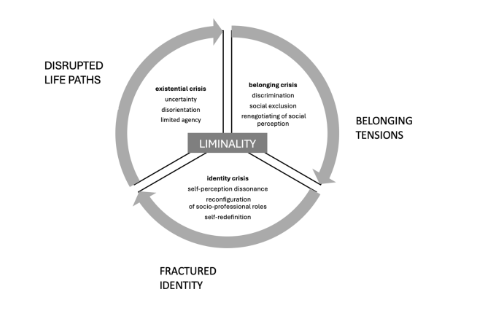
Source: own elaboration.
The multidimensional character of liminality demonstrates that it is not a uniform or monolithic condition – it is deeply shaped by the migrants’ socio-demographic positioning, including factors such as gender, age, class and socio-professional background. Recognising these intersecting factors allows for an understanding that middle-class, middle-aged Ukrainian women in Poland navigate displacement differently from other migrant groups and in other countries (see e.g. Kirk et al. 2017; Maxwell et al. 2024; Menin 2017; Scott et al. 2022; Weidenstedt et al. 2024).
Traditionally, liminality was defined as a transitional phase with a clear endpoint, culminating in the attainment of a new identity and social position (van Gennep 1909). Contemporary understandings, however, especially in the context of forced migration, challenge this linear model, emphasising its complex, fluid and evolving nature (Marotta 2025). Liminality shifts over time as migrants renegotiate agency, identity and belonging, developing new coping strategies and redefining their ties to both origin and new societies. It is thus a dynamic, ongoing process that continually (re)shapes migrants’ lives. Moreover, our research indicates that the state of liminality does not always lead to the formation of a hybrid or dual identity, as suggested by Tereshchenko (2024). In the context of forced migration, where individuals constantly struggle with rejection (Pandey and Limba 2023), such a choice is often not available. Migrants do not have the opportunity to freely integrate elements of their old and new identities, as their social position is negated by both sides – the origin country and societies of the country of residence. Such an experience does not lead to a harmonious blending of cultures but, rather, can reinforce the sense of exclusion and marginalisation, creating a state of ‘neither here nor there’, where identity becomes fragmented, incomplete and, in many cases, subject to a constant process of renegotiation.
To sum up, through a comprehensive in-depth analysis, we demonstrate that liminality is
a multidimensional, intersectional and dynamic process, marked by continuous shifts and transformations. Building on these insights, future research could further investigate how different socio-demographic factors – such as age, class, education and family responsibilities – interact with forced migration to shape the experience of liminality. Exploring the experiences of other groups, including men, younger migrants and those with different professional backgrounds, could provide a more comprehensive understanding of how forced migration generates liminality, revealing additional dimensions of this phenomenon. Comparative studies across various countries of residence could shed light on the role of national policies, labour-market structures and social attitudes in either mitigating or exacerbating this state. Moreover, qualitative longitudinal research would be particularly valuable in tracing the evolution of liminality over time, capturing the potential for transformation which it entails. In this article, we have focused on the individual experiences of liminality among Ukrainian women forcibly displaced to Poland. While we highlighted personalised stories, liminality emerged as a common thread connecting their narratives. Therefore, future studies should also examine the collective dimension of liminality within Ukrainian society – among those living abroad, those who decided to remain in a war-torn country and those who returned to Ukraine after spending a period of time abroad. Such an approach would not only generate new empirical insights but also advance the theoretical development of the concept of liminality.
Funding
This work was supported by the Polish National Science Centre through Grant no. 2020/37/B/HS6/02342 OPUS – ‘BigMig: Digital and Non-Digital Traces of Migrants in Big and Small Data Approaches to Human Capacities’ project.
Conflict of interest statement
No conflict of interest was reported by the authors.
Ethical considerations
The Ethics Review Committee at Kozminski University approved our interviews on 25 October 2022.
AI use disclosure
The authors used AI-assisted tools for the translation of selected fragments of the manuscript. All intellectual content, analysis, and responsibility remain with the authors.
ORCID IDs
Ivanna Kyliushyk  https://orcid.org/0000-0001-5347-649X
Dominika Winogrodzka  https://orcid.org/0000-0003-3905-6047
Emil Chról  https://orcid.org/0000-0003-3858-0533
References
Bammer A. (1994). Introduction, in: A. Bammer (ed.) Displacements: Cultural Identities in Question, pp. 11–20. Bloomington: Indiana University Press.
Baran M., Grzymała-Moszczyńska H., Zjawińska M., Sugay L., Pujszo I., Ovsiienko Y., Naritsa V., Niedziałek J., Boczkowska M. (2024). Superhero in a Skirt: Psychological Resilience of Ukrainian Refugee Women in Poland. A Thematic Analysis. International Journal of Clinical and Health Psychology: IJCHP 24(4): 100506.
Bastia T., Datta K., Hujo K., Piper N., Walsham M. (2022). Reflections on Intersectionality: A Journey Through the Worlds of Migration Research, Policy and Advocacy. Gender, Place and Culture 30(3): 460–483.
Blachnicka-Ciacek D., Trąbka A., Budginaite-Mackine I., Parutis V., Pustulka P. (2021). Do I Deserve to Belong? Migrants’ Perspectives on the Debate of Deservingness and Belonging. Journal of Ethnic and Migration Studies 47(17): 3805–3821.
Brun C. (2015). Active Waiting and Changing Hopes: Toward a Time Perspective on Protracted Displacement. Social Analysis 59(1): 19–37.
Chról E., Kyliushyk I. (2025). Where Do You See Yourself in 5 Years? Post-Migration Mobility of Ukrainian War Migrants, in: I. Grabowska, I. Kyliushyk, E. Chról (eds) Ukrainian Female War Migrants: Mobilising Resources for Prospective Social Remittances, pp. 152–189. Abingdon: Routledge.
Chwieduk A. (2022). ‘External Limbo’ – ‘Internal Limbo’. On the Detention of Immigrants in Polish Guarded Centres for Foreigners. Studia Migracyjne – Przegląd Polonijny 4(186): 129–156.
Clark-Kazak C. (2021). Ethics in Forced Migration Research: Taking Stock and Potential Ways Forward. Journal on Migration and Human Security 9(3): 125–138.
Cleton L., Scuzzarello S. (2024). Intersectional Migration Research: Re-Centring Governance Structures. International Migration 62(1): 343–346.
Dennler K.T. (2023). Uncertain Future, Unsettled Present: Suspending and Embracing Engagement with Life Among Newcomers in Toronto, Canada. Journal of Ethnic and Migration Studies 49(7): 1864–1880.
Elo M., Ermolaeva L., Ivanova-Gongne M., Klishevich D., Kothari T., Wiese N. (2024). Migrant Entrepreneurs: Strategic Approaches to Overcoming Liminality. International Small Business Journal 42(9): 1074–1102.
Fedyuk O., Kyliushyk I., Lashchuk I. (2023). New (Im)Possibilities for Agriculture and Domestic Services in Poland and Italy? Navigating Legal Solutions and Social Organisations’ Support for Ukrainian Women Displaced by The Full-Scale Invasion of Ukraine in 2022. Warsaw: Centre of Migration Research, University of Warsaw, CMR Working Papers 134, 192.
Górny A., Kaczmarczyk P. (2023). Between Ukraine and Poland. Ukrainian Migrants in Poland During the War. CMR Spotlight 2(48): 1–15.
Griffiths M., Rogers A., Anderson B. (2013). Migration, Time and Temporalities: Review and Prospect. Oxford: COMPAS, COMPAS Research Resources Paper.
Horvath A. (2015). The Genealogy of Political Alchemy: The Technological Invention of Identity Change, in: A. Horvath, B. Thomassen, H. Wydra (eds) Breaking Boundaries: Varieties of Liminality, pp. 72–92. New York, Oxford: Berghahn.
Horvath A., Thomassen B., Wydra H. (eds) (2015). Breaking Boundaries: Varieties of Liminality. New York, Oxford: Berghahn.
Jirka L., Kamionka M., Macková L. (2023). High-Skilled Precarity: The Situation of Ukrainian Refugees in the Czech Republic and Poland. Sociological Studios 2(23): 51–61.
Kilkey M., Ryan L. (2020). Unsettling Events: Understanding Migrants’ Responses to Geopolitical Transformative Episodes Through a Life-Course Lens. International Migration Review 55(1): 227–253.
Kirk K., Ball E., Janssen S.R. (2017). Migrants in Liminal Time and Space: An Exploration of the Experiences of Highly Skilled Indian Bachelors in Amsterdam. Journal of Ethnic and Migration Studies 43(16): 2771–2787.
Kyliushyk I., Chról E. (2025). Ukrainian Female Migration in a Historical Perspective, in: I. Grabowska,
I. Kyliushyk, E. Chról (eds) Ukrainian Female War Migrants: Mobilising Resources for Prospective Social Remittances, pp. 7–30. Abingdon: Routledge.
Kyliushyk I., Winogrodzka D., Chról E. (2025). Co-Creating Research Design: How to Achieve Participation in Social Studies Using Traditional Methods? Forum Qualitative Sozialforschung / Forum: Qualitative Social Research 26(3): 10.
Kyliushyk I., Winogrodzka D., Chról E. (2026). Making Sense of Forced Migration: The Scenarios of Meaning-seeking among Ukrainian Migrant Women in Poland. Journal of Refugee Studies.
Lulle A. (2024). Midlife Mobilities, in: V. Preston, S. McLafferty, M. Maciejewska, B. Yeo (eds) Handbook of Gender and Mobilities, pp. 128–137. Cheltenham: Edward Elgar.
Marotta V. (2025). Rethinking Liminality in Refugee and Migration Studies. Ethnicities 25(3): 1–19.
Maxwell C., Leybenson M., Yemini M. (2024). Managing Protracted Displacement: How Anchoring Shapes ‘Agency-In-Waiting’ Among Middle-Class Ukrainian Female Refugees in Berlin. International Sociology 39(4): 445–461.
Menin L. (2017). Suspended Lives: Undocumented Migrants’ Everyday Worlds and the Making of ‘Illegality’ Between Morocco and Italy, in: P. Gaibazzi, S. Dünnwald, A. Bellagamba (eds) EurAfrican Border and Migration Management: Political Cultures, Contested Spaces and Ordinary Lives, pp. 263–282. New York: Palgrave Macmillan.
Mijić A., Parzer M., Tkalich O., Zolotarova Y. (2024). Experiencing Forced Migration: Challenges of Arriving After Displacement from Ukraine. Journal of Ethnic and Migration Studies 50(14): 3396–3414.
Nowell L.S., Norris J.M., White D.E., Moules N.J. (2017). Thematic Analysis: Striving to Meet the Trustworthiness Criteria. International Journal of Qualitative Methods 16(1): 1–13.
Pandey S., Limba R. (2023). A Study of Cultural Hybridity and Liminality in the Works of Hala Alyan. Journal of Advanced Zoology 44(3): 1252–1258.
Peter L. (2024). Jointly Enclosed In-Between: The Collective Meaning of Liminality in Refugees’ and Other Migrants’ Mental Health Care. Anthropology and Medicine 31(1–2): 156–173.
Preston V., McLafferty S., Maciejewska M., Yeoh B. (eds) (2024). Handbook of Gender and Mobilities. Cheltenham: Edward Elgar Publishing.
Pustelnikovaite T. (2020). Locked Out, Locked In and Stuck: Exploring Migrant Academics’ Experiences of Moving to the UK. Higher Education 82: 783–797.
Ramachandran N., Vathi Z. (2022). Agency in Waiting? Everyday Tactics of Asylum Seekers and Refugees in Glasgow. European Journal of Social Work 25(6): 1104–1116.
Robertson S., Roberts R. (2022). Migrants ‘In-Between’: Rethinking Privilege and Social Mobility in Middle-Class Migration, in: S. Robertson, R. Roberts (eds) Rethinking Privilege and Social Mobility in Middle-Class Migration. Migrants ‘In-Between’, pp. 1–23. New York: Routledge.
Scott S., Jakobsen T., Rye J., Visser M. (2022). Labour Migration, Precarious Work and Liminality. Work in the Global Economy 2(1): 27–45.
Shen J. (2017). Stuck in the Suburbs? Socio-Spatial Exclusion of Migrants in Shanghai. Cities 60(B): 428–435.
Statistics Poland (2020). Populacja cudzoziemców w Polsce w czasie COVID-19. Główny Urząd Statystyczny. https://stat.gov.pl/obszary-tematyczne/roczniki-statystyczne/roczniki-st... (accessed 28 April 2026).
Szakolczai A. (2016). Permanent Liminality and Modernity: Analysing the Sacrificial Carnival through Novels. London: Routledge.
Tereshchenko O. (2024). Liminality in Migration. Skhid 6(3): 21–25.
Thomassen B. (2015). Thinking with Liminality: To the Boundaries of an Anthropological Concept, in:
A. Horvath, B. Thomassen, H. Wydra (eds) Breaking Boundaries: Varieties of Liminality, pp. 39–58. New York, Oxford: Berghahn.
Turner V. (1969). The Ritual Process: Structure and Anti-Structure. Brunswick, London: Aldine Transaction.
Ukrayinchuk N., Havrylchyk O. (2020). Living in Limbo: Economic and Social Costs for Refugees. Canadian Journal of Economics 53(4): 1523–1551.
USC (2024). Raport na temat obywateli Ukrainy (wg stanu na dzień 31 stycznia 2024 r.). Office for Foreigners. https://www.gov.pl/attachment/831fe2c9-ecbc-4c06-a9d5-7380e82457ea (accessed 29 April 2026).
Van Gennep A. (1909). The Rites of Passage. Chicago: The University of Chicago Press.
Weidenstedt L., Geissinger A., Leick B., Nazeer N. (2023). Betwixt and Between: Triple Liminality and Liminal Agency in the Swedish Gig Economy. Environment and Planning A: Economy and Space 56(4): 1280–1297.
Winogrodzka D., Kyliushyk I., Chról E. (2025). Mobility Capital Formation Among Forced Migrants: Experiences of Ukrainian Women in Poland. Migration Studies 13(2): 1–17.
Wolfensohn G. (2023). Liminal Lives: Gender and Diversity Assessment of Refugees from Ukraine in Moldova After One Year of Forced Displacement. Moldova: United Nations Entity for Gender Equality and the Empowerment of Women (UN Women), Moldova Country Office.
Appendix 1. Characteristics of IDI participants
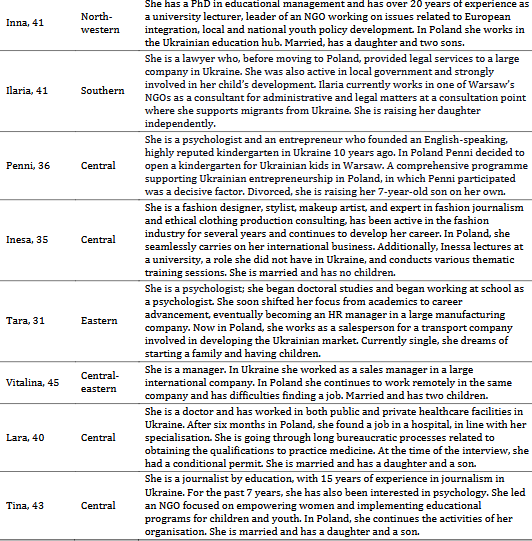
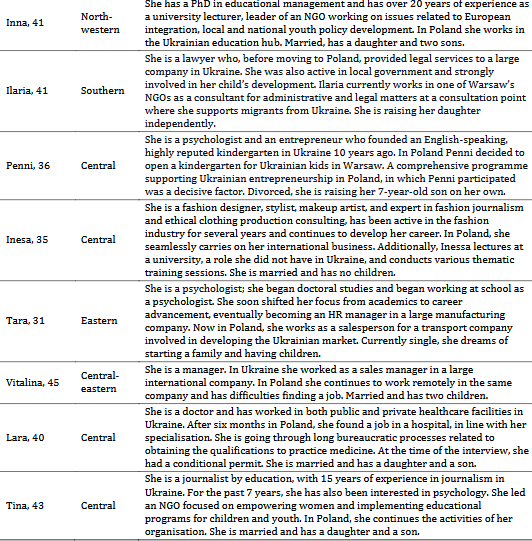
Copyright information
© The Author(s)
Open Access
This article is distributed under the terms of the Creative Commons Attribution 4.0 International License (http://creativecommons.org/licenses/by/4.0/), which permits unrestricted use, distribution, and reproduction in any medium, provided you give appropriate credit to the original author(s) and the source, provide a link to the Creative Commons license, and indicate if changes were made.
