



European Transnational Carers’ Lived Experiences and Perceptions of Workplace Policies in South-Western Ontario
-
Author(s):van Haaften, JacobSethi, BharatiWilliams-Habibi, SarahPublished in:Central and Eastern European Migration Review, Vol. 15, No. 1, 2026, pp. 179-198DOI: 10.54667/ceemr.2026.06Received:
14 August 2024
Accepted:27 February 2026
Views: 739
The lived experiences of Transnational Carer-Employees (TCEs) are becoming increasingly relevant to workplace scholarship surrounding caregiving. Furthermore, the conversations around Caregiver Friendly Workplace Policies (CFWPs) are growing due to their significance in helping caregivers to manage their care and work duties. In Canada, the growing immigrant population has led to an increased number of TCEs, yet their experiences remain understudied. The current qualitative study addresses the gap for a better understanding of TCEs experiences by exploring the lived experiences of European TCEs and their perception of CFWPs in Ontario, Canada. The findings suggest that European TCEs’ caregiving experiences are shaped by cultural expectations, including those based on gender. Participants provided practical, emotional and technology-based transnational caregiving. Their caregiving experiences were impacted on by their roles as paid employees. Transnational considerations such as travel time make negotiating paid work and caregiving complex. Participants reported overall positive experiences with their employers, regarding the accommodation of their needs to provide transnational care. However, there was a lack of awareness of CFWPs. Without these policies, TCEs and other carer-employees must navigate difficult conversations with employers in order to manage work expectations and caregiving responsibilities.
Introduction
The phenomenon of transnational caregiving is not novel in academic literature (e.g. Baldassar 2007; Dhar 2011; Giorgio and Alcantara 2021; Krzyżowski and Mucha 2013), yet it will continue to become more relevant in industrialised countries like Canada, where population growth is maintained by immigration (Government of Canada 2022). In 2021, immigrants accounted for 23 per cent of the Canadian population, with the nation’s growth expected to continue due to its reliance on immigration (Statistics Canada 2022a). It is noteworthy that, following the implementation of the points-based system, the rate of Europeans immigrating to Canada has declined (Statistics Canada 2022a). Most newcomers are of working age, young and visible minorities from Asia and the Middle East. The Employment Equity Act (2021, para. 18) defines visible minorities as ‘persons, other than Aboriginal peoples, who are non-Caucasian in race or non-white in colour’. However, Census Canada utilises the term ‘racialised’ to emphasise the process of racialisation (Statistics Canada 2022b); the visible-minority concept is currently under review (Statistics Canada 2024).
Racialised immigrants constitute four-fifths of labour-force growth and are expected to address Canada’s job vacancies (Statistics Canada 2022a). These job vacancies were 80 per cent higher post-pandemic. Many new immigrants are providing transnational care to their aging populations (Rottenberg, Seth and Williams 2023; Sethi, Williams and Leung 2022; Shahbaz, Williams, Sethi and Wahoush 2023). Understandably, recent research on transnational caregiving has primarily focused on the experiences of racialised immigrants. Yet, Bushnik, Tjepkema and Martel (2020) note that the substantial size of Canada’s aging European population will influence the health and socio-economic realities of many Canadians. As the Canadian population of European immigrants grow older so, too, will their loved ones across international borders. Global ageing is impacting on the increase in the number of caregiver-employees (CEs) in Canada and other industrialised nations (Hlebec, Monarres and Šadl 2024; Ireson, Sethi, Williams 2016; Sethi et al. 2022).
Defining caregiving and caregivers
Carer-Employees (CEs) are defined as:
family members and other significant people, who provide care and assistance to individuals (i.e. parent, spouse or life partner, adult child, sibling and/or friend) living with debilitating physical, mental and/or cognitive conditions, while also working in paid employment (Ireson et al. 2016: 1).
Due to evolving dynamics of caregiving based on factors such as technological advances, changing family structures, ageing populations, gendered roles in caregiving, increase labour mobility and increased migration (Bei, Zarzycki, Morrison and Vilchinsky 2021), the literature on informal (unpaid) caregiving from afar (Bei et al. 2021; Cagle and Munn 2012) and scholarship on eldercare in the context of transnational settings (Amin and Ingman 2014) has increased. In a recent study of immigrants caring for their family members in Europe, Shrestha, Arora, Hunter and Debesay (2023: 43) note: ‘Caregiving dynamics are changing, both in terms of motivations and approaches to caregiving’. These authors found that the lack of culturally sensitive policies has increased the care burden on immigrant families.
Distance Care Givers (DCGs) are individuals who are not living with their caregivers but provide informal care to adult family members or relatives who need help due to their physical and/or mental impairment across geographical distance within the same country (Bei et al. 2021). Transnational caregivers are individuals who provide unpaid care to family, friends or relatives with physical, mental and/or emotional health-care needs across international borders (Sethi et al. 2022). Despite the growth in literature on caregivers providing care to their families dispersed geographically across national or international borders, we do not know much about the experiences of caregivers working in paid employment in their country of migration and providing care to their family, friends and/or relatives across international borders. (Sethi et al. 2022)
Transnational Carer-Employees (TCEs) ‘provide unpaid/informal care across international borders to an adult family member, friend or relative with a disability and/or age-related needs, while also working in paid employment in the country of resettlement’ (Sethi et al. 2022: 427). Transnational caregiving can include any form of support, whether emotional, financial or moral (Sethi et al. 2022). Often, TCEs also have dependent family members to care for in Canada. TCEs differ from migrant care-workers who migrate to high-income countries such as Canada to address labour-market shortages and are paid for their employment (Marks 2024).
One of the issues in the international caregiving literature is the heterogeneity in definitions of caregiving and caregivers (Bei et al. 2021; Ireson et al. 2016; Sethi et al. 2022). With the growing ageing immigrant population worldwide, it can be expected that the number of TCEs in Canada and other nations will continue to rise (Rottenberg et al. 2023; Sethi et al. 2022). Further, due to the rising demand for paid and unpaid caregivers, Caregiver Friendly Workplace Policies (CFWPs) are necessary to support caregivers in being able to balance paid employment and unpaid caregiving. To address Canada’s caregiving crisis, the Canadian Centre for Caregiving Excellence (CCCE) has released a National Caregiving Strategy. One of the five priority areas is to support informal or family caregivers by encouraging employers to provide CFWPs across all federally regulated sectors (CCCE 2025). CFWPs are ‘intentional organisational changes, whether in practices, policies or the workplace culture, which relieve work–family conflict’ (Williams 2019: 1). CFWPs include policies such as flex and shared work, non-contiguous leaves, compressed work weeks, counselling, support groups and other workplace accommodations for CEs (Ireson et al. 2016). They are also called Family-Friendly Workplace Policies.
This article contributes to the growing scholarship on transnational caregiving – specifically on European TCEs’ experiences – and offers insights about TCE’s perceptions of CFWPs. The goal of this research was to continue to lift the voices of TCEs and advocate for workplace policies to help them to balance paid work and unpaid transnational caregiving. It is important to note that, in addition to providing transnational care, many TCEs also provide care to their families in Canada.
Context of the research
In the context of this study, we adopted both Hochschild’s (1983) and Thomas’ (1993) understandings of care, to define caregiving as a multifaceted concept and labour that draws upon emotional strength. In other words, individuals can both care about and care for others (Tronto and Fisher 1990). Although caring for and caring about individuals are not mutually exclusive, this study specifically examined TCEs who provide direct care to adults with age- or disability-related needs.
Some TCEs travel to their country of origin to provide personal care (e.g. Gui and Koropeckyj-Cox 2016; Heymann, Flores-Macias, Hayes, Kennedy, Lahaie and Earle 2009; Lahaie, Hayes, Piper and Heymann 2009). Others make informal care (having extended family or friends to help with groceries) or formal care (e.g. home-care visit) arrangements across international borders (e.g. Baldassar 2015; Brijnath 2009; Lee, Chaudhuri and Yoo 2015). Regardless, a transnational (between countries) and geographical context adds layers of complexity to how care is provided. Geographical distance is a foundational feature of transnational caregiving. Despite the challenges which this distance presents, family ties within the context of caregiving appear to remain strong (Baldock 2000). Gender also appears to play a role in TCEs’ caregiving experiences (Bernhard, Landolt and Goldring 2009; Lee et al. 2015). Cultural factors, in tandem with different international norms and policies of the immigrant’s country of origin, their country of resettlement and their employment status, all impact on the expectations of care and how it can be received and delivered. For TCEs, the workplace also fundamentally alters how care can be delivered (Merla and Baldassar 2016). The following sections detail the relevant literature on TCEs’ caregiving in the context of (1) geographical distance, (2) gender and culture, and (3) the workplace and CFWPs.
Geographical distance
Geographical distance provides new challenges as caregivers attempt to navigate complex healthcare and employment systems. While individuals can provide substantial emotional care virtually, they are more limited in their ability to help with ‘everyday’ practical matters (hands-on care: Kilkey and Merla 2013) such as dressing, cooking, cleaning and transportation. Nevertheless, due to technological advances, transnational caregivers play instrumental roles in establishing caregiving networks remotely (Brijnath 2009; Rottenberg et al. 2023). In some cases, transnational caregivers can arrange for caregiving (i.e. care coordination: Kilkey and Merla 2013) with family members and other loved ones still living in the same country as the person requiring support. However, transnational caregivers have expressed concerns about their loss of control over caregiving decisions, as they are no longer able to facilitate all caregiving needs (Amin and Ingman 2014). This can cause feelings of guilt as TCEs are not physically present to take care of their loved ones (Amin and Ingman 2014; Rottenberg et al. 2023).
At great geographical distances, transnational caregivers face other unavoidable challenges. For example, caregivers living in different time zones may find it difficult to organise communication times (Dhar 2011; Sethi 2022). Modern technologies can mediate some of these difficulties. For example, messaging platforms have provided more accessible international communication. Other technologies, such as shared calendars, can be beneficial for scheduling. Previous studies suggest that many transnational families rely on virtual platforms to maintain communication and sustain familial ties and bonds (Sethi et al. 2022). However, while the technologies serve as practical tools, they do not replace in-person interactions. Wilding (2006) expressed a sentiment felt by many transnational families – that, while technology ‘can increase feelings of psychological closeness, it does not completely eliminate the effects of geographical distance’ (as cited in Miyawaki and Hooyman 2021: 465). Some family members find this type of ‘information and communication technologies co-presence’ unsatisfying (Baldassar, Nedelcu, Merla and Wilding 2016: 133), suggesting that it cannot replace physical presence. Moreover, some individuals find that technology-mediated interactions remind them of the physical distance separating them from their loved ones (Madianou 2014). Furthermore, often, ‘physical separation causes participants’ struggles to be invisible to care recipients’ (Rottenberg et al. 2023: 5).
The COVID-19 pandemic also shed light on the difficulties of transnational (Rottenberg et al. 2023) and long-distance caregiving (Herbst, Schneider and Stiel 2022; Shahbaz et al. 2023) and highlighted the needs of caregivers, due to the shutdown and nation-wide quarantine policies. Many domestic caregivers (i.e. caregivers in their home country) felt frustration at their inability to participate in medical appointments and engage in in-person conversations; they also experienced limitations in advocating for their loved ones’ care (Sadler, Yan, Brauner, Pollack and Konetzka 2021).
While TCEs experienced challenges in providing care to their loved ones across international borders pre-pandemic, during the pandemic, border closures prevented them from travelling to their country of origin, even to attend a funeral (Rottenberg et al. 2023; Sethi 2022). Geographical distance is an identifying factor underlying all transnational caregiving. While modern technologies and techniques ease certain aspects of care, transnational caregivers still face limitations to the care they can provide across borders. Even with the advent of modern communication technologies and the intensified focus on long-distance caregiving due to the COVID-19 pandemic, the impacts of geographical distance deeply impact on the lives of transnational caregivers.
Gender and culture
Although caregiving expectations have shifted from what were once typical gender roles, recent studies have provided evidence of gender disparities in caregiving, with most caregivers being women (daughters, daughters-in-law or wives: Shrestha et al. 2023; Zygouri, Cowdell, Ploumis, Gouva and Mantzoukas 2021). Gender also plays a role in the type and quantity of caregiving expected from caregivers. For example, female caregivers spend more time providing emotional support to their loved ones than male caregivers (Amin and Ingman 2014; Shrestha et al. 2023; Zygouri et al. 2021). Studies have also shown that female transnational caregivers more often take leave from employment to travel to their loved ones to provide care compared to male transnational caregivers (Bernhard et al. 2009; Lee et al. 2015). Additional research has shown that caregiving is affected by overarching gender expectations and biases such as the stereotype that caregiving is a woman’s job (Shrestha et al. 2023; Wallroth 2016). For example, men find it difficult to assume caregiving roles because of stigma related to concepts of masculinity and needing to be the ‘breadwinner’ as opposed to the caregiver (Maynard, Ilagan, Sethi and Williams 2018). However, other research suggests that gender is less influential in caregiving than the practical capability of caregivers at the time of need (Miyawaki and Hooyman 2021). Notably, there is a lack of research which documents nationality and ethnicity as driving factors contributing to the differences in gender expectations, as they relate to caregiving broadly (Radziwinowiczówna, Rosińska and Kloc-Nowak 2018) and TCEs roles more specifically (Sethi et al. 2022).
Cultural obligations and family values are also motivating factors for transnational caregivers (Miyawaki and Hooyman 2021; Ran and Liu 2021; Sethi et al. 2022). Scheffler (2007) defines culture as the informal and formal connections between customs, institutions, rituals, values, beliefs, practices and norms. The importance of kinship and filial piety is a consistent theme within transnational research (Sethi, Williams, Desjardins, Zhu and Shen 2018). Obligations to fulfill these duties are often culturally constructed (Baldassar 2015). For example, there is a distinct tradition of care expectations in Chinese families regarding filial piety, suggesting that children are expected to provide care for their ageing parents (Gui and Koropeckyj-Cox 2016; Sethi 2022; Sethi et al. 2018).
These same cultural expectations – or the perception of them – can lead to feelings of guilt in transnational caregivers. For example, transnational caregivers feel an expectation to provide financial support to their families, and this sense of duty is often influenced by cultural pressures and outside perceptions of industrialised nations being lands of wealth and opportunity (Liu and Ran 2021). During COVID-19, TCEs were unable to provide money as they had lost their jobs. This led to increased feelings of guilt as remittance is the primary form of caregiving that many TCEs provide (Rottenberg et al. 2023).
The role of the workplace
The COVID-19 pandemic highlighted the caregiving crisis. In their recommendation to the federal government for a National Caregiving Strategy, CCCE (2025: 4) note: ‘Caregiving takes a significant toll on caregivers’ physical, mental and financial wellbeing: caregivers in Canada are past their breaking points, just as care needs are increasing across the country’. Given the significant contribution that caregivers make to the Canadian economy, employers must get more engaged in supporting CEs to remain in their profession and be able to provide care.
Research suggests that CFWPs tailored to immigrant workers, including flexible family leave, could alleviate some of the pressures imposed by travel time (Ireson et al. 2016; Miyawaki and Hooyman 2021). Notably, there are substantial differences in the experiences of TCEs within different work environments. For example, larger businesses with human-resource departments are sometimes more likely to offer CFWPs (Vuksan, Williams and Crooks 2012a, b). Without CFWPs and other similar support systems in place, TCEs and other caregiver employees are limited in their ability to provide care. Likewise, they often suffer work-related consequences which also impact on their employers – such as premature retirement, health problems, reduced productivity and other costs to employers (Peters and Wilson 2017).
Despite evidence supporting the need for CFWPs to help caregivers remain in the workplace there appears to be a lack of policies and programmes currently in place for TCEs within the workplace (Amin and Ingam 2014; Sethi et al. 2022); those that are in place are not always well-understood by employees (Peters and Wilson 2017). In fact, even when policies do exist, immigrant workers are often ineligible for caregiving benefits (Miyawaki and Hooyman 2021). As Canada continues to rely on immigrants to address its labour shortage (Statistics Canada 2019), CFWPs must be designed to help TCEs balance paid work, transnational caregiving and caregiving to their family in Canada.
Methodology
Aims
The study discussed herein is part of a larger 5-year research programme addressing gender, health and CFWPs. The larger research programme also recruited caregivers from other demographic groups (Sethi and van Haaften 2025; Shahbaz et al. 2023). The overall goals of the current study were: 1) to explore the lived experiences of European TCEs in London, Ontario; and 2) to examine TCEs’ understanding and knowledge of CFWPs within their workplaces. London is a city in South-Western Ontario, Canada, with a population of 422,324 (Statistics Canada 2021).
Recruitment, participants and data collection
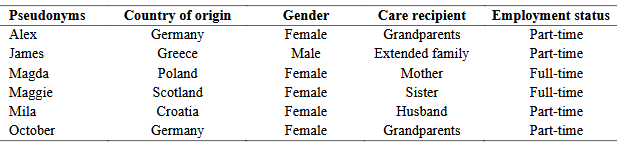
This study employed purposive and snowball sampling techniques (Morse 2007; Vasileiou, Barnett, Thorpe and Young 2018). The second author has built a substantial research programme in London, Ontario – and a research assistant (RA) emailed to contacts from this programme a flyer with the study information. Individuals were invited to participate if they were 18 years of age or older, living in London, Ontario, working, identified as European and were a caregiver to a family member or friend in their country of birth. Six participants were recruited for this study. Even though we made efforts to recruit people from different ethnicities who identified as European, we only received interest from white participants. It may be that immigrants from the European regions in the study area are largely white or it may be that our recruitment strategy did not adequately reach non-white European immigrants. Participants’ demographics are displayed in Table 1. While this is a small sample size, the study was conducted during COVID-19 health-care restrictions. Likewise, it is possible that the ageing nature of European immigrants in Canada did not fit the inclusion criteria for the study, as they were no longer working.
An RA conducted one-to-one 60–90-minute recorded interviews over Zoom, following interviewing techniques that were intensively culturally informed (Charmaz 2006). This method suited the interpretive inquiring nature of the study as it allowed for detailed and direct conversations about the topic at stake. The RA employed open-ended questions as prompts, thus allowing for an in-depth exploration of the participants’ experiences of transnational caregiving (Charmaz 2006). The interview questions were broadly captured in four categories:
- The challenges and opportunities of transnational caregiving
- The economic, social and health impact of transnational caregiving
- The cultural and gendered expectations of caregiving
- The participants’ knowledge and use of CFWPs at their workplace.
Table 1. Participant demographics
Data analysis
The authors employed Braun and Clarke’s (2006) thematic analysis for the initial analysis of the study data. Specifically, the researchers familiarised themselves with the interview transcripts through thorough re-reading. In Phase 1, the first author of this paper familiarised himself with the interview transcripts. In Phase 2, he generated initial codes from the data using NVivo 14. These codes were reviewed by the second and third authors. In Phase 3, codes were compiled into themes and subthemes. In Phase 4, these themes were reviewed collaboratively by the three authors, in the context of the transcripts, for comprehensiveness. In Phase 5, the final themes were solidified. This use of themes ensured that the interview data could be dissected in a meaningful way.
To further explore the data, the authors also applied foundational latent content analysis, a methodology for examining non-verbal communication established by Bales (1951). Building on what Potter and Levine-Donnerstein (1999) term ‘latent projective variables’, the authors documented their subjective interpretations of how key pieces of data (i.e., interview responses) were delivered, including tone of voice and other non-verbal clues (such as tone of voice), to explore potentially richer evaluations of the data. Potter and Levine-Donnerstein (1999: 258) also suggest that ‘content analyses need not be limited to theory‐based coding schemes and standards set by experts’. Therefore, the analyses of non-verbal data presented in this manuscript are meant not to replace but to enrich the existing thematic analyses. Specifically, the authors have provided insights into the data based on their impressions of the participants’ non-verbal communications. These analyses are presented and marked throughout the thematic analysis where relevant. Notably, most of the participants had a video on during the recording of their Zoom interview. However, one participant (Mila) did not. Therefore, non-verbal observations in that interview are limited to audio only.
Ethics
This study received approval from the McMaster University Research Ethics Board (MREB # 4881, 24 July 2018) and the King’s University College Research Ethics Review Committee (21 June 2019). Informed consent from participants was obtained through Qualtrics. The participants were informed of their right to withdraw from the study at any time without consequences. They selected pseudonyms to ensure their anonymity. The RA also made available to the participants a comprehensive resource list of community supports with up-to-date contact information. This was put in place in case participants experienced any distress during or after the interview. Participants were offered a $35 (CAD) honorarium for their participation in the study.
Author(s) positionality statement
Before we present the findings and in the spirit of reflexivity, we first present the positionality statement. A researcher’s positionality is important to acknowledge as:
…it necessitates the researcher consciously examining their own identity to allow the reader to assess the effect of their personal characteristics and perspectives in relation to the study population, the topic under study and the research process, the effect of their personal characteristics and perspectives in relation to the study population, the topic under study and the research process (Wilson, James and Williams 2022: 44).
There are three authors for the current study. The first is of European descent and male. The second is a female racialised immigrant who has been engaging in transnational care for over 15 years. She led the data collection and analysis processes and supervised the Research Assistant. The RA involved in the data collection process was of European descent. She kept a reflexive journal throughout the data collection process to remain conscious of how her positionality may impact on the research process (Ruokonen-Engler and Siouti 2013; Wilson et al. 2022). For example, the shared European ancestry of the RA conducting interviews may have influenced the data collection process to some extent. However, meaningful member-checking by giving participants the opportunity to provide feedback on the transcripts (McKim 2023) and peer-debriefing (Johnson, Crosschild, Poudrier, Foulds, McHugh, Humbert and Ferguson 2020) with the second author throughout the data collection process served as a valuable tool to reflect on potential biases and assumptions. The third author is a female racialised second-generation immigrant; her family has engaged in transnational care throughout her life. The three authors engaged in peer-debriefing throughout the data analysis process and contributed to data interpretation and implications of the study results.
Results
The thematic analysis identified three overall themes: (1) cultural expectations and gender roles, (2) multifaceted caregiving and (3) the role of the workplace and CFWPs.
Cultural expectations and gender roles
Participants in this study stated that their cultural identity played a role in their beliefs about and willingness to participate in unpaid care. Alex suggested that caring for family members is a part of her German identity. Further, James recounted that, in Greece, family comes first. The structure of the TCEs’ families is deeply informed by cultural expectations and can drastically influence the way that caregivers identify themselves. For example, three participants noted that there was no difference in the quality of care they provided to their transnational family and the family in Canada, meaning they did not prioritise one over the other. One participant reflected: ‘I have a sick husband, so I was taking care of him, helping him to get through life and helping my son and my daughter as well, trying to help as much as I can. Taking care of myself, it’s always last’ (Magda). This participant is the primary caregiver of her family in Canada, which extends to the role she feels she must play in a transnational context. This cohesion between caregiving roles across countries is also apparent in another participant’s reflections on how close he feels to his family. James commented: ‘I mean, it’s like I don’t distinguish between the levels of family, like, if I feel someone is my family, they are close to me’. He further reflected that ‘in the old days, like, they all lived in the same house’. Based on these responses, family members are close regardless of their genealogical separation. Other participants reported that caregiving had been part of their upbringing:
[My mother] had taken care of my grandparents when, um, my grandmother had Parkinson’s and so I was introduced at a very early age to caregiving: helping with bathing, general basic, um, care in the home, big farmhouse … they would take us at every opportunity to care for old relatives and they might be close by or away in the highlands … it was just a very colourful but compassionate introduction to that we gained from our parents (Maggie).
From a non-verbal perspective, Maggie delivered this statement nonchalantly. That is, when describing family caregiving and illness in her childhood, she presented the experiences as a normal part of her upbringing. This statement was delivered in an unchanging tone. Based on this, Maggie appeared to expect this type of engagement with caregiving from a young age.
While there appeared to be a strong connection between individual family values and caregiving practice, there were also challenges. Mila reflected that, for her parents, ‘it’s really hard to admit that they need help. They think they can do everything for themselves but it’s hard’. However, James, reflecting on the capacity of his family to ask for help, noted:
There’s just always open lines of communication, there’s daily, like, calls to my grandmother, my aunts, it’s, like, we’re always there for each other whether people like that or not. I mean sometimes it’s like our families tend to be intrusive okay [laughter] so we’re always in each other’s business’.
James delivered this statement with a big smile on his face; his comments about intrusiveness were not made in frustration. Based on the way he presented this response, it seems that he likes the family closeness. For example, even though they are apart geographically (James’s family is in Greece), they often pray together. Overall, there seems to be an appreciation of the importance of family and caring for family members; however, in some cases, it can be difficult to maintain these helping relationships because of pride.
For some participants, specific cultural factors impacted on their caregiving expectations – independent of gender roles and familial expectations – such as closeness with family. For example, Alex identifies the cultural impact of ‘family cohesion’ when discussing her caregiving family efforts, noting that she and her friends stay in contact with loved ones in Germany, ‘assuming it is partially cultural’. For Alex, it is an expectation that she remain in contact with her family members in Germany. However, she was initially hesitant to describe this as a cultural expectation. Nevertheless, through further probing, there was acknowledgement that such family cohesion across geographical distance was related to culture as she also has German friends who felt the same way. This manifested itself through pauses to reflect on the discussion and interruptions to her speech, such as ‘um’. James also alluded to the cultural forces that tie family members to caregiving efforts when discussing the typical dispersal patterns of families in Greece, noting ‘they are a very family-oriented society. I mean even if they do move far, they visit as much as they can’.
Mila felt that, at a societal level, there were marked differences in attitudes towards and values of caregiving between Canada and Croatia, particularly for the elderly. She shared that ‘in Europe it’s like a natural progression of things and how people are aging that means they are going to stay in the home and their children and their grandchildren are going to take care of them’. She further explained that ‘North America is, like, a little bit different … people here, they are afraid of retiring and going to a retirement home and nobody even considers whether the kids will take care of their parents when they are older’. In Croatia, it is a cultural expectation for the elderly to be cared for by their family, which is reflected in their strong welfare system. Mila suggested that there is less of an expectation for future generations to care for their elderly loved ones in Canada than in Croatia. Not unlike Mila’s sentiments, October observed that there is a difference in caregiving expectations between Canada and Europe. She noted that ‘friends [her] age, um, there’s only really one friend here that I can think of who’s taking care of her grandparents … Whereas [she knows] that European families, if you’re not helping out your grandma or grandpa, you’ll be sent to hell – at least that’s what they think’. October ended this observation with laughter, suggesting that, while she does not necessarily believe that she would be sent to hell if she did not help her family members, the expectation is deeply engrained in her family’s culture. For TCEs of European descent in Canada, caregiving is greatly influenced by cultural factors and family histories and structures.
Cultural expectations shaped gender roles. Below, the findings demonstrate how transnational caregiving responsibilities were gendered and influenced by culture. Five of the study’s participants were female. Two of the participants shared that they are expected to provide care due to being female. For example, one participant expressed surprise and gratefulness for her brother’s contributions:
…my brother. He doesn’t have to do it, and he’s still doing it… So I’m really grateful to my brother because he took the initiative and he’s cooking and cleaning at home and I’m really surprised that he stepped up and he planned to do this (Magda).
Magda further added: ‘…I think it’s a woman and women always do more than the man. In Poland that man is the head of the family. The man usually makes more money’. There did not appear to be any resentment in Magda’s tone or gestures as she related these gendered expectations. Magda sighed when she explained that there simply was not an expectation for men to contribute to these types of task. She also shrugged her shoulders when she said: ‘Women always do more than the man’. Indeed, her gratefulness for her brother’s contributions was substantial and sincere.
When asked about how caregiving duties are divided, one participant reflected: ‘My elder sister and I – and my brother to a lesser extent, a much lesser extent – it’s usually the sisters that have done the support’ (Maggie). She felt that she and her sister contributed more to caregiving efforts. She also shared that she ‘wasn’t just caregiving [or] supporting [her] family overseas. But [she] was caring for [her] in-laws here … [her] husband’s parents’. She reflected that it ‘was taking a huge toll, so yes, you’re just torn in every direction’ (Maggie). Further reflecting on her brother’s contributions, Maggie shared that ‘It was a big relief for [her] when [she] found out that [her] brother would just step up and start doing this extra work at home – he never did it before’.
Multifaceted caregiving
This theme explained three forms of care that participants engaged in: practical care, emotional care and technology-based care. The realities of transnational caregiving limit the types of practical care that caregivers can provide. In this study, practical caregiving served a functional role, including organising events and appointments, providing financial support and participating in daily activities.
Because of the transnational context and scheduling limitations due to work, TCEs often find it difficult to organise care for their care recipients. Alex shared that ‘the time difference with Germany is six hours, so being able to find a time to talk with them would usually be in the morning. But I usually work in the mornings, so a little bit complicated that way – finding time, I guess, for everything’. Alex’s tone and expressions during this part of the interview displayed frustration and sadness with the practical difficulties she experienced in providing transnational care. Alex shared these thoughts with multiple pauses and her tone was very pessimistic. Transnational realities, such as time changes and conflicting work schedules, may make it challenging for carers to connect with their loved ones synchronously. While these challenges pose limitations for all types of care, they make planning events and scheduling services particularly difficult.
Other participants shared that they provide financial care to their loved ones. However, the money does not help with ensuring that their loved ones receive proper care. Mila reflected that ‘If you don’t have anyone to employ to take care of you … that’s the hardest part in the whole process. I can send money but she doesn’t have anybody to employ to help her out’. If her loved ones are unable to put the money to practical use, it is not particularly helpful. Mila’s sombre and somewhat annoyed tone of voice conveyed her frustration and lack of control over her ability to arrange care for her loved ones.
This desire to provide practical care to their loved ones is mirrored in other participants’ stories. October shared that she ‘would prefer to go to doctor’s appointments and [she’d] love to be able to drive them places as well … but [she] can’t do it and there’s not a real way of [her] being able to manage that too from [Canada]’. October further expressed the guilt she feels when asking for help because she cannot provide practical care to her loved ones: ‘Something that wouldn’t be a big deal for me to go and get groceries for them might be a huge deal for somebody else because it takes, like, valuable time out of their day’.
While providing practical care for loved ones is very important, the emotional aspects of caregiving are also critical. This caregiving can take the form of phone and video calls, text messaging, emails and sending gifts as expressions of love. However, the transnational context also poses a challenge to emotional caregiving, such as a lack of physical presence. Magda reflected that ‘It’s completely different when you see somebody and talk to somebody just over the phone’. For the TCEs in this study, there appears to be a marked difference in experience between providing emotional care in-person and at a distance. This longing was expressed in Magda’s statement: ‘It is challenging because we don’t see each other and that human touch which … I think that’s something she is missing from her side and I’m missing from here you know, just to touch her and hug her; everybody needs a hug or touch from time to time’. Throughout the interviews, all participants expressed frustration about and guilt over their inability to properly provide emotional care transnationally. The conversations about the lack of control and the feeling of helplessness in the various interviews were often quieter and subdued, indicating that this issue has a particularly emotional significance.
The advent of modern communication technologies has drastically affected the caregiving landscape. These technologies have been very beneficial for TCEs. Some participants were grateful for their access to internet-based communications due to the significant cost savings they allow compared to long-distance calling. Likewise, Magda shared her appreciation for the increased ease of online shopping: ‘Buying on the internet a few years ago wasn’t as easy but, now, if you know what they need, some food, some other clothes or some medical supplies, it’s easier for me to buy online and just send it to them’. Alex also shared that her family has made efforts to keep her and other transnational members of the family informed through Zoom and other technologies: ‘My family members are trying to make it over Zoom… so my whole family here can watch and sort of be a part of it … there’s an attempt to keep us involved’. Yet, however helpful these technologies can be, they still present limitations and challenges to providing emotional and practical care. For example, October said that ‘There’s only so much that [I can do] over a phone call ... I can support them emotionally but I’m not actually there to help them out physically’. Likewise, the advanced technologies still cannot replace in-person caregiving in terms of its emotional value (Baldassar et al. 2016).
Role of the workplace and CFWPs
Central to studies concerning TCEs is the role of the workplace and the supports available to help caregivers to balance paid employment and family caregiving. Below we discuss this theme, based on participants’ workplace experiences and their knowledge of CFWPs. Overall, all participants reported positive experiences with their supervisors when they needed to take time off or limit their shifts due to caregiving responsibilities. For example, Alex shared: ‘I’ve had pretty good experiences with [my supervisor] ... I could usually just tell him what’s going on and he would make sure that I don’t have to work or whatever it is’. Alex works at a large company’s branch location and also reported that she ‘hadn’t really heard other people, at least at [their] store, having problems [with their manager]’. James shared similar sentiments about his workplace, reporting that they encouraged him to ‘take the time [he] needs’. Likewise, Mila shared that her workplace has a ‘really really good approach’ and she is ‘grateful to them for being there in that hard situation’.
While October’s direct experience with the employer was positive, her narrative suggests that she was upset that her mother’s employer was rigid and did not accommodate caregiving responsibilities. October worked part-time at the time of the interviews; she said that the part-time nature of her work was important because of the flexibility it provided. However, October notes ‘… when my mom tried to talk to her boss about this [and say] “I have to go help out my dad because he’s getting surgery”... they’re not that flexible and, in fact, they get kind of angry with her about it’. October’s facial expressions and the tone of her voice conveyed her frustration at the lack of support afforded to her mother at work. We asked participants if they were aware of any CFWPS to accommodate individuals who must leave work or alter their schedule to provide care for loved ones, particularly for transnational caregiving. While participants had not heard of CFWPs, they were able to relate to specific accommodations that the employers provided. Alex shared that, at his workplace, employees are given the option to round up their purchases and the excess change is placed into a fund dedicated to employees who may need support. This fund is then distributed to individuals to cover missed work shifts. However, this is not a policy specifically designed to cover the costs of caregiving leave. Instead, it is a discretionary fund for managers to distribute to an employee in need.
Mila suggested that her union provided some assurance: ‘We have a really good union and our union rules, I know I can take some time off to take care of my elderly parents if it’s needed’. Similarly, Magda felt confident that she would be given time off if she needed it but she was unaware of CFWPs:
I’m not aware of something like this but I can tell you if, for example, if I need a vacation and I need more than everybody else is taking, I never have a problem getting a longer vacation, so I could use, for example, four weeks at once … I’m sure that they will work it out with me. I will have to negotiate some stuff but I am sure that they will, they will provide.
Overall, the participants in this study were confident in their ability to obtain time off if needed but they were not aware of any protocols or policies designed to accommodate or protect transnational caregivers.
Discussion
This paper contributes to the burgeoning literature on TCEs. As we indicated previously, to our knowledge, this is the first study which is exclusively focused on European TCEs in North America. There is also little literature on the role of CFWPs in supporting caregivers. Although immigration rates in Canada from European nations are decreasing (Statistics Canada 2016), current European immigrant populations in Canada continue to play a pivotal role in the Canadian economy (Bushnik et al. 2020). As many European immigrants in Canada are also TCEs, we must continue to investigate how best to support this population. This discussion is based on the three overarching themes that we previously discussed in the paper.
Cultural expectations and gender roles
Similar to the cultural expectations regarding caregiving responsibilities which our participants identified, earlier studies have linked caregiving responsibilities and roles to cultural expectations (e.g. Sethi et al. 2022). For example, in a recent meta-ethnography study with older immigrants’ family members in Europe, a participant of Turkish origin said: ‘It is partly inspired by culture, partly by religion and our faith dictates that we must continue to look after our parents until the end’ (Shrestha et al. 2023: 11). Gui and Koropeckyj-Cox (2016) outline that Chinese immigrants in North America feel a specific responsibility to care for their ageing parents. Other research has found that, for many caregivers, cultural identity significantly impacts on their decision to provide care and the type of unpaid care they provide to family members (Miyawaki and Hooyman 2021; Ran and Liu 2021).
Rottenberg et al. (2023) make the important observation that culture intersects with gender to determine caregiving roles. Similarly, our results suggest that gender plays an important role in participant’s caregiving relationships. Overall, the findings of our research are consistent with the consensus of much caregiving literature, that gender significantly impacts on who provides care. In our study, two female participants directly voiced the larger caregiving responsibility they have as women. This phenomenon is mirrored across other caregiving literatures. In a scoping review, Ferrant, Pesando and Nowacka (2014) found that women contribute 2 to 10 times the amount of time to unpaid care work compared to men. In a transnational context, some female Polish immigrants in Germany feel constrained by societal pressures for women to act as caregivers and, therefore, provide the majority of unpaid care (Barglowski, Krzyżowski, Świątek 2015). In this study, Magda, a Polish immigrant in Canada, expressed her immense gratitude for her brother’s contributions to caregiving as, in Poland, men are typically seen as breadwinners and do not engage in unpaid/family care.
Multifaceted caregiving
Our study results identified practical, emotional and technology-based care. While not necessarily referred to in the same terms, these themes are present in much transnational literature. Sethi et al. (2022: 447) defined practical caregiving as ‘performing instrumental activities by paying actual visits … planning for home care … medical care’ and they reflect that ‘practical care is the only form of transnational care that cannot be provided on a regular basis by both parties’. Participants in this study shared several difficulties relating to this type of care, including Alex’s reflection on trying to connect with someone and organise events from a different time zone. Likewise, October revealed her desire to have FaceTime with her loved ones. The inability to be present in in-person care can also limit the benefits of financial support, as Mila outlined in her comments on the difficulty of hiring caregiving support in her home country. Although TCEs can send money, they cannot control how the money is used. This lost sense of control has also been observed in other transnational studies. Amin and Ingman (2014) reported that Bangladeshi immigrants living away from their country of origin felt like they had less control over the care which their loved ones were receiving.
Consistent with much of the transnational literature, our participants also engaged in emotional caregiving (Amin and Ingman 2014; Brijnath 2009). In this study and many others, much transnational caregiving is conducted over the phone or through other communication technologies (Sethi et al. 2022). However, participants in this study emphasised the limited nature of this type of emotional caregiving. Magda and Mila both reflected on feeling that the technology-assisted conversations could not replace true, in-person contact. This is also consistent with other research suggesting that technologies are not true replacements for human contact (Baldassar et al. 2016). Yet other participants in this study, like Alex, felt grateful for technology like Zoom as it allowed her to have some form of contact with family members who have now adopted these technologies for their own use.
The role of the workplace and CFWPs
Understanding the workplace culture, specifically in relation to workplace support, is necessary to help TCEs stay in their employment. Caregivers’ ability to manage work–family balance relies ‘heavily on supervisors’ understanding of the caring situation, encouraging working carers to ask for and take advantage of organisational or institutional measures’ (Hlebec et al. 2024: 3). On a daily basis, TCEs try to maintain a balance between employment in Canada and providing care across international borders. In this study, overall the participants had good experiences within their workplaces. However, none of the participants had heard of CFWPs nor were aware of how they were implemented. Nevertheless, there were other, more general, policies that supported them to do their unpaid caregiving duties. This suggests that general workplace flexibility (or policies that support their employees, more generally) is also supportive of carer employees. Alex discussed a ‘round-up policy’ in her workplace, which enabled employees to contribute to a fund to support their co-workers in times of need. Likewise, Mila believed that her union provides the necessary policies and support for employees engaged in caregiving. Ultimately, as has been observed in other research, there was an overall lack of awareness of carer policies, let alone TCEs-specific workplace policies (Ireson et al. 2016).
As we noted earlier, the Canadian Centre for Caregiving Excellence (CCCE) has unveiled a National Caregiving Strategy, highlighting five key priority areas. One of these focuses on supporting informal or family caregivers by advocating for the implementation of CFWPs within all federally regulated sectors (CCCE 2025). Current evidence also illustrates the health benefits and cost-effectiveness of CFWPs in employment – including worker satisfaction – and, thus, reduced absenteeism (Hlebec et al. 2024; Ireson et al. 2016; Lorenz, Whittaker, Tazzeo and Williams 2021; Rottenberg et al. 2023; Wang, Williams and Kitchen 2018).
Study implications and future directions
While some of our findings are consistent with existing research on transnational caregiving, such as the gendered nature of care, this paper contributes to the literature related to TCEs with special attention given to European TCEs’ experiences in London, Ontario. We also highlighted the importance of cultural factors in caregiving identity, the different types of care that TCEs provide and the need for a better understanding of CFWPs especially targeted to meet the needs of TCEs. Future research should continue to explore the overall experiences of TCEs from a wider range of ethnic identities. Likewise, wider studies could include comprehensive reviews of how gender-based expectations of care differ among cultures and transnational contexts. Future research should also continue to examine TCEs’ understandings of CFWPs as well as employers’ perspectives on offering CFWPs to their employees. This could lead to the development of specific recommendations for employers to accommodate TCEs within their workplaces. Evidence-based studies are needed to explore the relationship between remote work and its impact on employee productivity across major industry sectors.
Limitations
While this study has contributed to the growing literature on TCEs, particularly European TCEs, it is not without limitations. The study was conducted solely in London, a city in South-Western Ontario, Canada. Furthermore, the sample size of this study was comparatively small (n = 6) and not representative of the entirety of European TCEs’ experiences in Canada. While we provided insights about TCEs’ experiences from six different countries (see Table 1), we cannot draw definitive conclusions about culture based on the experiences of one individual. Consequently, larger studies should investigate these same questions with the heterogeneity of the participant population (age, class, gender, country of origin, etc.) in order to gather information about the diversity of their experiences. Studies with a larger sample size can help to draw pan-European conclusions. Similarly, this study explored the experiences of white European TCEs, whose experiences may be different from visible minority European TCEs. Furthermore, from the perspective of CFWPs, it is important to explore European and racialised TCEs’ experiences in different occupations (healthcare, education, etc.). For example, the study by Ireson et al. (2016) found that the availability of CFWP in the workplace is based on the company’s culture, size and motivation. While caregiving is gendered, more men are engaging in informal caregiving; thus, understanding immigrant men’s experiences, specifically, in a female-dominated industry, is vital to support this population in transnational care (Ireson et al. 2016). Further studies can also explore how countries of origin impact on TCEs’ experiences in Canada. Scholars may also consider undertaking a longitudinal study to explore TCEs’ experiences over time.
Conclusion
Future research can explore whether the sectors of the labour force, workplace diversity (e.g., ethnicity, race, gender, employment status, etc.) and other factors (such as workplace culture) impact on the perceived flexibility of workplaces. Canada is becoming increasingly transnational and culturally diverse and the global population is ageing. Amid these demographic and cultural shifts, Canada and other industrialised nations will continue to rely on immigration to address their skilled labour shortages. The COVID-19 pandemic highlighted the caregiving crisis. The current study has demonstrated that the type and nature of transnational caregiving are dependent upon cultural expectations. While men are also providing transnational care, caregiving continues to be gendered. CFWPs in the form of flexible work arrangements, remote work, paid leave and support services are fundamental to the promotion of caregivers’ work–life balance and address the caregiving crisis. Targeted services are necessary to support TCEs as they manage their employment with caregiving duties in Canada and their country of origin.
Funding
This research was supported by the CIHR/SSHRC Healthy Productive Work Partnership Grant ‘Scaling up the Career Inclusive Accommodating Organizations Standard’ FRN: HWP-146,001 (CIHR); 890-2016- 3018 (SSHRC).
Conflict of interest statement
No conflict of interest was reported by the authors.
AI use disclosure
Artificial Intelligence was not used in any part of the paper writing and publication process.
ORCID IDs
Jacob van Haaften  https://orcid.org/0000-0003-3608-4640
Bharati Sethi  https://orcid.org/0000-0002-8349-5517
Sarah Williams-Habibi  https://orcid.org/0009-0000-1955-0828
References
Amin I., Ingman S. (2014). Eldercare in the Transnational Setting: Insights from Bangladeshi Transnational Families in the United States. Journal of Cross-Cultural Gerontology 29(3): 315–328.
Baldassar L. (2007). Transnational Families and the Provision of Moral and Emotional Support: The Relationship Between Truth and Distance. Identities 14(4): 385–409.
Baldassar L. (2015). Guilty Feelings and the Guilt Trip: Emotions and Motivation in Migration and Transnational Caregiving. Emotion, Space and Society 16: 81–89.
Baldassar L., Nedelcu M., Merla L., Wilding R. (2016). ICT-Based Co-Presence in Transnational Families and Communities: Challenging the Premise of Face-To-Face Proximity in Sustaining Relationships. Global Networks 16(2): 133–144.
Baldock C. (2000). Migrants and Their Parents: Caregiving from a Distance. Journal of Family Issues 21(2): 205–224.
Bales R.F. (1951). Interaction Process Analysis. Cambridge: Addison Wesley.
Barglowski K., Krzyżowski Ł., Świątek P. (2015). Caregiving in Polish–German Transnational Social Space: Circulating Narratives and Intersecting Heterogeneities. Population, Space and Place 21(3): 257–269.
Bei E., Zarzycki M., Morrison V., Vilchinsky N. (2021). Motivations and Willingness to Provide Care from a Geographical Distance, and the Impact of Distance Care on Caregivers’ Mental and Physical Health: A Mixed-Method Systematic Review Protocol. BMJ Open 11(7): e045660.
Bernhard J.K., Landolt P., Goldring L. (2009). Transnationalizing Families: Canadian Immigration Policy and the Spatial Fragmentation of Care-Giving among Latin American Newcomers. International Migration 47(2): 3–31.
Braun V., Clarke V. (2006). Using Thematic Analysis in Psychology. Qualitative Research in Psychology 3(2): 77–101.
Brijnath B. (2009). Familial Bonds and Boarding Passes: Understanding Caregiving in a Transnational Context. Identities 16(1): 83–101.
Bushnik T., Tjepkema M., Martel L. (2020). Socioeconomic Disparities in Life and Health Expectancy among the Household Population in Canada. Health Reports 31(1): 3–14.
Cagle J.G., Munn J.C. (2012). Long-Distance Caregiving: A Systematic Review of the Literature. Journal of Gerontological Social Work 55(8): 682–707.
Canadian Centre for Caregiving Excellence (2025). A National Caregiving Strategy for Canada. https://canadiancaregiving.org/wp-content/uploads/2025/02/National-Care-... (accessed 16 May 2026).
Charmaz K. (2006). Grounded Theory, in: J. Smith (ed.) Qualitative Psychology: A Practical Guide to Research Methods, pp. 81–110. London: Sage.
Dhar V.E. (2011). Transnational Caregiving: Part 1, Caring for Family Relations across Nations. Care Management Journals 12(2): 60–71.
Employment Equity Act (2021). https://laws-Lois.justice.gc.ca/eng/acts/E-5.401/page-1.html#h-215195 (accessed 16 May 2026).
Ferrant G., Pesando L.M., Nowacka K. (2014). Unpaid Care Work: The Missing Link in the Analysis of Gender Gaps in Labour Outcomes. https://doi.org/10.1787/1f3fd03f-en (accessed 16 May 2026).
Giorgio L., Alcantara C. (2021). 175 Household and Transnational Caregiving and Sleep in Latinx Adults: The Modifying Effects of Employment Status. Sleep 44(S2): A71–A71.
Government of Canada (2022). New Immigration Plan to Fill Labour Market Shortages and Grow Canada’s Economy. https://www.canada.ca/en/immigration-refugees-citizenship/news/2022/02/n... (accessed 16 May 2026).
Gui T., Koropeckyj-Cox T. (2016). ‘I Am the Only Child of My Parents’: Perspectives on Future Elder Care for Parents among Chinese Only-Children Living Overseas. Journal of Cross-Cultural Gerontology 31(3): 255–275.
Herbst F.A., Schneider N., Stiel S. (2022). Long-Distance Caregiving at the End of Life: A Protocol for an Exploratory Qualitative Study in Germany. BMC Palliative Care 21(1): 69.
Heymann J., Flores-Macias F., Hayes J.A., Kennedy M., Lahaie C., Earle A. (2009). The Impact of Migration on the Well-Being of Transnational Families: New Data from Sending Communities in Mexico. Community, Work and Family 12(1): 91–103.
Hlebec V., Monarres M.H., Šadl Z. (2024). Working Carers in Europe and How Their Caring Responsibilities Impact Work-Family Life Conflict: Analysis of the European Quality of Life Survey. Healthcare 12: 2415.
Hochschild A.R. (1983). The Managed Heart: Commercialization of Human Feeling. Berkeley, CA: University of California Press.
Ireson R., Sethi B., Williams A. (2016). Availability of Caregiver-Friendly Workplace Policies (CFWPs): An International Scoping Review. Health and Social Care in the Community 26(1): e1–e14.
Johnson S.R., Crosschild T., Poudrier J., Foulds H.J.A., McHugh T.L., Humbert L., Ferguson L.J. (2020). ‘It’s a Big Adjustment Coming from the Reserve to Living in a Totally Different Society’: Exploring the Well-Being of First Nations Athletes Playing Sports in an Urban Mainstream Context. Psychology of Sport and Exercise 47: 101614.
Kilkey M., Merla L. (2013). Situating Transnational Families’ Care‐Giving Arrangements: The Role of Institutional Contexts. Global Networks 14(2): 210–229.
Krzyżowski Ł., Mucha J. (2013). Transnational Caregiving in Turbulent Times: Polish Migrants in Iceland and Their Elderly Parents in Poland. International Sociology 29(1): 22–37.
Lahaie C., Hayes J.A., Piper T.M., Heymann J. (2009). Work and Family Divided across Borders: The Impact of Parental Migration on Mexican Children in Transnational Families. Community, Work and Family 12(3): 299–312.
Lee Y.S., Chaudhuri A., Yoo G.J. (2015). Caring from Afar: Asian H1B Migrant Workers and Aging Parents. Journal of Cross-Cultural Gerontology 30(3): 319–331.
Liu L.S., Ran G.J. (2021). A Conceptual Framework Studying Transnational Immigrant Family Experiences: The Phenomenon of Chinese Seasonal Parents/Grandparents in New Zealand. Population, Space and Place 28(4): e2527.
Lorenz F., Whittaker L., Tazzeo J., Williams A. (2021). Availability of Caregiver-Friendly Workplace Policies: An International Scoping Review Follow-Up Study. International Journal of Workplace Health Management 14(4): 459–476.
Madianou M. (2014). Polymedia Communication and Mediatized Migration: An Ethnographic Approach, in: K. Lundby (ed.) Mediatization of Communication, pp. 323–348. Berlin: de Gruyter.
Marks E. (2024). Migrant Workers in the Care Economy. Geneva: International Labour Organization.
Maynard K., Ilagan C., Sethi B., Williams A. (2018). Gender-Based Analysis of Working-Carer Men: A North American Scoping Review. International Journal of Care and Caring 2(1): 27–48.
McKim C. (2023). Meaningful Member-Checking: A Structured Approach to Member-Checking. American Journal of Qualitative Research 7(2): 41–52.
Merla L., Baldassar L. (2016). Concluding Reflections. ‘Care Circulation’ in an Increasingly Mobile World: Further Thoughts. Papers: Revista De Sociologia 101(2): 275.
Miyawaki C.E., Hooyman N.R. (2021). A Systematic Review of the Literature on Transnational Caregiving: Immigrant Adult Children to Ageing Parents in Home Country. Journal of Family Studies: 29(1): 453–470.
Morse J. (2007). Sampling in Grounded Theory, in: A. Bryant, K. Charmaz (eds) The SAGE Handbook of Grounded Theory, pp. 229–244. Thousand Oaks, CA: Sage.
Peters I., Wilson K. (2017). The Business Case for Employers Supporting Carers: Reflecting on a UK Model. International Journal of Care and Caring 1(3): 415–420.
Potter W.J., Levine‐Donnerstein D. (1999). Rethinking Validity and Reliability in Content Analysis. Journal of Applied Communication Research 27(3): 258–274.
Radziwinowiczówna A., Rosińska A., Kloc-Nowak W. (2018). Ethnomorality of Care: Migrants and Their Aging Parents (1st edition). Abingdon: Routledge.
Ran G.J., Liu L.S. (2021). Re-Constructing Reverse Family Remittances: The Case of New Chinese Immigrant Families in New Zealand. Journal of Ethnic and Migration Studies 49(1): 313–331.
Rottenberg S., Sethi B., Williams A. (2023). Transnational Caring in Times of COVID-19: The Experiences of Visible Minority Immigrant Carer-Employees. Wellbeing, Space and Society 4: 100129.
Ruokonen-Engler M.-K., Siouti I. (2013). ‘Doing Biographical Reflexivity’ as a Methodological Tool in Transnational Research Settings. Transnational Social Review 3(2): 247–261.
Sadler T., Yan K., Brauner D., Pollack H., Konetzka R.T. (2021). Caregiving during COVID-19: A Multi-State Qualitative Study of Family Caregiver Experiences and Decision Making. Health Services Research 56(S2): 14–15.
Scheffler S. (2007). Immigration and the Significance of Culture. Philosophy and Public Affairs 35(2): 93–125.
Sethi B. (2022). Negotiating Culture, Geographical Distance, and Employment: The Lived Experiences of European Transnational Carer Employees. Wellbeing, Space and Society 3: 100083.
Sethi B., van Haaften J. (2025). Holistic Experiences of Indigenous Carer-Employees in Southern Ontario. Journal of Indigenous Social Development 13(3): 84–110.
Sethi B., Williams A., Desjardins E., Zhu H., Shen E. (2018). Family Conflict and Future Concerns: Opportunities for Social Workers to Better Support Chinese Immigrant Caregiver Employees. Journal of Gerontological Social Work 61(4): 375–392.
Sethi B., Williams A., Leung J.L.S. (2022). Caregiving across International Borders: A Systematic Review of Literature on Transnational Carer-Employees. Journal of Cross-Cultural Gerontology 37(4): 427–461.
Shahbaz R., Williams A., Sethi B., Wahoush O. (2023). Commonalities and Differences in the Experiences of Visible Minority Transnational Carer–Employees: A Qualitative Study. International Journal of Environmental Research and Public Health 20(18): 6800.
Shrestha S., Arora S., Hunter A., Debesay J. (2023). Changing Dynamics of Caregiving: A Meta-Ethnography Study of Informal Caregivers’ Experiences with Older Immigrant Family Members in Europe. BMC Health Services Research 23(1): 43.
Statistics Canada (2016). Canadian Demographics at a Glance, Second Edition. https://www150.statcan.gc.ca/n1/en/pub/91-003-x/91-003-x2014001-eng.pdf?... (accessed 16 May 2026).
Statistics Canada (2019). Population Projections for Canada (2018 to 2068), Provinces and Territories (2018 to 2043). https://www150.statcan.gc.ca/n1/pub/91-520-x/91-520-x2019001-eng.htm (accessed 16 May 2026).
Statistics Canada (2021). London Ontario Census Profile, 2021 Census of Population. https://open.canada.ca/data/en/dataset/750e6035-adf8-4426-966f-4c25b12a999e (accessed 16 May 2026).
Statistics Canada (2022a). Profile Table, Census Profile, 2021 Census of Population – Canada [Country]. https://www12.statcan.gc.ca/census-recensement/2021/dp-pd/prof/details/p... (accessed 16 May 2026).
Statistics Canada (2022b). Visible Minority and Population Group Reference Guide, Census of Population, 2021. https://www12.statcan.gc.ca/census-recensement/2021/ref/98-500/006/98-50... (accessed 16 May 2026).
Statistics Canada (2024). Visible Minority Concept Consultative Engagement. https://www.statcan.gc.ca/en/consultation/2022/visible-minority-concept (accessed 16 May 2026).
Thomas C. (1993). De-Constructing Concepts of Care. Sociology 27(4): 649–669.
Tronto J., Fisher B. (1990). Toward a Feminist Theory of Caring, in: E. Abel, M. Nelson (eds) Circles of Care, pp. 36–54. New York: SUNY Press.
Vasileiou K., Barnett J., Thorpe S., Young T. (2018). Characterising and Justifying Sample Size Sufficiency in Interview-Based Studies: Systematic Analysis of Qualitative Health Research over a 15-Year Period. BMC Medical Research Methodology 18(1): 1–18.
Vuksan M., Williams A.M., Crooks V.A. (2012a). The Workplace Perspective on Supporting Family Caregivers at End of Life: Evaluating a New Canadian Social Program. Community, Work and Family 15(3): 317–333.
Vuksan M., Williams A., Crooks V. (2012b). Family Friendly Policies: Accommodating End‐of‐Life Caregivers in Workplaces. International Journal of Workplace Health Management 5(1): 4–14.
Wallroth V. (2016). Men Do Care! A Gender-Aware and Masculinity-Informed Contribution to Caregiving Scholarship (1st edition). Linköping: Linkopings Universitet.
Wang L., Williams A., Kitchen P. (2018). Health of Caregiver-Employees in Canada. International Journal of Workplace Health Management 11(6): 382–394.
Wilding R. (2006). ‘Virtual’ Intimacies? Families Communicating Across Transnational Contexts. Global Networks 6(@): 125–142.
Williams A. (2019). Caregiver-Friendly Workplace Policies Fact Sheet. Hamilton, Ca: McMaster University.
Wilson C., James G., Williams J. (2022). Identity, Positionality and Reflexivity: Relevance and Application to Research Paramedics. British Paramedic Journal 7(2): 43–49.
Zygouri I., Cowdell F., Ploumis A., Gouva M., Mantzoukas S. (2021). Gendered Experiences of Providing Informal Care for Older People: A Systematic Review and Thematic Synthesis. BMC Health Services Research 21(1): 730.
Copyright information
© The Author(s)
Open Access
This article is distributed under the terms of the Creative Commons Attribution 4.0 International License (http://creativecommons.org/licenses/by/4.0/), which permits unrestricted use, distribution, and reproduction in any medium, provided you give appropriate credit to the original author(s) and the source, provide a link to the Creative Commons license, and indicate if changes were made.
