



All By Myself? The Self-Responsibilisation of Young Migrants for Integration: Insights from Poland
-
Author(s):Kyliushyk, IvannaWinogrodzka, DominikaTrąbka, AgnieszkaBlachnicka-Ciacek, DominikaPietrusińska, MartaPublished in:Central and Eastern European Migration Review, Vol. 15, No. 1, 2026, pp. 139-162DOI: 10.54667/ceemr.2026.04Received:
2 December 2024
Accepted:27 February 2026
Views: 497
In migration studies, integration is predominantly conceptualised by scholars as a ‘two-way’ process. In practice, however, migrants are increasingly being held responsible for integration. In this article, grounded in qualitative data from Poland – collected between 2021–2022 from young migrants and representatives of NGOs and public institutions supporting migrants – we explore how they perceive and experience this process. We argue that, influenced by neoliberal discourses of individuality, migrants often view the challenge of integration as their personal responsibility – a phenomenon we refer to as self-responsibilisation. Thus, we identify and analyse three intersecting and mutually reinforcing processes: 1) the shift of responsibility for integration onto young migrants as a consequence of state negligence, 2) the asymmetry of responsibility as a result of the host society’s othering of migrants and 3) self-responsibilisation as a consequence of migrants’ internalisation of responsibility for integration. Together, they form what we call the self-perpetuating mechanism of (self)responsibilisation of young migrants for integration. Our analysis indicates that this mechanism may lead to the empowerment of young migrants although it can also foster the normalisation of structural constraints, hinder the migrants’ access to available support, increase stress and may even contribute to deteriorating mental and physical health.
Introduction
A growing body of scholarship recognises the importance of conceptualising integration with migrants as a ‘two-way’ process involving not only the migrants’ own efforts but also the active engagement of the host society and the state (Kehoe, Alisic and Heilinger 2019; Klarenbeek 2021). Similar calls have emerged in the rapidly changing Polish migratory context (Podgórska, Grzymała-Kazłowska, Łukasiewicz and Pachocka 2024). However, while public discourse and opinion polls in Poland reveal a strong expectation for migrants to integrate into the host country, for instance by learning the Polish language and adopting local rules and values (Karaś and Traczyk 2025), the responsibility of the host society, along with the institutional frameworks that enable integration, remains largely unfulfilled.
Poland’s integration policies remain fragmented and underdeveloped (Łodziński and Szonert 2023), despite a substantial increase in immigration since the country’s accession to the European Union (EU) in 2004 (Okólski 2021). This increase has been driven not only by rapid economic development – and the resulting demand for labour – but also by the continued emigration of Polish citizens and the accelerating ageing of the population. At the time that our research was conducted – prior to the forced migration from Ukraine to Poland following Russia’s full-scale invasion in 2022 – the number of migrants in Poland stood at 2,106,101, including 1,351,418 Ukrainian nationals (Cope, Keryk and Kyliushyk 2021). A significant proportion (38 per cent) of these were young people aged 21–30. After the full-scale Russian invasion of Ukraine in early 2022, around 1 million forced migrants from Ukraine found temporary protection in Poland.
Despite the rapid growth of the migrant population, especially after 2022, Poland still lacks a coherent, long-term integration policy. Although a migration strategy for 2025–2030 was adopted in late 2024, it has not resulted in the development of a comprehensive integration framework. Poland also has no official state-level definition of integration. The current Migration Strategy (2024) frames integration mainly as migrants’ adaptation to majority norms and values. Its emphasis on ‘avoiding the mistakes of other states’ and preventing ‘alternative social structures’ in this process reinforces a narrative of risk and control. The role of the state is outlined only in general terms, centred on security and institutional efficiency, with no specific instruments, sectoral responsibilities or service standards. As a result, integration is presented primarily as a tool for avoiding social tensions rather than supporting equitable participation. The strategy further defines successful integration as ‘when a migrant communicates in Polish, respects the law and prevailing norms and values and actively participates in local community life’, without clarifying the roles of the state or society in enabling this.
In effect, the strategy reflects an assimilationist perspective that places the burden of integration primarily on migrants – a tendency repeatedly highlighted in expert assessments by migrant-support organisations. As stated in the Position of the Polish Migration Consortium1 on the government’s migration strategy, the approach adopted in the governmental document ‘violates the right of migrants to preserve their own cultural identity and is at odds with the principles of equality and respect for diversity’ (Konsorcjum Migracyjne 2024). Witold Klaus (2025) describes the state’s approach to integration in a similar way: ‘The state abdicates when it comes to integration. It has no ideas on how to do it and allocates no resources for this purpose. (…) When we talk about the definition of integration, we most often refer to it as a two-way process. Therefore, it is not only people with migration experience who integrate but society also changes and integrates with them. This latter aspect is completely absent from the Polish debate, as well as from the Polish migration strategy’.
Researchers describe this kind of situation as an example of an ‘integration policy without policy’ (Łodziński and Szonert 2023). Consequently, the limited measures that have been implemented focus almost exclusively on the labour market, while many other areas relevant to integration – such as assistance in legalising residence, the adaptation of public services to migrants’ needs, language acquisition, cultural orientation and, crucially, efforts to foster host-society integration – remain neglected (Migdał, Sułkowski and Zając 2020).
This situation is rooted in the fact that Polish migration law and practice prioritise temporary employment and residence – responding to the demands of the labour market, while simultaneously hindering migrants’ prospects for long-term settlement (Cope et al. 2021). In response, local authorities – particularly in urban areas – have assumed a degree of responsibility, often in collaboration with non-governmental organisations (NGOs), to provide various forms of support aimed at facilitating integration with migrants (Migdał et al. 2020). However, their capacity to do so has been constrained, primarily due to a lack of stable and continuous funding for integration initiatives. Insufficient state support is increasingly being replaced by support from the private sector, which has commercialised, for instance, assistance in legalising stay (Kindler and Wójcikowska-Baniak 2018). This shift also transfers responsibility onto migrants, as they must pay for such services.
Moreover, research indicates that Polish society faces significant challenges in the integration of migrants, with the latter experiencing widespread discrimination and social exclusion – particularly of individuals from non-EU countries (Jaskulowski and Pawlak 2019; Thérová 2023). Migrants in Poland encounter racism, prejudice, stereotyping and a range of social barriers to integration. These social attitudes towards migrants are both a cause and a consequence of negative governmental narratives. Official government discourse has been dominated by hostility towards migrants (Arendas, Trąbka, Messing, Pietrusińska and Winogrodzka 2023), contributing to the stigmatisation of the term ‘migrant’ in public debate (Janicki and Świętek 2025). This occurs even though the number of migrants legally working and residing in Poland continues to grow steadily. The lack of a coherent integration policy results in migrants being at a higher risk of marginalisation or exposure to multiple forms of exclusion and vulnerability (Oliveira, Nienaber, Bissinger, Gilodi, Richard and Albert 2024).
As a result, we observe a mechanism whereby the burden of integration is shifted onto individual migrants, rather than addressing systemic barriers and collective responsibilities (Kehoe et al. 2019). Migrants often internalise this expectation, perceiving integration as their personal task. This is particularly evident among young migrants entering adulthood (Oliveira et al. 2024), who face additional pressures tied to individual success, amplified by neoliberal narratives of productivity and self-betterment (Binkley 2014; Ikonen and Nikunen 2019; Kelly 2006; Sultana 2024). In this article, through the in-depth qualitative analyses of interviews with young migrants and representatives of NGOs and other public institutions – primarily those supporting migrants – we demonstrate both the multifaceted causes and complex consequences of the processes of responsibilisation and self-responsibilisation for integration.
Firstly, we situate the concept of responsibilisation within broader debates on integration in migration studies and propose our understanding of the process of self-responsibilisation. Following the discussion of our methodology, we present the results of our empirical analysis, structured around a cause-and-effect model, focusing on three key dimensions: the state’s legislative framework, host-society relations with migrants and migrants’ individual perspectives. We conclude by developing and discussing a model of the self-perpetuating mechanism of (self)responsibilisation, which helps to explain how the task of integration is shifted onto and internalised by migrants.
Integration and (self)responsibilisation in the context of migration studies
At the outset of the article, we want to briefly discuss three concepts crucial to our further reasoning, namely integration, responsibilisation and self-responsibilisation. To begin with, we acknowledge that ‘migrant integration’ has been a widely debated and contested concept in migration studies (Favell 2003; Grzymala-Kazlowska and Phillimore 2017) with significant policy-relevant implications (Dodevska 2024). It has been criticised as normative and assuming that there is a natural path of progression, which migrants need to follow to become part of host societies. The shift in integration policies from welfare-state models to a neoliberal approach in many Western countries has introduced a discourse of migrant individualisation, activation and responsibilisation for their broadly understood integration (Uehling 2015).
More-recent theorising has recognised that integration, to be successful, needs to be a ‘two-way process’ and involve the effort undertaken not only by migrants (Kehoe et al. 2019; Klarenbeek 2021; cf. Grabowska, Hansen, Jastrzebowska, Lind, Manafi, Nienaber, Powell and Shahrokh 2025) but also by the state and host society. The state, at all levels of government, establishes the legal, political and institutional frameworks that regulate access to employment and to social and political rights; it ensures inclusive public services by removing administrative barriers and strengthening institutional capacities through regular staff training. The state also shapes evidence-based public opinion about migrants, helping to counter misinformation and negative stereotypes. The host society, through everyday interactions, social norms and civic organisations, co-creates the space and conditions for integration with migrants. In a two-way process, residents’ attitudes, willingness to engage and recognition of diversity underpin trust-building, reduced social distance and migrants’ improved sense of inclusion. Research shows that societal attitudes are among the strongest determinants of the integration process, meaning that society’s role extends beyond passive acceptance to the active collective shaping of an equitable and participatory environment (Atalay, Korkut, Nicolson, Scholten and Laidlaw 2023).
Other researchers have described integration as ‘liquid’, driven by multi-directional processes and multifaceted dimensions (Skrobanek and Jobst 2022). Most recently, Adrian Favell (2022) argued that the concept of ‘migrant integration’ derives from the desire rooted in colonial history for the nation states to uphold (racial) hierarchies. Some scholars propose rethinking the entire concept of integration by situating it in the broader dynamics of societal inequality and the efforts to reduce it (cf. Klarenbeek 2024).
If there is one thing about integration that the vast majority of authors agree on is that it is a very broad and multidimensional – even ‘fuzzy’ – concept (Ager and Strang 2008; Grzymala-Kazlowska and Phillimore 2017). Thus, instead of attempts to elaborate one definition of integration that would cover its different meanings, numerous concepts or ‘operational definitions’ – as Ager and Strang (2008) call them – were formulated. What is worth highlighting is the broad understanding of integration in these concepts. For instance, Ager and Strang’s framework is composed of 10 domains, including not only employment, citizenship/legal status or social bonds but also health, sense of safety and stability etc. Another promising stream of research on integration is aimed at grasping migrants’ own understanding of this notion and what it means to be integrated (Biaback Anong, Skrobanek, Wagner and Nienaber 2023; Erdal 2013). It appears that migrants apply a broad definition of integration that is (or, rather, should be) a two-way process which does not exclude transnational practices and, moreover, is connected with notions of wellbeing. The latter is particularly notable in the case of young migrants. As Regalia, Giulani, Carones and Matuella (2022: 79) put it: ‘Overall, they seem to think of being integrated as feeling at home, delving into the cultural and historical aspects of the host country and feeling good’.
For the purposes of this article, we operationalise the definition of integration in line with the proposal of the International Organization for Migration (IOM 2017), which defines integration as:
The two-way process of mutual adaptation between migrants and host societies, in which migrants are incorporated into the social, economic, cultural and political life of the receiving community. Such integration entails a set of shared responsibilities for both migrants and host communities (...). Integration is a cross-cutting and multi-sectoral issue that relates to policy areas addressing the economic, social, legal, cultural and civic spheres and affects all aspects of migrants’ lives.
We adopt this broad approach to integration, as it proves useful for understanding young migrants’ experiences of the ‘double transition’ (Oliveira et al. 2024). This concept refers to the simultaneous engagement in two major life processes: (1) the transition to adulthood, including micro-transitions such as completing education, entering the labour market and potentially forming an independent household or family; and (2) integration with a new socio-cultural environment. For young migrants, these two processes intersect, creating a compounded set of challenges which they must navigate.
Moving beyond this broad understanding of integration, responsibilisation emerges as a second pivotal theoretical concept for this article, a term rooted in the field of governmentality (Juhila and Raitakari 2016). It describes the process of making the private sector and civic society, as well as individuals, responsible for public tasks where, previously, public institutions played an active role. The term responsibilisation is strongly associated with neoliberal discourses (O’Malley 2009). While, in the welfare-state approach, citizens, including migrants, were supported (Joppke 2024), in the neoliberal approach it is the citizens and migrants who are made responsible, meaning that they are expected to manage their own risks and demonstrate self-care (Liebenberg, Ungar and Ikeda 2015; Pyysiäinen, Halpin and Guilfoyle 2017).
Some authors link this process with practising one’s autonomy, choice, self-governance (Barnett 2003) and self-entrepreneurship (Juhila and Raitakari 2016), which is a consequence of the requirements of an individualised society (Bauman 2005). Other authors associate responsibilisation with the process of shifting societal problems onto individuals (Uehling 2015) and the privatisation of risk (Miller and Rose 2008). Citizens who fail to manage their own lives and demonstrate self-governance may be marginalised or excluded from society. Moreover, governmental organisations and NGOs implementing projects that foster responsibilisation may, through their institutional practices and evaluative framework, contribute to the production of divisions among their clients into those ‘deserving’ and those ‘undeserving’ of support (Juhila and Raitakari 2016). This means that they define who is expected to become a responsible citizen after receiving support and who will fail to become one. This approach is also evident in the migration discourse, which categorises migrants into groups according to their perceived deservingness (Ratzman and Sahraoui 2021).
Beyond prevailing societal attitudes and discourses surrounding migrants in the host society (Kehoe et al. 2019), several other factors have been identified in migration studies as contributing to the responsibilisation of migrants for their integration. The first factor is the way in which national and local policies are designed, along with the integration frameworks they establish, which define both what integration entails and how it should be achieved (Pettrachin, Caponio and Borgna 2024). These policies, often influenced by a broader neoliberal discourse, frequently frame integration predominantly in terms of economic participation and self-reliance (Suvarierol 2015). Secondly, another source of responsibilisation of migrants is the criminalisation of migration. Due to this process, migrants who chose an undocumented path of entry or stay in the country are held responsible for their marginalisation and lack of access to integration tools (Innes 2013). Finally, transnational connections and the expectations and hopes of migrants’ families who remain in their home countries further contribute to this burden of responsibilisation (Castles 2013).
When connecting the themes of integration with young migrants and the responsibilisation for this process, a clear pattern emerges: when examining the attitudes of young migrants towards their ‘integration task’, we often observe an internalisation of responsibility. This fosters the preconception that it is primarily the young migrants’ duty to become ‘integrated’ and active members of the host society. We refer to this process as ‘self-responsibilisation’. This concept entails the belief that everyone is the architect of their own destiny and that success or failure depends solely on one’s actions and efforts (Juhila and Raitakari 2016; Sofritti, Benozzo, Carey and Pizzorno 2020). Migrants internalise this view, which motivates or forces them to exert effort in adapting to the new socio-political environment (Blachnicka-Ciacek, Trąbka, Budginaite-Mackine, Parutis and Pustulka 2021; Winogrodzka, Trąbka and Pietrusińska 2024). Such an attitude is strongly influenced by neoliberalism (Sultana 2024) and its related discourses of the entrepreneurial self and employability (Juhila and Raitakari 2016; Sofritti et al. 2020). Although these discourses are nowadays increasingly contested by the younger generation, as evidenced in recent studies (Mind the Gap 2024), they remain prevalent. We can assume that instability on the labour market, associated with migratory experiences, reinforces these attitudes (Winogrodzka 2025).
Neoliberal discourses shape the way of thinking, behaving and, in consequence, experiences of young migrants as they navigate the integration process in host countries. These discourses, rooted in the principles of extreme individualism and self-reliance, promote a view of the individual as a self-managing subject, fully and utterly responsible for his or her own success and well-being but also for their failures. In line with the requirements of the modern world, young people should be ambitious, calculating, goal-defining, resilient, adaptable and action-taking (Bröckling 2015; Kelly 2006). They also should embody the ‘right mindset’ characterised by openness, positive thinking, happiness, gratefulness and growth orientation (Binkley 2014; Ikonen and Nikunen 2019). These attributes collectively foster their ability to adapt, develop and thrive in a new socio-economic context, laying the foundation for a ‘successful’ integration experience.
Methods and data
This article draws on empirical material collected between 2021 and 2022 for the Horizon 2020 research project ‘MIMY: Empowerment through Liquid Integration of Migrant Youth in Vulnerable Conditions’, which focuses on the integration processes of young migrants living in nine European countries: England (UK), Germany, Hungary, Italy, Luxembourg, Norway, Poland, Romania and Sweden. The qualitative part of the research was conducted with the involvement of peer researchers at different stages of the project (Blachnicka-Ciacek, Winogrodzka and Trąbka 2025). The article addresses several research questions: How do the processes of responsibilisation and self-responsibilisation of young migrants for integration manifest? What are their underlying causes and what consequences do they have for young people? During the following analysis, we offer a comprehensive understanding of the multifaceted (self)responsibilisation phenomena and their impact on the lives of young migrants.
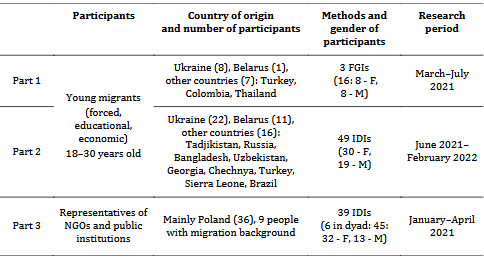
We draw on the results of the complementary parts of qualitative research with two groups. The first group consisted of 65 young migrants (18–30 years old) who had lived in Poland for a minimum of one year and had different migration experiences (see Table 1). In this group there were three sub-groups – forced, educational as well as economic migrants – who experience a particular kind of vulnerability.2 The purpose of delineating these three subgroups in the study was to ensure that a range of trajectories and migration experiences were covered. While we acknowledge the fundamental differences in the life situations and legal statuses of forced and voluntary migrants, our analysis does not treat these categories as analytically isolated from one another. Rather than assuming shared experiences, we focus on recurring themes related to integration and responsibility. Most interviewees were Ukrainian or Belarusian, as migrants from these two countries make up most migrants in Poland (Górny and Kindler 2023). In our study, we also conducted 39 interviews with 45 representatives of NGOs and other public institutions who were mainly those supporting migrants – like the employment office, schools, integration centres, social welfare and cultural centres.
We conducted most of our interviews in two main locations: Warsaw (capital city) and a small town near Gdańsk. However, some interviews were also carried out with migrants residing in other Polish cities, such as Poznań, Kraków and others. In the first stage of the project, we recruited representatives of NGOs and selected public institutions with the aim of having a diversified sample of institutional actors supporting migrants. Interviews with them were held in the first part of 2021 while interviews with young migrants took place between March 2021 and February 2022. Thus, forced migrants who arrived after the full-scale Russian aggression against Ukraine were not included in our study. Participants were recruited mainly through peer researchers’ networks, complemented by occasional NGO/institutional contacts and snowball sampling.
The interviews with young migrants included questions about their migratory experiences and, more specifically, the various factors which they perceive as opportunities and constraints along their integration journey. With NGOs’ and public institutions’ representatives, we talked about their activities and services available for and problems faced by migrants, as well as about the challenges and facilitators of integration processes.
Table 1. Sample characteristics in the four parts of the study
Source: Authors’ elaboration.
The MIMY project adhered to ethical standards regarding interviewing, data handling and the preservation of anonymity, which are characteristic of research with migrants experiencing vulnerable conditions (Happ 2021). The Research Ethics Committee at the implementing institution (SWPS University) approved the research design. All individual and group interviews were recorded and transcribed with participants’ permission – or detailed notes were made. To analyse the research material, we used thematic analysis (Nowell, Norris, White and Moules 2017) supported by MAXQDA software.
Findings: the (self)responsibilisation of young migrants for integration
In this section, we explore the mechanisms which lead to young migrants’ (self-)responsibilisation for integration in Poland, by presenting an empirical analysis structured around three interconnected phenomena that collectively drive this process: 1) the shift of responsibility for integration onto young migrants as a consequence of state negligence, 2) the asymmetry of responsibility as a consequence of othering by host society and 3) self-responsibilisation as a consequence of migrants’ internalisation of responsibility enhanced by neoliberal discourse.
‘You ask questions but no one gives you answers’. The shift of responsibility for integration onto migrants as a consequence of state negligence
The primary driver behind the responsibilisation of migrants for their integration in Poland is the protracted lack of a comprehensive and supporting integration policy at the national level (Arendas et al. 2023; Klaus 2025; Łodziński and Szonert 2023). As representatives of NGOs and other institutions supporting migrants pointed out, this situation stems from a persistent trope that migrants are merely a temporary solution to labour-market needs (Cope et al. 2021). As a result, this area of policy has long suffered from governmental negligence: ‘We [as a state] do nothing, so that the system was up to date with what is going on right now, we should have prepared 10 years ago, and now the system is stuck’ (P3, F, NGO).3 This expert perspective highlights the disconnect between the evolving migration reality and the state’s outdated national policy framework (Janicki and Świętek 2025). As a result, migrants, a majority of whom are young individuals, are treated as an ‘elephant in the room’ – whose integration needs are consciously disregarded by the Polish government. This non-engagement effectively absolves the state of its obligation to facilitate a two-way process of integration (Kehoe et al. 2019; Klarenbeek 2021), shifting the onus of adaptation onto the shoulders of the migrant population (Uehling 2015).
As a result, migrants are forced to navigate the system and manage all formalities connected with their stay in Poland on their own. The existing infrastructure does not facilitate it. For instance, both migrant interviewees and stakeholders complained about lack of information in languages other than Polish and about the necessity to ask Polish-speaking persons for assistance as interpreters in contacts with Polish public institutions, as well illustrated by Martin’s (P2, M, 31, Brazil) statement:
I had difficulties with documents because everything was in Polish and I didn’t really understand what I was doing. I had to ask a friend to go with me to the migration office. I asked a guy there if he spoke English and he replied that ‘Here in Poland we speak Polish’. (...) So, every time I needed to go to a public place here, I felt I wanted to cry. I need to speak Polish but I’m not able to.
As the Polish state offers little support to migrants in the process of legalising their stay – nor further contacts with public services – the migrants become ‘responsibilised’ for dealing with bureaucracy in Polish and without sufficient support on the part of offices: ‘It’s difficult with documents, you stay in long, long lines, you ask questions but no one gives you answers; there is a lack of centres that could inform and coordinate migrants’ (P2, Anzelika F, 27, Belarus).
Moreover, the system for obtaining residence permits in Poland is regarded as dysfunctional because the procedures are chronically protracted and may take up to several years (NIK 2019), forcing migrants to submit new documents, because those previously submitted expired during the procedure. Such prolonged legal uncertainty forces migrants to repeatedly legalise their stay under unstable and unpredictable conditions rather than progressing through a clear and predictable legal process. This inefficacy of the system – causing a lot of stress and frustration – was often mentioned by migrant interviewees:
The downside of a migrant’s life is instability. When it comes to legalisation, you’re never sure – even if you’ve submitted everything, you don’t know whether the decision will be positive or negative. They might not receive a letter or might not send it at all. Small things like that can determine the outcome. You feel discomfort. They keep checking you. It’s all connected to stress. That’s why I apply for visas – because I don’t want to feel like a slave. While my application is being processed, I can’t go anywhere. I can’t visit my relatives. Many foreigners complain about this. I know people who have waited even two years for a decision (P2, Larysa, F, 29, Ukraine).
The necessity of being able to cope with systemic inefficiency illustrates the shifting of responsibility for integration onto migrants (Uehling 2015): it is the individual, not the government, who must deal with institutional unpreparedness and dysfunction (Cope et al. 2021). The burden of handling administrative matters has been placed on the young migrants to whom we spoke – they are expected to know their rights and obligations on their own and, moreover, to inform and prove to officials that they are entitled to a given public service. As Larysa continued: ‘I think that, in all administrative institutions, you have to prove that you have the right to something. (...) They’re constantly unhappy about something, even though they’re wrong – they simply don’t know. However, if you know your rights, you feel a bit more comfortable – though it’s still stressful’.
Even in cases where migrants are already familiar with bureaucratic procedures and know about their rights, once they enter the Polish system, their knowledge often proves insufficient in the face of the institutional chaos and lack of support. Even a thorough understanding of the legalisation process does not protect them from receiving a negative decision, as is well illustrated by Katia’s (P2, F, 28, Ukraine) experience:
It was hard. You could cry – try to do whatever. I submitted documents for a temporary residence permit and received a refusal. The refusal was issued due to the insurance. However, I know these kinds of things – even from back in Ukraine. It was very unpleasant for me. I thought: ‘How can this be?’ (...) I never thought I’d get a refusal in a neighbouring country. I thought: ‘Well then, I’ll just go home and stay in Ukraine’. However, I filed an appeal.
Stakeholders suggested that the above-described practices in offices and other public institutions reflect a certain attitude towards migrants: that it is they who should try hard, they who should take care, stand in lines and visit countless offices – in short, they who are responsible for integration: ‘Such a nonchalant attitude: if they don’t like it, let them go, another two will be ready to take this place’ (P3, F, NGO). Thus, when we look at systemic solutions, there are few to no signs of understanding integration as a two-way process (Kehoe et al. 2019; Klarenbeek 2021). This is particularly challenging for young migrants, who often experience separation from their families and social networks as a consequence of migration (Oliveira et al. 2024).
To a certain extent, NGOs, including those created by migrants themselves, step into the gap left by state authorities by offering services: they assist migrants in offices or help to deal with paperwork connected to the legalisation of stay, work, taxes or education (Migdał et al. 2020). However, this strategy cannot replace a long-term, comprehensive policy, as ‘NGOs are patching holes in the big dam with band-aids’ (P3, F, NGO). Another NGO stakeholder complained that, without a national integration policy, they ‘lack framework’ and stable funding in their work, they are forced to jump from one project to another: ‘Especially migrant organisations, pro-migrant... we’re a bit like dogs on a leash, little poodles following wherever money is thrown at’ (P3, M, NGO). Although the role of NGOs and local governments is to fill the gaps left by the lack of integration policies, their efforts are often insufficient, making integration largely a one-way process (Kehoe et al. 2019; Klarenbeek 2021).
The above-described consequences of the lack of a supportive integration policy at national level fosters a deep-seated sense of temporariness among young migrants. Despite building their lives in Poland – entering adulthood, taking their first steps on the labour market and forming new relationships – their ability to stay there is uncertain. With these circumstances of state negligence, young migrants are striving to meet the basic needs essential for their stability and security and, as a consequence, their well-being, which are indispensable elements in their definition of integration (Ager and Strang 2008; Biaback Anong et al. 2023; Erdal 2013; Regalia et al. 2022).
Until someone gives me a paper saying I’m here permanently and securely, I will continue to feel discomfort. I will feel like I’m on the border – that I’m non-European, not from the EU. I’ll always fear questions that could affect my stability here. Whenever I’m at the border, I feel fear, even if all my documents are in order – I still feel afraid. Even though I live in Poland and this is my home, if someone doesn’t like something, they can take it all away from me. You feel like a stranger, like someone inferior (P2, Larysa, F, 29, Ukraine).
‘Migrants are solely responsible for their life from A to Z’. The asymmetry of responsibility as a result of othering by the host society
Despite the theoretical understanding and empirical evidence highlighting integration as a mutual, reciprocal two-sided process in which the host society plays a crucial role (Biaback Anong et al. 2023; Grabowska et al. 2025; Klarenbeek 2021), Polish stakeholders indicated that implementing these assumptions in practice remains difficult. Drawing upon their extensive experience, several NGO representatives highlighted a prevailing narrative that absolves the host society of its responsibilities, placing the entire burden on newcomers and thus creating a distinct asymmetry in these relationships: ‘There’s a shifting of responsibility, arguing that, since someone comes to a particular country, it’s their conscious decision, so they’re solely responsible for their well-being from A to Z (...). Meanwhile, everyone, each of us as residents, has responsibility – individual responsibility’ (P3, F, NGO). Thus, in this part of the article, we refer to the society’s perception of migrants as positioned outside of the host society – a phenomenon we term as othering – which, in turn, legitimises asymmetric expectations and responsibilities placed upon migrants.
Stakeholders highlighted the absence of effective programmes involving both migrants and members of the host society. This imbalance was underscored by an NGO representative who noted that projects are almost exclusively addressed to migrants, overlooking the crucial role of the host society – ‘Meanwhile, the host society has a huge impact on the daily lives of migrants, so if we don’t prepare them [Poles], their [migrants’] stay in Poland won’t be pleasant and may be full of challenges’ (P3, F, public cultural institution). In fact, one of the challenges often mentioned by young migrants was the actual difficulty of developing more meaningful connections with members of Polish society (Atalay et al. 2023). While day-to-day, mundane contact is possible, several of our interviewees noted that developing deeper contacts with Poles is challenging, as they are not particularly interested in meeting migrants or learning about their experiences:
I am trying to learn Polish but, when you move to a new country, you want to see that someone else is also interested in it, not only you. We live in a selfish world but still, it would be great to see that at least someone is interested in this too, that you won’t have obstacles with it (P2, Ivan, M, Belarus, 22).
One stakeholder, who himself has a migration background, echoed Ivan’s opinions, emphasising that meaningful integration necessitates reciprocal effort from the host society. He recounted his experience organising an annual event designed to foster interaction between individuals with migration backgrounds and the local Polish community. Despite his persistent efforts to engage the broader community, the number of Polish participants consistently remains low. He stated: ‘This terrifies me. Whatever we do, we invite Poles – but Poles rarely come over and join us. I’m not saying that all Poles are bad but that there’s not enough openness’ (P3, F, NGO). This observation highlights a perceived lack of proactive engagement and openness on the part of the host society, which directly impedes the development of the mutual relationships essential for integration as a truly two-way process (Kehoe et al. 2019; Klarenbeek 2021).
What emerges from these discussions with both NGO representatives and young migrants is a pattern of asymmetric responsibility for integration, disproportionately burdening newcomers while the host society’s engagement remains limited (Atalay at al. 2023). This means that, in practice, the discussions about integration are one-sided, focused solely on the expected efforts of migrants and not mentioning other aspects of this complex process. One of the interviewees refers to this bias when she contrasts her understanding of integration with the one she encounters in public discussions:
For me, integration is precisely about getting to know another culture, other rules in society, adapting to these rules but also not forgetting about myself, about who I am and about the fact that I am and can be different and have the right to my own culture. This is precisely why we very often talk about the fact that, unfortunately, integration is often confused with assimilation (P2, Oksana, F, 26, Ukraine).
Compounding this issue, NGO interlocutors frequently mentioned a scarcity of initiatives that would allow for more substantive encounters and true reciprocity between the host society and migrant populations. They suggest that the programmes, which are relatively easy to obtain funding for, are often limited to events like ethnic festivals. At such events, migrant groups are expected to present essentialist notions of their culture. In these cases, they bear the responsibility for preparing the event, while members of the host community remain passive recipients. According to some stakeholders, these types of events do not facilitate a deeper exchange and, in fact, often reinforce stereotypical views of migrant cultures.
Crucially, political attitudes and narratives play a significant role in shaping societal sentiment towards migrants and in reproducing processes of othering (Janicki and Świętek 2025; Łodziński and Szonert 2023). These political and media discourses often amplify prejudices and discriminatory practices (Thérová 2023), creating an unwelcoming environment (Arendas et al. 2023) that directly impacts on the behaviour and well-being of young migrants, for whom successful integration is often intrinsically linked to a sense of belonging and acceptance (cf. Biaback Anong et al. 2023; Regalia et al. 2022). As one young Belarusian migrant expressed it, integration means ‘feeling at home that means to me that you don’t feel unwanted’ (P2, Anzelika, F, 27, Belarus). Similarly, another interviewee highlighted that being integrated signifies a state ‘when you are fully accepted, when you are not prejudiced, when you are just accepted without even paying attention to what you are like, where you are from, when you are treated like a person’ (P2, Alyona, F, 18 Russia). However, our research demonstrates that young migrants rarely feel this kind of acceptance stemming from their contacts with the receiving society, thus directly hindering the integration process. This is clearly illustrated by the accounts of young migrants facing discrimination and racism (Jaskulowski and Pawlak 2019), as apparent in the quote below:
The first two months everything looked great, we thought that the grass is greener in Poland, tomatoes are tastier, we didn’t notice many things. Later we started to have lots of problems and difficulties and there was a moment of not accepting yourself inside the country, not accepting foreign culture. I was annoyed with the language, nationalists, people who are not polite. Some people, when they heard my accent, they considered me a person of third quality (P2, Anzelika, F, 27, Belarus).
Thus, young migrants’ experiences with Polish society often contrast sharply with their own visions of integration, which are predicated on ‘coexistence’ and symmetrical relationships between themselves and representatives of the host country. This inherent disparity creates significant challenges for their successful settlement and sense of belonging. The migrants’ perspective emphasises mutual support and an inclusive environment, regardless of linguistic proficiency or cultural background. As Teodor (P2, M, 26, Ukraine) articulated: ‘Being integrated means supporting someone regardless of whether they understand you in that language, whether they make mistakes and cannot communicate. For me, integration is about certain tools that enable us to create a space for everyone, where people will laugh, talk, drink tea, and learn to coexist’.
Meanwhile, Polish society tends to perceive migrants through one simple lens, viewing them through the prism of their ‘foreignness’ and ‘otherness’. This essentialist perception reduces individuals to a single, defining characteristic, disregarding the multifaceted identities and rich experiences that shape them. As a result, migrants frequently feel a need to present themselves in ways that transcend their newcomer status, constantly compelled to prove they are more than just ‘migrants’. This pressure to constantly legitimise their worth is acutely felt, leading to a deep sense of being perpetually underestimated. A young Belarusian woman vividly articulated this struggle:
I feel a certain nationalism, when you are underestimated. You can’t prove anything to anyone, that you are great, you know so many things, you have some professional experience, how many books you’ve read etc. It’s difficult. Not only because you take 10 steps behind in your career path, you leave everything behind: friends, family, comfort, you survive on enthusiasm, young people have this adventure spirit – then it turns out to be super hard and it strikes you so heavily (P2, Anzelika, F, 27, Belarus).
The cumulative effect of the factors described above leads to a deep-seated disillusionment among young migrants. Despite their earnest efforts to adapt, learn the language and contribute, many are left with the disheartening realisation that true integration, as they define it, may remain unattainable. The socially assigned status of ‘foreigner’ – rooted in broader mechanisms of social exclusion – can never be fully exchanged for the status of a permanent, integral part of society, as well illustrated by one Ukrainian migrant statement: ‘I think that, no matter what, for the rest of my life, I will always remain a foreigner, a stranger. No matter how hard I try, what I do, even if I knew Polish, even if there was no accent, it won’t matter – I still won’t be “one of them”’ (P2, Lana, F, 26, Ukraine).
‘I can’t rely on anyone else, only on myself’ and ‘When you believe in yourself, it’s enough for fulfilling something’. Self-responsibilisation a consequence of the internalisation of responsibility
Finally, the last important driver of migrants’ responsibilisation for integration is a process influenced by broader neoliberal discourse (Binkley 2014; Bröckling 2015; Ikonen and Nikunen 2019; Juhila and Raitakari 2016; Kelly 2006; Sofritti et al. 2020; Sultana 2024). This phenomenon arises from young newcomers’ internalisation of responsibility for this domain, leading to self-responsibilisation. Self-responsibilisation also occurs as a consequence of the broader demands of an individualised society (Bauman 2005), a dynamic that is particularly relevant for young migrants entering adulthood (Oliveira et al. 2024).
Under the influence of these expectations, even though young migrants face difficulties during integration and speak openly about them, they continue to take further steps to address these challenges, believing it is their responsibility to do so. Despite the obstacles they face, they keep trying to integrate, convinced that they themselves must work harder to overcome the problems. It is also evident that young migrants take responsibility for their own ‘fate’ and ‘success’ in the process of finding their way in a new country, internalising the demands imposed on them by the system (cf. Juhila and Raitakari 2016). Our interviewees emphasised their need to exert effort and take action to achieve their integration goals: ‘First of all, don’t be afraid of this integration, be open to what is unknown, take some risks but try and cooperate, communicate with more and more people and knock on every door. One won’t open, the other will open’ (P2, Habriela, F, 29, Ukraine). This is associated with migrants considering that they need to step out of their comfort zone.
Migrant interviewees, talking about their integration in Poland, emphasised the importance of personal resources for this process in the first place (Winogrodzka et al. 2024), resources such as determination, rather than support from the state or host society. This involves setting goals and striving to achieve them: ‘You should always keep in mind your purpose in coming here’ (P2, Simon, M, 26, Bangladesh). Additionally, perseverance and a determination not to give up were essential for them: ‘I’m stubborn in life in general and it has helped me a lot because I keep going to the end, to victory – and, most importantly, a person should know what he wants’ (P2, Maria, F, 23, Ukraine). These traits were often described as crucial for achieving success in the integration process.
The imperative of development and risk-taking within the neoliberal discourse indoctrinates young migrants into an ‘entrepreneurial mindset’, relying on constant self-enhancement and a proactive approach to challenges, thus also perceiving themselves as human beings in categories of ‘success’ and ‘failure’ (Bröckling 2015; Kelly 2006). As Maria (P2, F, 23, Ukraine) said, ‘The most important thing is the desire to develop’. This perspective fosters a self-improvement culture whereby migrants and, generally, young people, are encouraged to constantly invest in themselves through education and professional development (Winogrodzka 2025). The attitude of trial and error, the capacity to overcome setbacks and the ability to draw life lessons from them are highly valued (Ikonen and Nikunen 2019).
Responsible self-management of oneself, one’s migration and integration path require a change of not only one’s attitudes and behaviour but also one’s mindset (Binkley 2014). Features such as resilience, flexibility and adaptability, even to situations of societal injustice and institutional discrimination, are key. As Katia (P2, F, 28, Ukraine) said: ‘I understood that you have to adapt to the situation’. This forces upon the migrants an essentially conformist attitude which, in addition, forces them to internalise all the hardships they have to go through. After all, as the neoliberal discourse taught them, everyone is the architect of his/her own (mis)fortune (Sultana 2024). As Anzelika (P2, F, 27, Belarus) said: ‘When you believe in yourself, it’s enough for fulfilling something’. Young people feel social pressure to easily adapt and navigate efficiently in the new socio-economic and cultural environment, even when this environment is hostile to them. In the context of the ‘right mindset’, no less important is a positive attitude towards the things (which are sometimes not positive at all) that migrants encounter – ‘The person should not feel bad but realise that it is not that bad. See the positive side in every situation’ (P2, Katia, F, 28, Ukraine).
This attitude of resilience and optimism aligns with the neoliberal discourse, which promotes the idea that success is attainable for anyone who works hard enough – yet still experiences difficulties and suffering – but who maintains the ‘right’ attitude, thus persevering towards their goal (Ikonen and Nikunen 2019). Fatih told us about the need for strong mental health to cope with challenges in the new country:
I think it’s about mindset. (...) I have to survive in a very different place. (...) Those who are really weak in a mental way, those who are not very strong mentally, it’s hard for them to survive in a new environment. In the beginning you have to be very smart, your mental health should be very good, otherwise you won’t be able to adapt to everything fast (P2, Fatih, M, 27, Bangladesh).
The neoliberal discourse promises ‘equal opportunities for all’, leading young migrants to believe that those who fall behind can only blame themselves and are perceived by society as ‘losers’. Migrants who go to a foreign country fear returning for this reason, which reinforces the pressure to not give up in difficult moments and to view them as positive experiences that build resilience: ‘I would advise new migrants not to give up, not to pack their luggage to go back; many people are tempted to do that when difficulties start. This experience, even if it’s not pleasant, it’s very useful. Give yourself time’ (P2, Anzelika, F, 27, Belarus). Such an approach by migrants is sometimes compounded by parental attitudes (Castles 2013). In instances where parents withhold support for their child’s migration decision, the young migrants often feel compelled to be entirely self-reliant, because they want to prove to their parents that they made the right decision. Conversely, if the migration was initiated by the parents, they may exert considerable pressure, because they have already put effort and investment into it and, in some cases, even expect their child to facilitate their subsequent relocation to Europe (Trąbka, Pietrusińska and Winogrodzka 2023).
Regardless of the challenges experienced, young migrants, especially those in vulnerable conditions, stated that difficulties in the integration process have their temporal dimension and therefore will, sooner or later, ultimately end with a positive outcome: ‘In the integration programme they also said that it’s the psychology of a migrant – you have a downfall but later it gets better and better, you can’t stay on the bottom’ (P2, Anzelika, F, 27, Belarus). Therefore, it is not worth throwing everything at the ‘half way’ point. This becomes evident in situations when migrants have been waiting for their residence permit for such a long time already that their only feasible option becomes even more waiting.
Additional pressure comes from the investments already made in self-development to ‘stand out from the crowd’ and be competitive, which prevents one then stepping back. Habriela’s experience indicated that, once you are on this path, no matter what difficulties you encounter, you must continue the efforts to pursue your goal, according to the principle that investments made have to pay off. She saw no other scenario, saying ‘Because that’s just how it is’. She emphasised that the social world is shaped this way and she will not change it. Therefore, the only way out is ‘to keep moving forward’.
What motivates me? It’s the fact that I’ve already put so much effort into this that I simply can’t give it up. I’ve worked so hard, I’ve done so much, I have to keep moving forward, so there’s no turning back. (...) I don’t really have much of a choice, I’m moving forward because that’s just how it is. (...) Sometimes, when I’m at such a low point in this journey, when things aren’t working out, I’m feeling down, whether emotionally or financially, I tell myself: ‘Just pull yourself together, keep going, you’ve already done so much, you can keep going’ (P2, Habriela, F, 29, Ukraine).
In line with ‘no pain, no gain’ philosophy, neoliberalism creates social expectations that young migrants should persistently strive and persevere, despite encountering adversity and hardship over which they have no influence. Furthermore, it causes them to express appreciation and gratitude for their challenging experiences, on the assumption that all difficulties are crucial learning moments that pave the way for future success (Ikonen and Nikunen 2019). Consequently, the best strategy is to turn all experiences into an educational opportunity, as exemplified in the statement cited above by Anzelika:
They say that a person grows in uncomfortable moments, that’s how you get experience, and any experience will give an easier road later. Once you overcome something with difficulties, you know you can do it again. You probably need to treat difficulties that they will pass, that’s a growing point (P2, Anzelika, F, 27, Belarus).
This process is marked by a high level of acceptance for the lack of external support: ‘I can’t rely on anyone else, only on myself’ (P2, Eleonora, F, 18, Belarus). Taking for granted the need to deal with integration challenges on their own limits migrants’ inclination to seek and ask for institutional help. This aligns with the general tendency of the host society to abdicate their share of responsibility for migrant integration, which we have described in the previous empirical sections of the article. In addition, while emphasising that ‘If someone doesn’t want to help you, they have a right to this’ (P2, Anzelika, F, 27, Belarus), migrants simultaneously forget and diminish their right to receive help in the integration process.
Influenced by the neoliberal discourses of self-responsibilisation, young migrants construct their narratives around a ‘self-governing, surviving, and happy self’ (Ikonen and Nikunen 2019: 833). They expressed a sense of gratitude towards the host country for the opportunities received, thus sometimes not giving themselves the right to talk about the oppressive situations which they go through (Jaskulowski and Pawlak 2019; Thérová 2023) – such as racism, xenophobia and other types of discrimination. ‘Poland is a country that opens various possibilities related to what you want to do. [Here] you can try; if you fail, you can keep trying. Poland doesn’t trap you in one field for the rest of your life’ (P2, Olga, F, 28, Belarus).
Additionally, perceiving the host country through the lens of a place that offers numerous opportunities, compared to their country of origin, leads to the conviction among young migrants that, as a result, they should strive to be useful citizens, workers and, more broadly, valuable individuals to the host society (Ratzman and Sahraoui 2021). This results in migrants being hesitant to talk about the difficulties they encounter and this inhibits them from criticising the host society.
Young migrants, in their pursuit of self-fulfilment, independence and self-reliance, at the same time expressed a strong belief in their agency and capability to shape their destinies. For instance, one interviewee emphasised that the realisation of plans depends mainly on individual efforts and ambitions, disregarding the structural and contextual factors that may hinder the implementation of individual plans – ‘100 per cent depends on me, (...) depends on your ambitions, abilities, using what you know’ (P2, Luka, M, 22, Ukraine). Another study participant said: ‘I felt my power during these events and I’ve realised that nothing is coming out of nowhere – you have to work for everything; if you want to have something, you really need to deserve it’ (P2, Natali, F, 26, Georgia).
However, what needs to be emphasised is that young people’s attitude based on courage, independence and perseverance may have negative consequences:
The neoliberal mechanisms enforcing (self)development, showing initiative, unleashing one’s potential, competing, being resilient to stressful situations, and the need to make rational and economically viable choices (...) often lead [young adults] to life’s traps, increasing disorder in everyday reality, and a sense of perpetual uncertainty’ (Waniek 2023: 34, own translation).
The overlapping challenges of being young and a migrant result in the feeling of being left to sink or swim, as in this metaphor used by one of the study participants:
Beside the list of things you need to know – language, finding a job, and so on and so on, not to be late with deadlines for your university, you also need to learn how to integrate. So basically, you need to keep up all areas of your life at a high level. (...) When you are a young student and you are a young person, you feel like you are in the middle of the ocean and you don’t know which way to swim, because you don’t know who you want to be or which path you want to choose (P1, Ulyana, F, 21, Belarus).
The neoliberal mindset demands perseverance from migrants and the mobilisation of all their resources towards achieving goals in the host country. In this process, there is no room for weakness. Over time, however, this pressure can contribute to physical or mental health issues and life burnout.
It is worth noting that those who felt integrated – after putting significant effort into the process – were more willing to critique the practices described above of shifting responsibility for integration and the pressures of neoliberalism, as exemplified by Marta (P2, F, 26, Ukraine): ‘Before, (...) I always thought that you will never reach perfection and you always run for more and more. But in some parts of my life, I just stopped running and I’m starting to enjoy my life and live just like a human’. Openness to such criticism of societal demands may stem from a higher degree of economic and cultural capital and the length of stay in Poland, contributing to a sense of greater stability and readiness to challenge the status quo. For example, Margo (P2, F, 27, Ukraine) publicly draws attention to the issue of migrant inclusion in Poland through various artistic projects, an ability she attributes to her social position: ‘What we call symbolic capital, such as education, various competitions, recognition, participation in different projects’.
Self-perpetuating mechanism of (self)responsibilisation of young migrants for integration
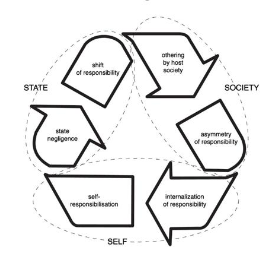
To summarise and systematise the findings of our analysis, this section introduces a theoretical model which we refer to as the ‘self-perpetuating mechanism of (self)responsibilisation of young migrants for integration’ (see Figure 1). The model captures a self-reinforcing mechanism, rooted in inefficient integration policy, societal attitudes and individual experiences, through which the responsibility for integration is shifted – from state institutions and host society to the migrants themselves.
The first component of this mechanism is state negligence – the withdrawal of the state from an active role in integration. This attitude is not new: for years, when Poland was not a popular destination country, it was driven by the belief that migrants constitute merely a temporary labour force and therefore do not require long-term integration. Contemporarily, taking into account how migration trends have changed, this attitude should also be transformed. Unfortunately, political elites, guided by electoral considerations, tend to avoid actions that could be perceived as ‘too pro-immigration’ in the face of prevailing public attitudes. As a result, the state fails to develop comprehensive integration policies, effectively leaving migrants to navigate the process on their own and shifting the responsibility for integration onto their shoulders. Migrants are thus forced to deal by themselves, relying on their own resources and immediate surroundings but without institutional support from the state. Without a comprehensive integration policy framework – one that requires proper funding and institutional support – local governments and NGOs assisting migrants tend to merely mitigate the symptoms of the situation rather than address its root causes, which remains insufficient given the scale of the problem. At this point, the first paradox related to integration becomes evident: the state, while failing to provide structural conditions conducive to integration, simultaneously imposes expectations of swift and effective adaptation on migrants. This reveals a profound discrepancy between the structural barriers – such as institutional opacity, bureaucratic chaos and symbolic exclusion – and the integration demands placed upon migrants. As a result, the responsibility for integration is shifted onto the individual, while the system remains ineffective or even hostile. Paradoxically, the less the state does, the more it demands – not of itself but of migrants.
The state’s lack of engagement is reflected in the way in which migrants are socially perceived as an external group – expected to adjust or even assimilate yet not recognised as an integral part of society. In the social sphere, the anti-migrant discourse strengthens stereotypes and discriminatory practices, while the dominant reaction from the majority of society is one of indifference or distance – often stemming from a lack of meaningful contact with migrants or their visibility solely in the context of labour and services. Expectations placed on young migrants are markedly one-sided: they are expected to integrate, learn the language and culture and refrain from causing any ‘problems’, despite the fact that integration is not supported as a reciprocal process. This reveals the second paradox, rooted in a profound asymmetry of expectations and involvement: the receiving society shows little openness or willingness to participate in the integration process, while simultaneously expecting migrants to integrate on their own. As a result, integration becomes a one-directional process – demanded of those who possess the fewest tools to achieve it – while the majority population remains passive or even resistant to any form of change. This form of othering constitutes the second element of the (self)responsibilisation mechanism – the asymmetry of responsibility between migrants and the host society.
The third component of our model illustrates how young migrants – operating in conditions of systemic neglect and othering – internalise dominant narratives under the influence of neoliberal discourses and the broader process of transition to adulthood, often marked by separation from family and increasing individualisation. In this context, they adopt the belief that it is the individual – not institutions or society – who is responsible for integration. As a result, they assume full responsibility for their own well-being ‘from A to Z’. This does not mean that they lack agency – on the contrary, it is precisely their agency that enables them to persevere, overcome certain barriers, continue making efforts and pursue personal development and a sense of stability and security in the host country. However, this often comes at the cost of their physical and mental health. Nor does this mean that they refrain from criticising the system – but such criticism typically emerges only after their most basic integration needs have been met. The third paradox lies precisely in the fact that public criticism of state negligence and social othering in the field of integration is the most commonly voiced by those migrants who already felt integrated (cf. ‘integration paradox’ – Schaeffer and Kas 2023). These are individuals with relatively high levels of capital – particularly cultural capital that is specific to the host country – as well as a more stable residence status and a secured social position. It is their knowledge, competence and higher expectations of the state and host society that allow them to more clearly perceive structural inconsistencies and symbolic boundaries that continue to block full recognition and belonging, even when all formal requirements have been met. Their criticism exposes that even a high degree of adaptation does not protect against systemic exclusion.
Figure 1. Self-perpetuating mechanism of the (self)responsibilisation of young migrants for integration
Source: Authors’ elaboration.
Paradoxically, the resourcefulness of young migrants in navigating integration reinforces the perception – both within institutions and society – that no support is needed. If they are managing on their own, the assumption follows that the system is functioning effectively. In this way, the mechanism closes in on itself and begins anew, giving rise to a self-perpetuating circle. The state remains inactive, guided by public opinion and the perception of migrants as temporary newcomers; witnessing their apparent self-sufficiency, it becomes further convinced that comprehensive, supportive integration policies are unnecessary. Society, in turn, influenced by political narratives and relying on stereotypes, shows little engagement – failing to feel responsible for or to recognise migrants as equal members of the community – while simultaneously expecting them to undertake all the efforts required for integration. Young migrants engage in integration efforts as they attempt to establish their lives in the new country, largely because they have limited alternatives. This, in turn, strengthens both institutional and societal withdrawal, reproducing the entire mechanism. The result is a multidimensional and self-reinforcing model that creates a persistent imbalance: integration becomes a one-sided process, carried out by young migrants under structural constraints and conditions of social exclusion – rather than a shared social and institutional responsibility.
Discussion and conclusion
Entering adulthood involves navigating complex roles and expectations. For young migrants, this transition is further complicated by the uncertainties of adapting to a socio-political context in a new country of residence (Oliveira et al. 2024). Their integration (Ager and Strang 2008; Biaback Anong et al. 2023; Erdal 2013; Regalia et al. 2022) is therefore highly dependent on institutional and social support. Yet, particularly in contexts like Poland, such support is often lacking, leaving migrants to navigate the process on their own.
While researchers have examined how neoliberal states shift responsibility for integration onto migrants (Kehoe et al. 2019; Uehling 2015), in this article we go further by exploring how young migrants experience this responsibilisation as well as internalise this burden – a process we term ‘self-responsibilisation’. Our main contribution to the existing literature lies in elucidating how responsibilisation and self-responsibilisation for integration among young migrants are manifest, as well as the underlying causes and consequences of these processes. First, responsibilisation refers to the shift of responsibility onto migrants, where state withdrawal, inefficient infrastructure and exclusionary attitudes of the host society make integration an individual task. This reflects broader neoliberal trends of transferring responsibility for social outcomes onto individuals (Liebenberg et al. 2015; Pyysiäinen et al. 2017). Second, self-responsibilisation involves the internalisation of these expectations. Migrants come to see integration as a personal obligation, shaped by neoliberal discourses of extreme individualism, self-reliance and the pursuit of self-made success (Juhila and Raitakari 2016; Sofritti et al. 2020). Thirdly, we argue that responsibilisation and self-responsibilisation are intertwined and mutually reinforcing processes. As shown in the self-perpetuating mechanism of (self)responsibilisation, the external imposition of responsibility by the state and society strengthens migrants’ internalised belief that integration is their own task. The outlined paradoxes help to explain how and why the entire mechanism functions and reproduces itself. This dynamic diverts attention away from structural shortcomings and normalises the expectation that migrants themselves should overcome integration barriers. Consequently, young migrants face a dual burden: navigating external obstacles while managing internalised pressure to adapt independently. While some may achieve empowerment through resource mobilisation, many in vulnerable positions face frustration, withdrawal or internalised failure that has an effect on their well-being. Even seemingly integrated migrants remain exposed to exclusion and systemic precarity.
Although grounded in the Polish context, the proposed model of (self)responsibilisation may also be relevant in other countries influenced by neoliberal and populist narratives, which are increasingly gaining traction across many Western societies. In such contexts, integration is increasingly framed as an individual task across all migrant groups. This presents an urgent challenge for policymakers, researchers, activists and migrants themselves: how to reimagine integration as a shared societal responsibility – without undermining migrants’ agency. Addressing this challenge requires further research.
Acknowledgements
We would like to express our gratitude to the members of the Department of Social Anthropology, Ethnic and Migration Studies, Faculty of Sociology, University of Warsaw, for their valuable feedback on an earlier draft of this article. We are also grateful to Jakob Muraschkowski for his careful editing and proofreading of the manuscript.
Funding
The paper is a result of the project ‘EMpowerment through Liquid Integration of Migrant Youth in Vulnerable Conditions’ (MIMY). MIMY has received funding from the European Union’s Horizon 2020 research and innovation funding programme under Grant Agreement No. 870700. The project was carried out at SWPS University.
Conflict of interest statement
No conflict of interest was reported by the authors.
AI use disclosure
The authors used AI-assisted tools for the translation of selected fragments of the manuscript. All intellectual content, analysis, and responsibility remain with the authors.
ORCID IDs
Ivanna Kyliushyk  https://orcid.org/0000-0001-5347-649X
Dominika Winogrodzka  https://orcid.org/0000-0003-3905-6047
Agnieszka Trąbka  https://orcid.org/0000-0003-4813-4916
Dominika Blachnicka-Ciacek  https://orcid.org/0000-0002-8457-388X
Marta Jadwiga Pietrusińska  https://orcid.org/0000-0002-1248-6816
Notes
- The Polish Migration Consortium (Polish: Konsorcjum Migracyjne) is a cooperation platform of nine social organisations working on behalf of migrants and refugees. The Consortium coordinates the activities of its member organisations so as to make better use of available resources and share them effectively. Its work includes counselling and support (legal, psychological, social, vocational) for migrants, integration and information activities for Polish citizens and migrants, Polish-language courses and the monitoring of the social and political situation of migration. Link: https://konsorcjum.org.pl/en/about-us/.
- The ultimate goal of the MIMY project was to derive evidence-based policy recommendations, after examining the effectiveness of integration policies and investigating the integration processes of young non-EU migrants who find themselves in vulnerable situations. In the project we used a broad concept of vulnerability ‘including dimensions like negative life events, adverse childhood experiences, illness, injuries and disabilities, as well as social, cultural and economic exclusion’ (Trąbka, Pietrusińska and Winogrodzka 2023: 20). In the research we gave space to the young migrants to define themselves in which aspects related to integration they felt vulnerable (e.g. health, the labour market, education, political participation etc.).
- Each quote was signed, providing information about the part of the study it comes from (P1–P3); the nickname of the research participant, their age and country of origin (regarding young migrants), gender (F – female, M – male) or the sector represented (in the case of stakeholders).
References
Ager A., Strang A. (2008). Understanding Integration: A Conceptual Framework. Journal of Refugee Studies 21(2): 166–191.
Arendas Z., Trąbka A., Messing V., Pietrusińska M.J., Winogrodzka D. (2023). Agency of Migrant Youth in Hostile Sociopolitical Environments: Case Studies from Central Eastern Europe. Social Sciences 12(4): 210.
Atalay D., Korkut U., Nicolson M., Scholten P., Laidlaw M. (2023). Beyond Integration: A Re-Evaluation of Migrant and Host Society Relations. Central and Eastern European Migration Review 12(1): 7–12.
Barnett N. (2003). Local Government, New Labour and ‘Active Welfare’: A Case of ‘Self Responsibilisation’? Public Policy and Administration 18(3): 25–38.
Bauman Z. (2005). Liquid Life. Cambridge: Polity Press.
Biaback Anong D., Skrobanek J., Wagner L., Nienaber B. (2023). Consonant and Dissonant Experiences – Young Migrants’ Understandings of Integration: A Cross-Country Comparison between Germany, Luxembourg and Norway. Social Sciences 12(2): 78.
Binkley S. (2014). Happiness as Enterprise: An Essay on Neoliberal Life. Albany: State University of New York Press.
Blachnicka-Ciacek D., Trąbka A., Budginaite-Mackine I., Parutis V., Pustulka P. (2021). Do I Deserve to Belong? Migrants’ Perspectives on the Debate of Deservingness and Belonging. Journal of Ethnic and Migration Studies 47(17): 3805–3821.
Blachnicka-Ciacek D., Winogrodzka D., Trąbka A. (2025). Enhancing Benefits for Peer Researchers: Towards a Flexible and Needs-Based Approach to Participatory Research. International Journal of Social Research Methodology 28(5): 511–524.
Bröckling U. (2015). The Entrepreneurial Self. Fabricating a New Type of Subject. Thousand Oaks, CA: Sage.
Castles S. (2013). The Forces Driving Global Migration. Journal of Intercultural Studies 34(2): 122–140.
Cope B., Keryk M., Kyliushyk I. (2021). The Impact of Covid-19 on Ukrainian Women Migrants in Poland. https://pl.boell.org/sites/default/files/2021-03/NV_Boll_Raport_Covid_A4... (accessed 23 March 2026).
Dodevska I. (2024). The Production of ‘Evidence’ for Migrant Integration Policy in the European Union. Migration Studies 12(4): mnae032.
Erdal M.B. (2013). Migrant Transnationalism and Multi-Layered Integration: Norwegian–Pakistani Migrants’ Own Reflections. Journal of Ethnic and Migration Studies 39(6): 983–999.
Favell A. (2003). Integration Nations: The Nation-State and Research on Immigrants in Western Europe, in: G. Brochmann (ed.) Multicultural Challenge, pp. 13–42. Bingley: Emerald Group Publishing.
Favell A. (2022). The Integration Nation: Immigration and Colonial Power in Liberal Democracies. Cambridge: Polity Press.
Górny A., Kindler M. (2023). Polska jako nowy kraj imigracji, in: M. Lesińska, M. Okólski (eds) 30 Wykładów o Migracjach, pp. 293–308. Warsaw: Wydawnictwo Uniwersytetu Warszawskiego.
Grabowska I., Hansen C., Jastrzebowska A., Lind J., Manafi I., Nienaber B., Powell R., Shahrokh T. (2025). Young Migrants, ‘Integration’ and the Local: Critical Reflections from European Stakeholders. Comparative Migration Studies 13(43): 1–23.
Grzymala-Kazlowska A., Phillimore J. (2017). Introduction: Rethinking Integration. New Perspectives on Adaptation and Settlement in the Era of Super-Diversity. Journal of Ethnic and Migration Studies 44(2): 179–196.
Happ D. (2021). Ethical Challenges Arising from the Vulnerability of Refugees and Asylum Seekers within the Research Process, in: S. Henn, J. Miggelbrink, K. Hörschelmann (eds) Research Ethics in Human Geography, pp. 78–91. London: Routledge.
Ikonen H.M, Nikunen M. (2019). Young Adults and the Tuning of the Entrepreneurial Mindset in Neoliberal Capitalism. Journal of Youth Studies 22(6): 824–838.
Innes A.J. (2013). International Migration as Criminal Behaviour: Shifting Responsibility to the Migrant in Mexico–US Border Crossings. Global Society 27(2): 237–260.
IOM (2017). Integration and Social Cohesion: Key Elements for Reaping the Benefits of Migration. https://www.iom.int/sites/g/files/tmzbdl2616/files/2018-07/IOM-Thematic-... (accessed 22 November 2025).
Janicki W., Świętek A. (2025). To Accept or Not to Accept? Discrepancies Between Declared and Actual Actions of the Polish Government Towards Immigrants. Migration Studies 13(2): 1–22.
Jaskulowski K., Pawlak M. (2019). Migration and Lived Experiences of Racism: The Case of High-Skilled Migrants in Wrocław, Poland. International Migration Review 54(2): 447–470.
Joppke C. (2024). Neoliberal Nationalism and Immigration Policy. Journal of Ethnic and Migration Studies 50(7): 1657–1676.
Juhila K., Raitakari S. (2016). Responsibilisation in Governmentality Literature, in: J. Kirsi, S. Raitakari, C. Hall (eds) Responsibilisation at the Margins of Welfare Services, pp. 11–34. London: Routledge.
Karaś U., Traczyk A. (2025). Między niepokojem a życzliwością. Polki i Polacy wobec migracji. Raport z badań. Warsaw: More in Common. https://a.storyblok.com/f/283339/x/5021f469f4/miedzy-niepokojem-a-zyczli... (accessed 26 July 2025).
Kehoe K., Alisic E., Heilinger J.C. (eds) (2019). Responsibility for Refugee and Migrant Integration. Berlin, Boston: de Gruyter.
Kelly P. (2006). The Entrepreneurial Self and ‘Youth at-Risk’: Exploring the Horizons of Identity in the Twenty-First Century. Journal of Youth Studies 9(1): 17–32.
Kindler M., Wójcikowska-Baniak K. (2018). Sieci społeczne i integracja migrantów z Ukrainy. Raport z badań jakościowych. Warsaw: Centre of Migration Research, University of Warsaw. https://www.migracje.uw.edu.pl/wp-content/uploads/2018/05/WP107165-1.pdf (accessed 26 July 2025).
Klarenbeek L. (2021). Reconceptualising ‘Integration as a Two-Way Process’. Migration Studies 9(3): 902–921.
Klarenbeek L. (2024). Relational Integration: From Integrating Migrants to Integrating Social Relations. Journal of Ethnic and Migration Studies 50(1): 233–256.
Klaus W. (2025). Migrationspolitik in Polen – Wo Sind Wir Und Wohin Gehen Wir? Polen-Analysen 352. https://laender-analysen.de/polen-analysen/352/PolenAnalysen352.pdf (accessed 16 November 2025).
Konsorcjum Migracyjne (2024). 10 punktów krytyki Rządowej Strategii Migracyjnej. https://konsorcjum.org.pl/10-punktow-krytyki-rzadowej-strategii-migracyj... (accessed 16 November 2025).
Liebenberg L., Ungar M., Ikeda J. (2015). Neo-Liberalism and Responsibilisation in the Discourse of Social Service Workers. The British Journal of Social Work 45(3): 1006–1021.
Łodziński S., Szonert M. (2023). Polityka Migracyjna ‘Bez Polityki’. Antynomie Tworzenia Polityki Migracyjnej w Polsce w Okresie 2016–2022. Studia Migracyjne – Przegląd Polonijny 49(3): 123–146.
Migdał A.M., Sułkowski Ł., Zając A. (2020). Macro Perspective of Integrating Migrants in Poland, in: S. Przytuła, Ł. Sułkowski (eds) Integration of Migrants into the Labour Market in Europe. Advanced Series in Management, pp. 47–64. Leeds: Emerald Publishing Limited.
Migration Strategy (2024). Odzyskać kontrolę. Zapewnić bezpieczeństwo. Kompleksowa i odpowiedzialna Strategia Migracyjna Polski na lata 2025–2030. Rada Ministrów, Polska. https://www.gov.pl/web/premier/odzyskac-kontrole-zapewnic-bezpieczenstwo... (accessed 16 November 2025).
Miller P., Rose N. (2008). Governing the Present: Administering Economic, Social and Personal Life. Cambridge: Polity Press.
Mind the Gap (2024). How Gen Z is Disrupting the Workplace in 2024. https://www.jabra.com/-/media/Images/Campaigns/GLOBAL/2024---Gen-Z/PDf/J... (accessed 30 May 2024).
NIK (2019). Przygotowanie administracji publicznej do obsługi cudzoziemców. Lata 2014 (od maja) –2018. https://www.nik.gov.pl/plik/id,20964,vp,23596.pdf (accessed 30 May 2024).
Nowell L.S., Norris J.M., White D.E., Moules N.J. (2017). Thematic Analysis. Striving to Meet the Trustworthiness Criteria. International Journal of Qualitative Methods 16(1): 1–13.
O’Malley P. (2009). Responsibilisation, in: A. Wakefield, J. Fleming (eds) The SAGE Dictionary of Policing, pp. 276–278. London: Sage.
Okólski M. (2021). The Migration Transition in Poland. Central and Eastern European Migration Review 10(2): 151–169.
Oliveira J., Nienaber B., Bissinger J., Gilodi A., Richard C., Albert I. (2024). Double Transition of Young Migrants in Luxembourg: Vulnerable, Resilient and Empowering Integration Trajectories in the Period of Youth. Frontiers in Sociology 9: 1–22.
Pettrachin A., Caponio T., Borgna C. (2024). Who Is Responsible for Migrant Integration? Contextual Political Drivers of Governance Actors’ Responsibility Frames in Small and Medium European Localities. Local Government Studies, 16 September, doi: 10.1080/03003930.2024.2401916.
Podgórska K., Grzymała-Kazłowska A., Łukasiewicz K., Pachocka M. (2024). Integracja, in: M. Lesińska, A. Górny, K. Podgórska, B. Solga, A. Trąbka. (eds) Polityka migracyjna Polski w opiniach aktorów instytucjonalnych. Raport z badania zrealizowanego przez Komitet Badań nad Migracjami PAN na zlecenie MSWiA, pp. 85–101. Warsaw: Komitet Badań nad Migracjami PAN.
Pyysiäinen P., Halpin D., Guilfoyle A. (2017). Neoliberal Governance and ‘Responsibilization’ of Agents: Reassessing the Mechanisms of Responsibility Shift in Neoliberal Discursive Environments. Distinktion: Journal of Social Theory 18(2): 215–235.
Ratzmann N., Sahraoui N. (2021). Conceptualising the Role of Deservingness in Migrants’ Access to Social Services. Social Policy and Society 20(3): 440–451.
Regalia C., Giuliani C., Carones G., Matuella M. (2022). Local Reports and Final Report on Vulnerability and Resilience of Groups of Young Migrants in Condition of Vulnerability. Deliverable No. 4.2. MIMY Confidential Report.
Schaeffer M., Kas J. (2023). The Integration Paradox: A Review and Meta-Analysis of the Complex Relationship Between Integration and Reports of Discrimination. International Migration Review 58(3): 1384–1409.
Skrobanek J., Jobst S. (2022). Researching ‘Liquid Integration’: Breaking New Ground for Processual and Contingent Methodology. Conflict and Communication Online 21(2): 1–11.
Sofritti F., Benozzo A., Carey N., Pizzorno M.C. (2020). Working Precarious Careers Trajectories: Tracing Neoliberal Discourses in Younger Workers’ Narratives. Journal of Youth Studies 23(8): 1054–1070.
Sultana R.G. (2024). Four ‘Dirty Words’ in Career Guidance: From Common Sense to Good Sense. International Journal for Educational and Vocational Guidance 24(1): 1–19.
Suvarierol S. (2015). Creating Citizen-Workers through Civic Integration. Journal of Social Policy 44(4): 707–727.
Thérová L. (2023). Anti-Immigration Attitudes in Contemporary Polish Society: A Story of Double Standards? Nationalities Papers 51(2): 387–402.
Trąbka A., Pietrusińska M.J., Winogrodzka, D. (2023). Responsibilisation of Young Migrants for Integration. Navigating Between Vulnerability and Resilience. MIMY Synthesis Report. https://mimy-project.eu/outcomes/public-deliverables/MIMY_870700_D8-1_Sy... (accessed 13 May 2023).
Uehling G. (2015). The Responsibilization of Refugees in the United States: On the Political Uses of Psychology. Anthropological Quarterly 88(4): 997–1028.
Waniek K. (2023). Kilka uwag o dobrym życiu w biograficznym doświadczeniu i jego nadmiernej terapeutyzacji. Studia Socjologiczne 1(248): 31–58.
Winogrodzka D. (2025). ‘Stability is a Foggy Concept’: Work Stability from the Perspective of Young People with Mobility Experiences. Journal of Youth Studies 28(2): 353–373.
Winogrodzka D., Trąbka A., Pietrusińska M.J. (2024). ‘It’s About Mindset’. How Do Young Migrants in Poland Build Their Resilience? Journal of Ethnic and Migration Studies 50(12): 2858–2878.
Copyright information
© The Author(s)
Open Access
This article is distributed under the terms of the Creative Commons Attribution 4.0 International License (http://creativecommons.org/licenses/by/4.0/), which permits unrestricted use, distribution, and reproduction in any medium, provided you give appropriate credit to the original author(s) and the source, provide a link to the Creative Commons license, and indicate if changes were made.
